

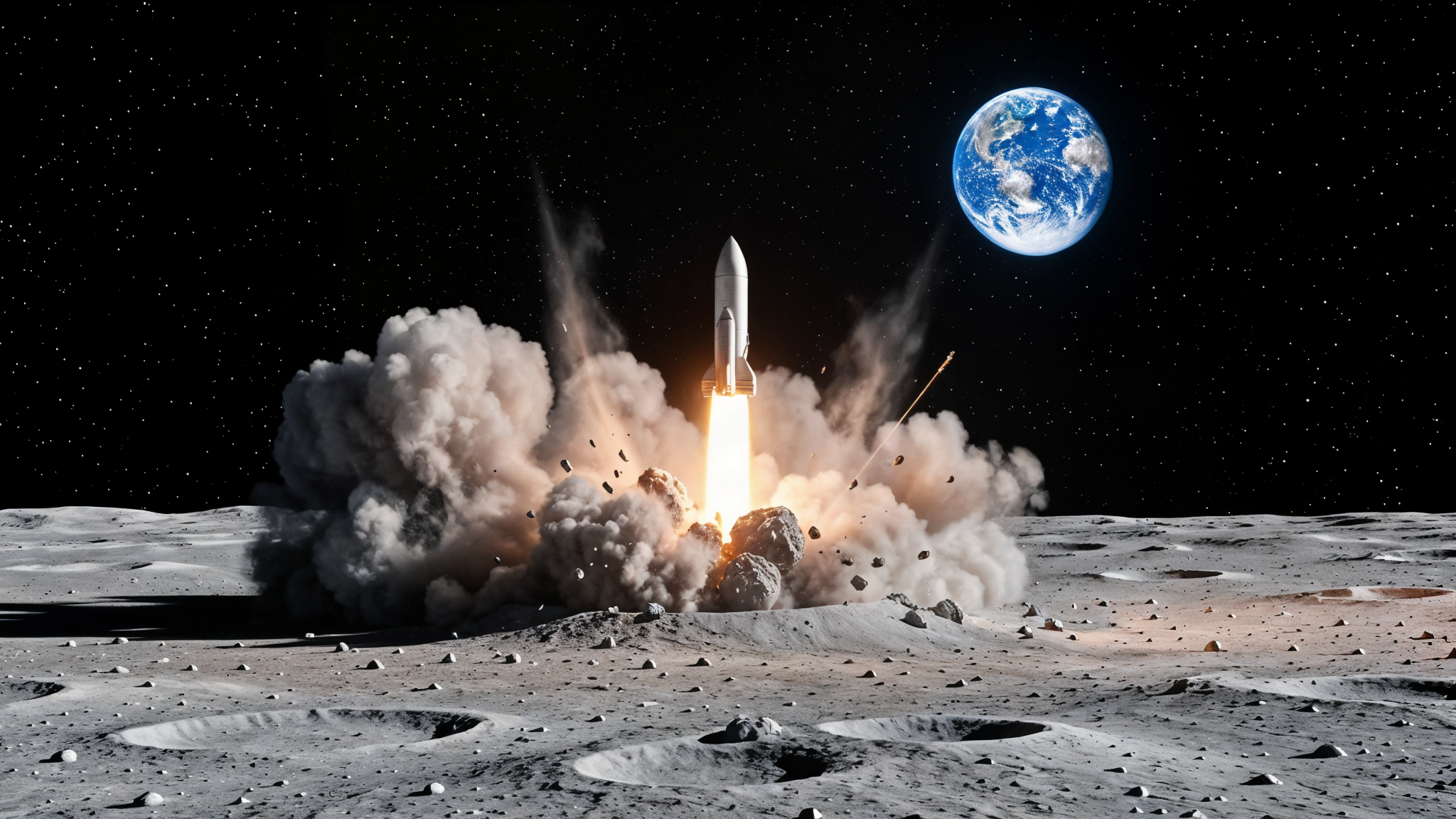
A SpaceX rocket crashed into the Moon: the impact created a 20-metre crater
In the early hours of 5 August 2026, a piece of a rocket from the company SpaceX collided with the Moon. The impact was so strong that it left a new hole in the satellite about 20 metres wide. It was not a surprise, movie-style accident: scientists had been warning for months that it was going to happen. And, although it sounds worrying, it posed no danger to Earth.
What exactly crashed?
To make it easy to understand: a rocket is not a single object. It is like a train, made up of several carriages that separate during the journey. The first part is the one that pushes at launch and, normally, returns to Earth. The second part, the one left at the top, keeps pushing until it puts what it carries into orbit.
That top part was the one that ended up on the Moon. It had taken off in January 2025 carrying two lunar landing modules towards our satellite. When it finished its job, it was left spinning in space, abandoned. For more than a year, the gravitational pull of Earth, the Moon and the Sun gradually pushed it until its path became inevitable: it ended up crashing into the Moon.
At full speed and without brakes
The piece weighed around 4 tonnes, more or less like a big car. And it was not coming slowly: it hit at about 8,700 kilometres per hour. That is more than seven times the speed of sound.
Here there is an important detail: the Moon has no air. On Earth, when an object falls that fast, the air slows it down and it often breaks apart from the heat before hitting the ground (that is why we almost never see space debris falling into our homes). On the Moon there is no such protection. The rocket touched the surface directly, with all its force. The result was a crater about 20 metres wide and a cloud of dust and rocks that shot out.
How do we know it happened if nobody saw it?
Nobody recorded the exact moment of the impact. It was too fast and it could not be seen from Earth. But the scientists confirmed the impact another way. A large telescope in Chile detected, a few minutes after the crash, a cloud of gas with traces of sodium and lithium. The sodium comes from the Moon’s soil; the lithium, very likely, from the rocket itself. That is, they found the traces that the rocket had indeed touched the lunar ground.
In addition, the South Korean space probe Danuri, which is orbiting the Moon, managed to take photographs of the area just before and just after the impact. The images show how the terrain changed. Now, the space agencies will compare those photos with those of other satellites to study the new crater in detail.
Why is this good for science?
Although it looks like an accident, the scientists are delighted. It sounds strange, but there is a trick to it. When a meteorite falls on the Moon, they hit at kilometre-per-second speeds and nobody really knows what the object was like. In contrast, here we know perfectly well the speed, the weight and the trajectory of what impacted. It is as if you had done the experiment with all the answers known in advance.
That helps them better understand how craters form, how lunar dust behaves and how to prepare for future missions with astronauts. Because in the coming years humans are expected to set foot on the Moon again, and it is worth knowing exactly what happens when something crashes there.
A warning: space junk around the Moon
Here is the part that should really make us think. A few years ago there was almost nothing orbiting the Moon. Now there are old rockets, probes and abandoned debris. And they fall without control. The Moon has no air to burn up the debris, so any piece that enters its zone ends up crashing.
The experts warn that, before building houses or bases on the Moon, we must learn to control and clean up all that debris. Otherwise, a neglected object could fall near a future installation with people inside.
For now, the impact of the SpaceX rocket did not harm anyone. And, in passing, it left the scientists a valuable gift to better understand our satellite. But it also reminds us that, as human beings look back at the Moon, they have to do so sensibly.