

A SpaceX rocket crashes into the Moon and science celebrates the accident
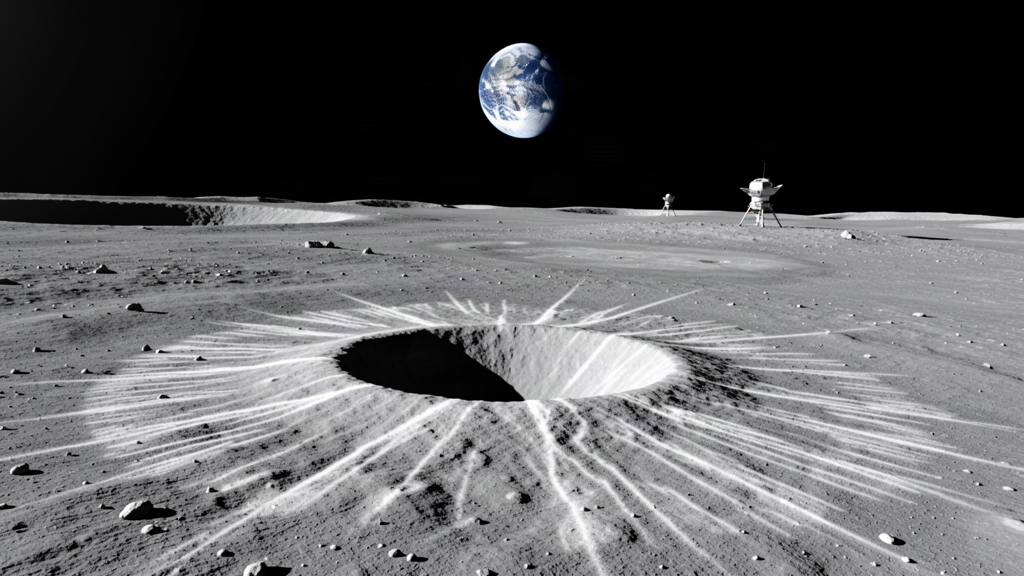
On Wednesday, August 5, early in the morning, a piece of rocket the size of a five-story building crashed into the Moon at 8,700 kilometers per hour. It was neither a failure nor a surprise: astronomers had been tracking its path for months and knew it would end up there. Far from being bad news, the impact has given scientists a golden opportunity to study how craters form and what lies beneath the lunar surface.
What happened exactly?
The rocket was the upper stage of a SpaceX Falcon 9 that lifted off from Florida on January 15, 2025. Its mission was to push two commercial lunar landing modules toward the Moon. It succeeded. The first stage of the rocket —the one that provides the launch thrust— returned to Earth as it is designed to do. But the upper stage, now empty of fuel and weighing some 4,000 kilograms, was left drifting in an elongated orbit that carried it from Earth to the Moon and back.
For 18 months, the gravity of the Earth, the Moon and the Sun, together with the push of sunlight, gradually modified its trajectory. Astronomers calculated that those small nudges would eventually bring it to crash into the far side of the Moon, near the Einstein crater. And so it happened, around 01:35 Eastern US time.
An experiment no laboratory can replicate
The valuable thing about the impact is that scientists knew exactly what was going to hit, at what speed and at what point. That turns an accident into a controlled experiment, something very rare in planetary science. It is as if, instead of throwing a stone into a puddle and guessing what happens, you knew the weight of the stone, the force of the throw and the exact place where it will land, and you could measure every wave and every splash.
Telescopes from the European Southern Observatory in Chile detected a cloud of sodium and lithium gas that lasted between 5 and 10 minutes. The sodium came from the lunar soil; the lithium, probably from the rocket itself. That "plume" of gases is the most visible part of the impact and makes it possible to analyze the composition of the terrain without having to dig.
What is the use of knowing how a crater forms?
Understanding how much rock and dust is flung out after an impact helps design safer landing modules and future lunar bases. If you know how far the ejected fragments travel, you can decide where to place the modules so the "rain" of stones does not reach them. It also serves to calibrate the models that predict the risk of micrometeorites —small rocks at bullet speed— striking a base or a spacesuit.
The material that comes from deep layers, which are normally hidden, offers clues about lunar geology and how the Earth-Moon system formed 4.5 billion years ago. It is as if the rocket had made a free drilling and brought samples up to the surface.
It is not the first time, but there is more and more "junk"
Since 1959, dozens of human spacecraft have ended up on the Moon: the Soviet probe Luna 2, NASA’s Ranger spacecraft, Apollo rocket stages and, in 2009, the LCROSS mission, crashed on purpose to search for water ice. The last confirmed accidental impact was in 2022, from a stage of a 2014 Chinese mission.
The episode is a reminder that space junk has been accumulating for more than half a century. With the boom in commercial launches, experts are studying how to prevent high-energy rocket upper stages from drifting adrift in the Earth-Moon system. NASA and SpaceX are already collaborating on safer disposal routes.
A lesson for the future
The Falcon 9 impact endangers no one, but it is a visible reminder that space is neither infinite nor clean. Every launch leaves traces. Science has managed to take advantage of this accident to learn, but the long-term goal is that future rockets do not end up as unintended projectiles: that they come back, burn up in the atmosphere or head to "graveyard" orbits where they cause no trouble. The Moon, for now, keeps collecting scars —and data— from our space race.