

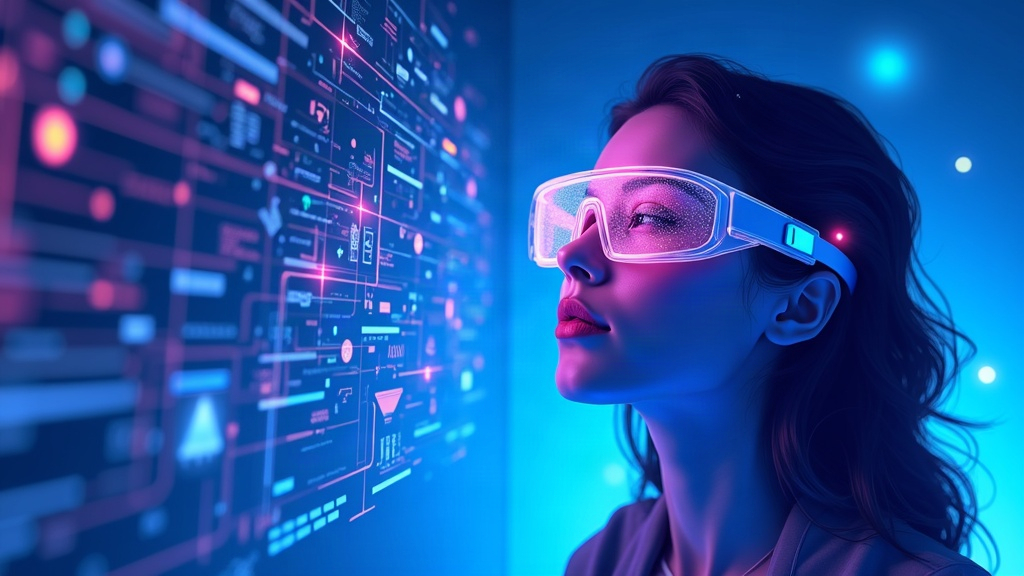
Do you remember that film where the protagonist puts on some glasses and suddenly sees information floating over the real world? Well, that scene is no longer science fiction. It is called augmented reality, and it lives with us every day, sometimes without us realizing it. Together with its sister, virtual reality, it is changing the way we learn, play, work and even shop.
Two worlds, two different technologies
First of all, it is worth clarifying two words that are frequently confused: virtual reality and augmented reality. They are not the same, even though they sound similar.
Virtual reality takes you to a completely invented world. You put on glasses that cover your view and, all of a sudden, you are inside a video game, on top of a mountain or inside a spaceship. Everything you see is digital; the real world disappears.
Augmented reality is exactly the opposite: it does not take you out of the real world, but adds things on top. You see the street you are walking along, but with a floating sign telling you where the nearest café is. The world is still there; digital layers are simply superimposed on it.
The technology that makes the trick possible
Behind these experiences there are several pieces that work together. The most important are the screens and lenses that place the images right in front of your eyes. In virtual reality headsets, each eye sees a slightly different image, and the brain joins them together to create the sense of depth, just as in real life.
But something more is needed: knowing where you are and which way you are looking. The headsets use sensors that detect every turn of your head. If you look left, the image moves left; if you duck your head, you see the floor. That balance between your movements and what you see on screen is called “tracking” and it is what makes the experience so convincing.
In mobile augmented reality, on the other hand, the phone’s camera and sensors do the work. The device recognizes the environment (a table, a wall, the floor) and places the digital objects on top, as if they really were there.
Much more than games
It is easy to think this is only about entertainment, and it is true that video games were the great drivers. But the uses go much further and already touch almost every area of our lives.
In education, a medical student can practise with a 3D heart floating in front of them, rotating it and seeing its layers without needing a real body. In furniture shops, you can place a virtual sofa in your living room with your phone camera to check whether it fits before buying it. Architects walk through buildings that do not exist yet. And mechanics receive instructions drawn on the very machine they are repairing.
It is also used in medicine to plan operations, in the army to train without risk and in tourism to “try out” a hotel before booking it. The list keeps growing.
Glasses, headsets and phones: each to their own
There are different devices for each need. Virtual reality headsets are the most immersive: they isolate you completely and are usually used for gaming, watching films or taking guided tours in 360 degrees. They are ideal when you want to “switch off” from the world.
Augmented reality glasses are lighter and let you see the real world with layers on top. They are perfect for tasks where you need your hands free, such as a technician consulting instructions while working. And we must not forget the phone: with a simple camera, anyone can enjoy augmented reality without buying anything extra. That filter that puts cat ears on you or changes your face in video calls is, no more and no less, augmented reality.
And what does the future bring us?
Experts believe that these two technologies will end up merging into what some call “mixed reality”: glasses capable of switching between the real and the digital world effortlessly, and even mixing them. Work is also being done on making them lighter, with better battery life and with screens so sharp that it becomes hard to tell the real from the virtual.
There will be challenges ahead, such as price or privacy (those glasses see what you see, and that needs to be managed carefully). But the direction is clear: we will carry more and more technology on us, and the boundary between the physical and the digital will get thinner and thinner.
In summary
Virtual reality takes us to other worlds; augmented reality enriches ours. One makes us disconnect, the other helps us connect better with what surrounds us. And although we are still at the beginning, they are already part of our daily lives. Next time you use a filter, try a game with glasses or “place” a virtual piece of furniture in your living room, you will know what magic lies behind it: pure technology, designed so that the impossible seems, simply, natural.