

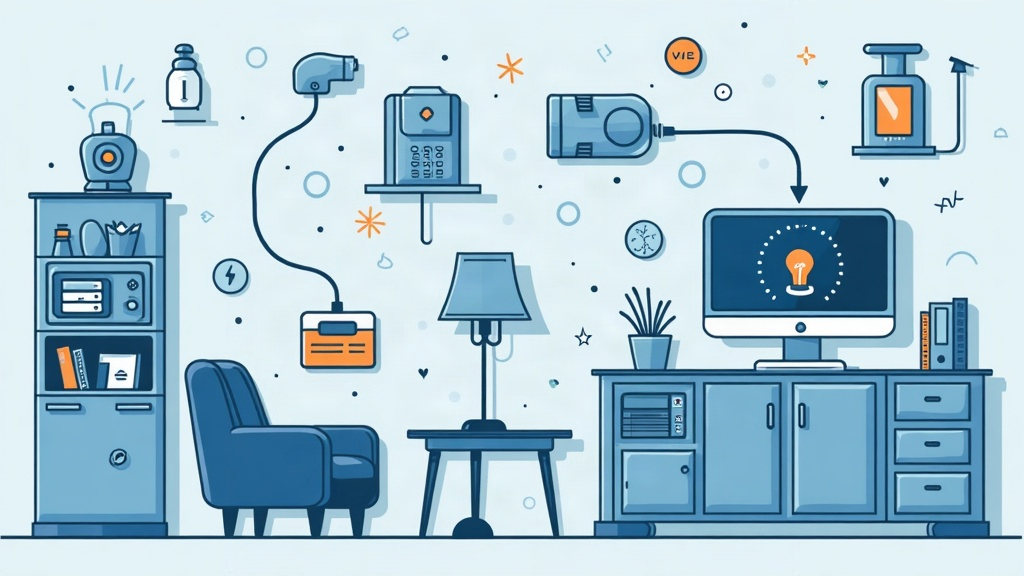
We live surrounded by objects that connect to the internet. The watch that counts your steps, the thermostat that adjusts the heating, the light bulb that turns on with your voice or the fridge that warns you when milk is missing. All of them are part of what is known as the Internet of Things, or IoT for short.
What the Internet of Things exactly is
The name sounds like science fiction, but the idea is simple: equipping everyday objects with sensors and network connectivity so they can collect data and act on their own. We are no longer talking only about computers and phones: anything can “talk” to others and to us.
Imagine that your home knows when you arrive. The blinds go up, the heating rises a few degrees and your favourite music plays, all without you touching a button. That is the goal: that technology adapts to you instead of forcing you to adapt to it.
The ingredients of a connected home
For all this to work, three pieces are needed. The first are the sensors, which capture information such as temperature, movement or light. The second is the connection, almost always through Wi-Fi or mobile data, which sends that data. And the third is the intelligence, usually in the cloud, which decides what to do with that information.
The smart speaker in your living room combines all three: it listens to your request, sends it to a remote server, interprets it and responds. All in just a few seconds and without you thinking about the complexity behind it.
Beyond the home: the city and industry
The IoT does not stay at home. Cities use it to manage street lighting, control traffic or warn that a container is full. In the countryside, sensors measure soil moisture to water only when needed. And in factories, machines warn before they break down, avoiding costly stoppages.
Even hospitals benefit: devices can constantly monitor a patient’s vital signs and alert doctors to any change, without someone having to watch a screen all day.
The other side: privacy and security
With so many connected objects, an inevitable question arises: what happens to our data? Each device collects information about us, and if it is not well protected, a stranger could access it. Security is, today, the biggest challenge of the IoT.
That is why it is worth following some basic rules: change the passwords that come from the factory, keep the software updated and ask yourself whether a device really needs to be connected. Not everything has to be on the network just because it can be.
A future that is already here
It is estimated that there are already billions of connected devices in the world, and the figure keeps growing. The Internet of Things promises to make our lives more comfortable and efficient, save energy and look after our health. But it also forces us to think about what data we share and with whom.
Technology advances fast, and understanding how it works is the first step to using it wisely. Because, in the end, in a world of objects that think, the one who decides is still the person.