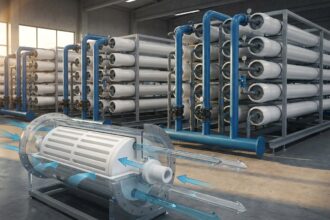

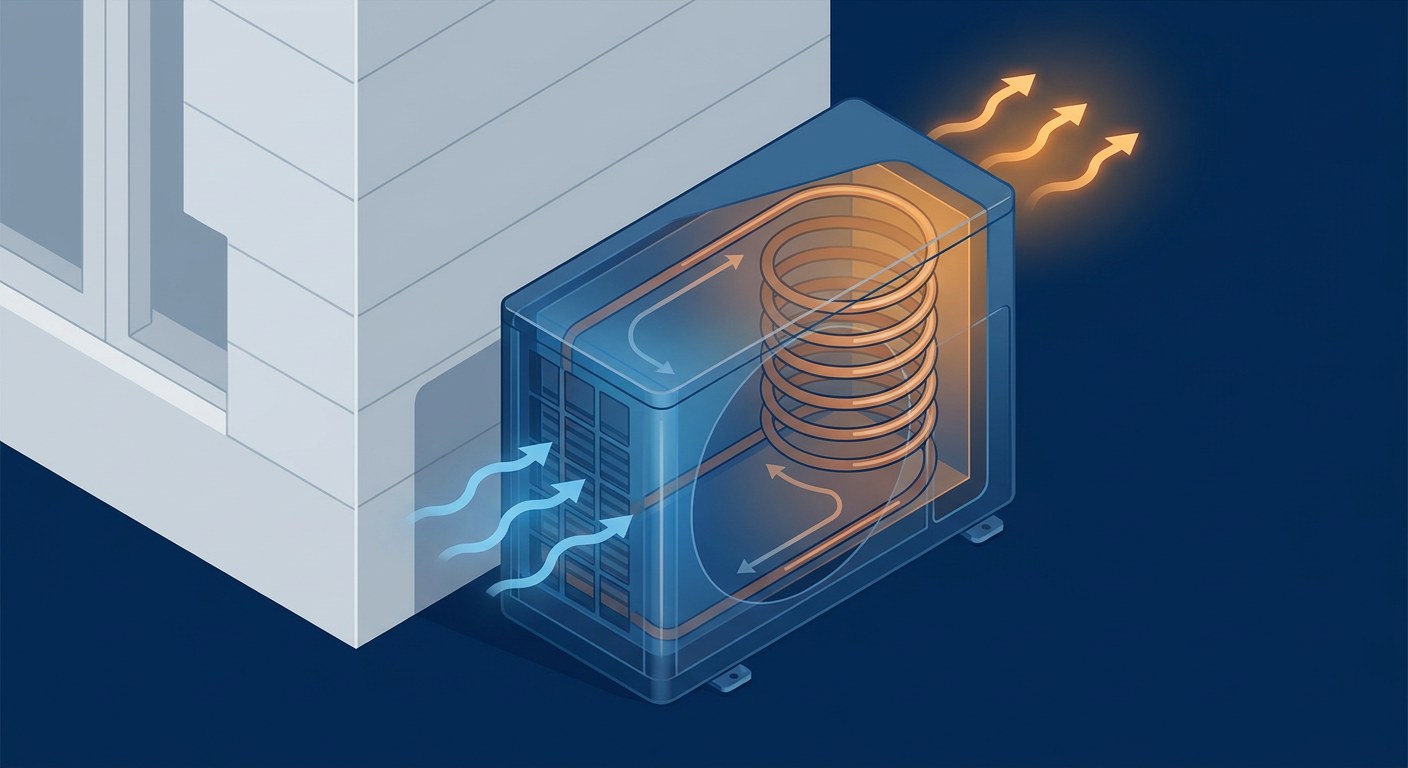
A unit the size of a suitcase draws 1 kWh of electricity and delivers between 3 and 4.5 kWh of heat inside the house. There is no accounting trick and no broken meter: there is a heat pump, and its principle is not to make heat but to move it. Even on a January day at 2 °C, the outdoor air still holds enough thermal energy to heat an entire home.
Four stages and a change of state
At the heart of the system is a closed circuit carrying a refrigerant that boils from liquid to gas and back again. The cycle has four mandatory stations:
- Evaporator. The refrigerant arrives at very low pressure and therefore at a very low temperature, below that of the outdoor air. As it passes through the outdoor coil it absorbs heat from the air and vaporises. That phase change is the key: the latent heat of vaporisation captures a large amount of energy while the gas barely warms up.
- Compressor. It compresses the gas. As pressure rises, the temperature climbs well above the indoor temperature. This is the only stage that consumes electrical work to any significant degree.
- Condenser. The hot gas gives up heat to the system water or the indoor air, cools and condenses back into a liquid.
- Expansion valve. It drops the liquid’s pressure sharply, chilling it and preparing it to return to the evaporator.
A refrigerator does exactly the same thing, with the evaporator inside the freezer and the condenser in the grille at the back. A heat pump is that fridge with the two heat exchangers swapped around: it cools the street in order to warm the living room. In summer, a four-way valve reverses the flow and the unit switches to cooling, dumping household heat outside.
Why cold air heats: the absolute scale
The confusion comes from measuring heat in degrees Celsius. Thermodynamics measures it in kelvin, and 2 °C is 275 K: the outdoor air still holds an enormous amount of internal energy. What matters is not how much heat is available but the temperature difference between source and sink. A heat pump does not need a hot source, only a source hotter than the vaporised refrigerant.
The theoretical limit is set by the Carnot efficiency: COP = Thot / (Thot − Tcold), in absolute temperatures. With a source at 275 K and a flow temperature of 308 K (35 °C), the maximum would be 9.3. In practice, compressor and heat-exchanger irreversibilities leave a seasonal COP of 3 to 4.5 in modern equipment. That is still three or four times better than an electric resistance, which by definition turns 1 kWh into 1 kWh of heat.
The compressor rules: modulation and real consumption
Because COP depends on the temperature difference, the design goal is to work at the lowest possible flow temperature. That is where scroll or rotary compressors with inverters come in, spinning between 20 % and 120 % of nominal speed instead of switching on and off. By modulating, the unit matches output to the house’s demand, avoids short cycling and keeps the evaporator at its efficient operating point.
The energy label does not use instantaneous COP but SCOP, calculated under standard EN 14825 with a temperature curve for a specific region in heating mode. An SCOP of 4.5 (class A+++) means 4.5 kWh of heat per kWh of electricity across the year, including start-ups, defrosts and shutdowns.
The problem with real cold
When the outdoor temperature drops below −10 °C, the thermal gap widens, COP falls and capacity shrinks, because the refrigerant has less heat to absorb and gas density drops. Cold-climate models turn to vapour injection (EVI): gas is injected at mid-compression into a second chamber of the compressor, raising mass flow and holding output down to −25 °C.
The other headache is defrosting. With humidity and temperatures near 0 °C, the outdoor coil ices over and the cycle must be reversed to melt it, during which the unit stops heating while still drawing power. Good predictive control reduces those cycles but cannot eliminate them. In very harsh climates a bivalent point is used: below a certain temperature a backup boiler or resistance heater kicks in, and the hybrid system keeps the compressor from working outside its useful range.
What gas is inside, and why it is changing
The refrigerant is the fluid that makes the whole cycle possible, and choosing one is now a regulatory problem. R-410A, the standard for two decades, has a global warming potential (GWP) 2,088 times that of CO₂. R-32 drops to 675 and propane R-290 to 3. The European F-gas regulation (EU 2024/573) schedules the progressive phase-down of HFCs and pushes R-290 into small equipment.
Propane has a catch: it is flammable (A3 classification), which caps the charge per circuit at around 500 grams under standard IEC 60335-2-40 and requires detectors and ventilation in large installations. In exchange, its thermodynamic behaviour is excellent and it can reach 70 °C flow temperatures without losing too much efficiency.
The installation matters as much as the machine
A heat pump performs better the lower the water temperature it delivers. With underfloor heating at 35 °C, COP can sit around 4.5; with old radiators sized for 70 °C, it falls to 2.5. That is why retrofits usually include low-temperature emitters or extra radiation surface. Domestic hot water is another case: it needs 55-60 °C plus legionella shock cycles, so its COP is always worse than that of space heating.
Hydraulics matter too: poorly balanced flow, oversized pipes or a badly sized buffer tank can ruin the efficiency of an excellent unit. And so does the building envelope: a heat pump does not fix an uninsulated house, it only heats it with less electricity than a resistance. The figure that really counts is not in the brochure but on the January bill.