
A 51.2 Tbps network switch, the kind that fills any AI training hall, burns more energy moving bits from one chip to another than deciding where they should go. And the cost is not in the switching, but in the last stretch: the one between the silicon and the optical module plugged into the front panel. A few centimetres of copper trace, a connector, and a module carrying its own signal processor. The industry has spent two years dismantling that stretch, and the operation has a name: co-packaged optics (CPO).
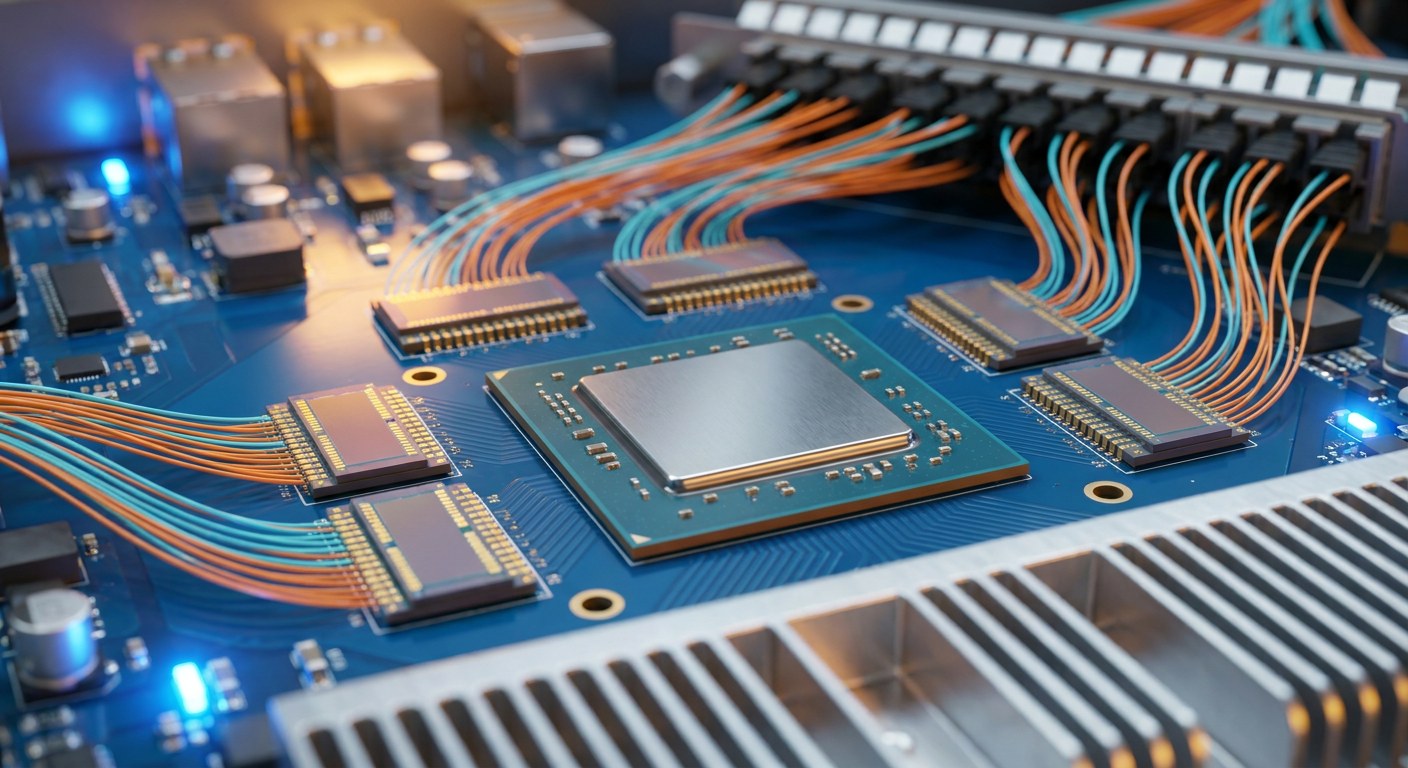
The idea is easy to state and hard to manufacture: take the electrical-to-optical conversion out of the pluggable module and move it onto the same package as the switch chip. What used to be a 10- or 20-centimetre patch cable becomes a distance of millimetres inside the package. The module DSP can then be dropped, insertion loss shrinks, and the port becomes far cheaper in watts.
The numbers that broke the model
An 800 Gbps pluggable transceiver with its own DSP draws 14 to 15 watts. With 64 such ports in a 51.2 Tbps switch, the modules take more than half of the system power and more than half of the bill of materials. In 2024 Broadcom showed Bailly, a 51.2 Tbps Ethernet switch with a Tomahawk 5 at the centre and eight 6.4 Tbps silicon optical engines around it, all on the same substrate. Its published figure is 5 watts per 800 Gbps including laser light: about 6.25 picojoules per bit, against 17.5 picojoules per bit on the pluggable path. Sixty to seventy percent less.
The physical reason is distance. Pushing 112 Gbps per lane through a 20-centimetre PCB channel and a connector costs roughly 22 dB of insertion loss; inside the package, with the optical engine millimetres from the ASIC, that figure drops to about 4 dB. No amount of good analogue design closes that gap: you equalise with a DSP, and that is where the watts go.
How it is built: light inside the package
A modern optical engine is a silicon photonics system: waveguides, resonant ring modulators (micro-rings that shift their refractive index with voltage and modulate the light) and germanium photodiodes for reception. The electronic half, which serialises and shapes the signal, is stacked on top of the photonic circuit. Broadcom uses TSMC’s SoIC stacking to bond the two; TSMC calls its platform COUPE and already produces 200 Gbps micro-ring modulators.
On the electrical side, the interface stops being a long channel and becomes a couple of dozen very short-reach lanes (in practice the CEI-112G-XSR interface OIF defines for 3.2 Tbps engines), while the optical side leaves through eight 400 Gbps ports heading to an MPO or LC fibre panel. Modulation is PAM4: four amplitude levels encoding two bits per symbol, at 112 or 224 Gbps per lane. In a real box that means 144 ports of 800 Gbps in 4U, 115.2 Tbps switched and about 4.3 kW of draw with liquid cooling, with more than three hundred fibre connections leaving a single package.
The laser stays outside, on purpose
There is one part nobody packages: the light source. The laser is the component that degrades most with temperature and fails most often, so it stays pluggable outside the chassis in modules known as ELSFP (External Laser Small Form Factor Pluggable). Each module feeds several engines and can be swapped hot without opening the switch. An NVIDIA Quantum-X, for instance, distributes its light from 18 external sources. The fibre arriving from outside already carries generated light; inside the package it is only modulated, split and detected.
What is gained
Beyond the picojoules, density. Broadcom talks about an eightfold improvement in silicon area efficiency, and OIF works with edge densities of about 140 Gbps per millimetre of package edge. Cooling is simpler too: instead of 64 fifteen-watt modules spread across the front panel, the heat to remove comes from one large package and the external light sources. Latency drops as well, because serial conversions and equalisation stages disappear.
What is paid
The price is serviceability. A pluggable transceiver is swapped by hand in seconds with nothing powered down; an optical port integrated into the package is not. If one fails, the switch keeps running at reduced capacity until the whole module is replaced, which pushes redundancy design into the network rather than the box. Add manufacturing yield — bonding fibre to the package accurately and automatically is still the most delicate step in the chain — and standards work that is still under way.
Copper does not disappear
None of this means copper is retiring. At distances of millimetres or a couple of metres, cable remains cheaper and, at short range, more efficient: every watt spent on optics is a watt not spent on switching. The rule is always the same: what decides is not speed, but the product of speed and distance. Co-packaged optics attacks exactly the stretch where that product can no longer be paid for, which is why 2026 is seen as the year it stops being a laboratory prototype and becomes a catalogue option, with generations reaching 409.6 Tbps of aggregate capacity.
In between sits a third path, linear pluggable optics (LPO): the cage and the field-replaceable module stay, but the DSP goes and equalisation moves to the switch’s SerDes. It saves 30% to 50% of the power without giving up hand servicing, at the cost of some reach and some multi-vendor tolerance. For many operators it will be the reasonable compromise while fibre glued to the chip learns how to be repaired.