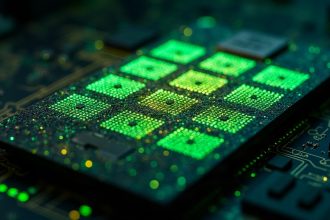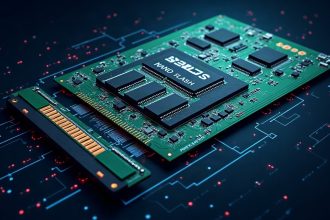


When you switch on your phone in the morning, you switch on a small miracle of modern engineering. Inside that shell there is not one computer but several, and they all live on a chip smaller than a fingernail. How is something so tiny and so complex made? The answer is one of the most fascinating industrial stories of the 21st century.
It all starts with sand
The main ingredient of a microchip is silicon, an element we find everywhere: beach sand is, for a large part, silicon oxide. To use it in electronics, it must be purified to almost perfect levels and turned into cylinders called ingots. They are then cut into ultra-thin wafers: those shiny discs you see in photos of factories.
A single wafer can hold hundreds of chips at once. What happens from there on resembles building a miniature city with light more than any other industrial technique.
Drawing circuits with light
The heart of the process is called lithography. It is like projecting a photograph onto the wafer, but at such a small scale that each “pixel” is finer than a tenth of a hair. Light passes through templates with the circuit design and engraves that pattern onto the silicon surface, layer after layer.
With a technology called extreme ultraviolet lithography, the machines that do this work are enormous and cost as much as a passenger plane. They are so precise that a vibration or a speck of dust can ruin an entire batch. That is why chip factories work in cleanrooms a hundred times cleaner than an operating theatre.
Layer by layer, atom by atom
A microchip is not built all at once: dozens of layers are stacked, each with its own pattern. Between layers, other materials are introduced that act as insulators or conductors, and tiny transistors are added — the switches that turn the current on or off to represent the ones and zeros with which the machine thinks.
A modern chip can contain billions of transistors. Millions could fit in a single grain of rice. That is the reason a modern phone has more computing power than the computers that took humans to the Moon.
The work you see and the work you do not
When all the layers are ready, the wafer is cut into individual chips. They are given a protective casing and little golden legs to connect them, and they undergo quality tests. At the end of the journey, a chip that works in your phone has gone through thousands of manufacturing steps and halfway around the world, because design, machines and assembly are usually in different countries.
That is the part we do not see: chip manufacturing is one of the most globalised and, at the same time, most concentrated industries on the planet. A handful of factories produce almost all of the world’s advanced chips, and that is why every time there is a shortage, like the one that sent the prices of cars and consoles soaring, we feel its effects across the whole economy.
How much smaller can it get?
Engineers have been fulfilling an informal rule for decades: every two years, twice as many transistors fit in the same space. But they no longer fit the way they used to. We are brushing against the physical limits where atoms start behaving strangely, and manufacturers are turning to imaginative solutions: stacking chips in three dimensions or connecting several in the same package.
In the end, every time your phone responds instantly or your console loads a huge world, behind it all there is a silicon wafer, light drawing circuits and millions of transistors working in silence. The next time you look at the screen, you may think about everything it took for that small chip to do its magic.