
For decades, nuclear fusion seemed like a promise that always arrived «in thirty years». Well: 2026 is one of those years in which that phrase is starting to sound less like a joke. Several projects have achieved energy records, dozens of private companies are investing billions, and even governments are joining in. What exactly are we talking about when we say «fusion»? Come with us to understand the energy that powers the Sun.
The same recipe as the stars
Fusion is the opposite of fission, the technology nuclear power plants use today. In fission, a large, heavy atom, such as uranium, is split, and that rupture releases energy. In fusion, two small, light atoms join to form a heavier one. Along the way, a tiny fraction of their mass is converted into energy.
It’s exactly the process that happens at the core of the Sun and the other stars, where hydrogen turns into helium at temperatures of millions of degrees. The energy that reaches your skin as light and heat in the morning was born from that process.
The challenge isn’t the idea, it’s the containment
The trick is that fusing atoms requires extreme conditions. The fuel must reach temperatures of about 150 million degrees, hotter than the very core of the Sun. At that temperature, matter turns into a plasma, a state in which electrons and nuclei separate.
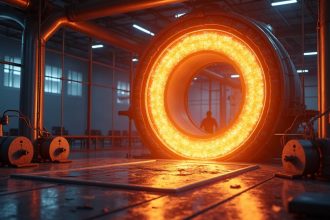
And here’s the biggest challenge: how do you enclose something at 150 million degrees without melting anything? The most common approach is to use powerful magnetic fields that levitate the plasma suspended in a vacuum, as if it were an invisible chamber. This is the idea of the ‘tokamak’, the most studied design.
Why so many people are excited
Fusion has advantages that almost look like a wish-list. Its fuel, hydrogen and its variants, is easily obtained from water and lithium, and is abundant on Earth. It produces no CO2 emissions and, above all, it doesn’t generate the very long-lived radioactive waste that fission does.
Moreover, it’s intrinsically safe: if something fails, the reaction shuts itself off, like a flame going out without oxygen. In practice, it’s impossible to trigger an uncontrolled, Chernobyl-type fusion. That’s why it’s called the energy that is «clean and safe at the same time».
The milestones that are getting people talking
In 2022, a US laboratory managed, for the first time in history, to obtain more energy than was needed to start the reaction. It was only a handful of kilojoules and lasted a fraction of a second, but the symbolism was huge: the «breakeven point» barrier was crossed.
Since then, both the big government-funded projects (such as ITER in France or its British rival) and a group of private startups have accelerated. It’s no longer a field reserved for public laboratories: there are more than thirty companies in the sector behind different designs, from giant magnets to cutting-edge lasers.
When will we see light at home?
It’s best to keep calm: fusion isn’t going to replace the electrical grid tomorrow or in five years. The most realistic experts talk about the 2030s to 2050s for the first commercial reactors capable of feeding the grid. And there are still engineering problems to polish, such as keeping the plasma stable for hours.
The real change is swift and important: what was once fundamental science is today also an industrial sector with investment, prototypes and business plans. Perhaps, at last, the phrase «in 30 years» is starting to wear thin. When you turn on the light in a couple of decades, it wouldn’t be surprising if part of that electricity came from a star made by human beings.