
For half a century, nuclear safety has depended on the power staying on. If the grid fails and the diesel generators follow, the pumps that circulate cooling water stop, the fuel heats up and the accident begins. Small modular reactors, or SMRs, invert that dependency: they are designed to remove decay heat by convection, with no pumps and no electricity, and to keep the core from running dry even if nobody intervenes.
They are not shrunken power plants. A classic 1,000-megawatt-electric (MWe) pressurised water reactor keeps its pressure vessel in one building, its steam generators in another and several primary coolant pumps pushing water at 155 bar and about 300 °C through pipes almost a metre across. An SMR such as NuScale’s US460 delivers 77 MWe per module with the opposite philosophy: put inside the vessel everything that sits outside in the big plant.
The vessel that swallows the machine room
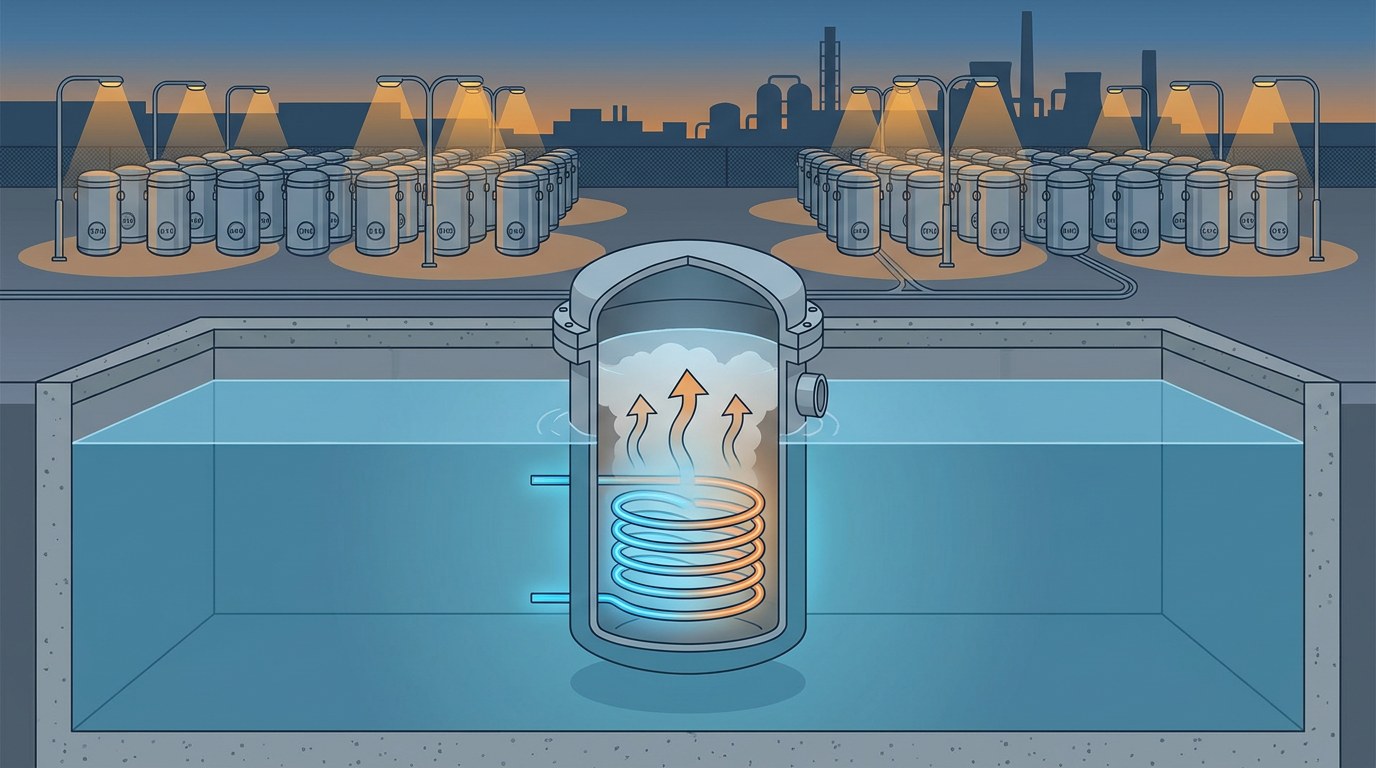
In an integral reactor, the steam generators sit inside the steel cylinder itself, next to the pressuriser that holds the pressure. There are no large primary coolant lines that could break and drain the loop: the so-called large-break loss-of-coolant accident stops being the dominant scenario, and the containment building can be far smaller. The module is also installed underground, in a steel-lined, water-filled pool.
Hot water from the core rises through an inner riser, gives up heat to the steam generators and comes back colder down the annulus between that riser and the vessel wall. That density difference, a few grams per litre, is enough to drive the required flow by natural circulation. The primary pumps disappear: in a conventional PWR they draw several megawatts and need guaranteed power. Other designs, such as GE Hitachi’s BWRX-300, apply the same idea to a boiling-water reactor of about 300 MWe, with isolation condensers that shed heat by gravity.
Shutting the reactor down does not shut the heat down
The fission chain stops in milliseconds once control rods enter the core and the water loads up with boron, a neutron absorber. But the fission products accumulated in the fuel keep decaying and producing heat: roughly 6-7 % of thermal power at the instant of shutdown, about 1 % an hour later and around 0.4 % after a day. In a 250-megawatt-thermal (MWt) module, that 1 % is 2.5 MW inside a few tonnes of uranium dioxide. Without cooling, the fuel melts.
The SMR answer is the pool: heat crosses the vessel wall by conduction, the water outside boils and the steam escapes, carrying energy away. A few hundred cubic metres of water buys days without refilling. NuScale claims its module can stay cooled indefinitely with pool water plus the loop’s own inventory, with no operator and no power for at least 72 hours. Rolls-Royce SMR, at 470 MWe, relies on equivalent passive systems with elevated tanks and valves that open by gravity.
Fuel: fewer refuelling stops, higher enrichment
Standard fuel is uranium dioxide pellets enriched to 4-5 % in uranium-235, clad in zirconium tubes, replaced every 18 or 24 months. Several SMRs stretch the cycle to three, five or more years to cut maintenance outages, and that calls for higher-enriched uranium: HALEU, with up to 20 % U-235, the line between low-enriched uranium and material considered directly usable. The HALEU supply chain is the sector’s most concrete bottleneck today, because until recently only Russia had commercial capacity.
High-temperature designs go further. X-energy’s Xe-100 uses TRISO fuel: uranium kernels wrapped in layers of carbon and silicon carbide that hold fission products up to about 1,600 °C, well above operating temperature. The reactor is cooled by helium and drives a steam turbine through an intermediate heat exchanger, at 80 MWe per unit.
The problem is no longer physics, it is the factory and the numbers
The promised economic advantage comes not from size but from repetition: welding the same vessel a hundred times in a shipyard costs less per unit than building a one-off plant on a greenfield site. That learning effect only appears with serial orders, and so far they have been scarce. NuScale’s Carbon Free Power Project, 462 MWe across six modules, was cancelled in 2023 after the estimated cost rose to about $9.3 billion. The first unit is always expensive; the tenth, in theory, is not.
Regulation also weighs. The US NRC certified NuScale’s design in 2023 and has reviewed its 77 MWe version; in Europe, Rolls-Royce SMR is moving through the UK generic design assessment while several countries study joint licensing so the same file is not repeated in every capital.
Where they actually fit
An SMR will not beat solar on cost per kilowatt-hour in a sunny country. Its niche is elsewhere: small or isolated grids, industrial process heat, district heating, desalination and data centres that need 24-hour baseload. Also replacing coal plants: the land, the connection and the staff already exist, and a module fits where a 1,000 MWe reactor would not. And there is a safety argument that matters: a reactor that cools itself by physics rather than by procedure shrinks the surface where human error, sabotage or a supply cut turns into an accident.
Open questions remain: what to do with the waste, which still needs a permanent repository; how to control the proliferation risk of a more enriched fuel; and whether serial manufacturing really brings costs down. But the design is already on the table, and its logic is hard to argue with: the less that has to work to prevent disaster, the harder it is for disaster to happen.