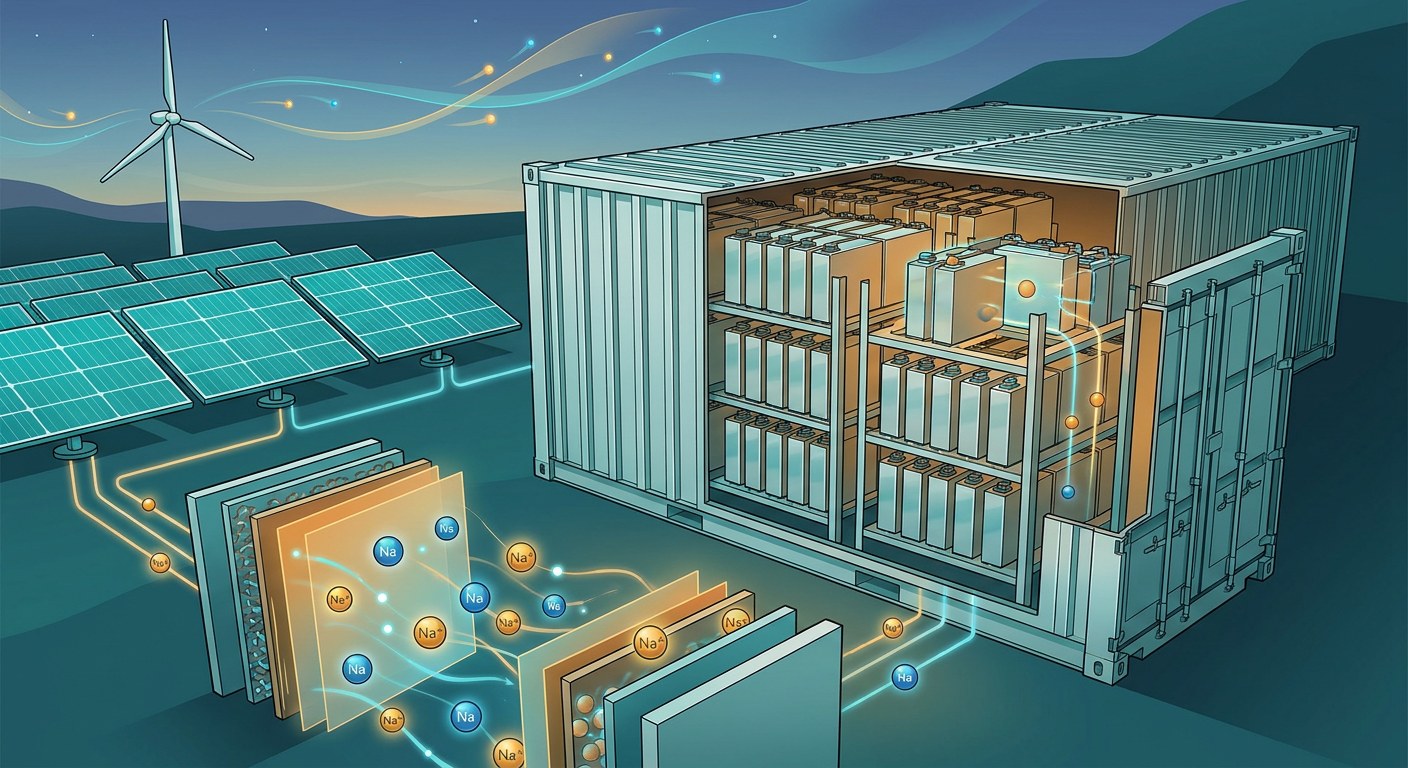
Next to a solar farm stands a metal container full of cabinets, fans and cables. Inside, thousands of cells charge during the sunny hours and give that electricity back at night. That job — charging and discharging every single day for fifteen or twenty years — is brutal for any battery chemistry, and it is exactly where sodium is starting to beat lithium.
The grid does not need sports cars, it needs pack mules
A car battery is chosen for energy per kilogram: every spare kilo is range lost. A grid battery is chosen for something else: cost per installed kilowatt-hour, cycle count and the price of money. The metric that rules is LCOS (levelised cost of storage, the real price of every MWh that comes out of the battery across its whole working life). If a cell costs half as much and lasts twice as many cycles, weighing 30 % more is irrelevant: nobody is going to drive that container.
And the duty cycle is punishing. A grid-scale storage system runs one to two full cycles a day, sometimes with one-hour power peaks and twelve-hour rests. Over fifteen years that adds up to 5,000 to 10,000 equivalent cycles. That is where lithium suffers: lithium metal plating unevenly on the anode — the growth of dendrites — and electrolyte breakdown gradually eat away at capacity.
An ion 34 % fatter
The atom that changes everything is the sodium cation (Na⁺). Its ionic radius is about 1.02 angstroms, against 0.76 for lithium (Li⁺): in volume it is more than twice as big. That difference has three very concrete technical consequences.
The first is that sodium does not intercalate well into graphite. Graphite stores lithium by slipping the ions between its carbon layers, and lithium fits comfortably; sodium, being larger, barely finds room and forms unstable compounds. The industry solved this with a different anode material: hard carbon, a disordered carbon with voids and nanopores instead of ordered layers, which stores sodium in cavities and at surface defects.
The second is that sodium does not alloy with aluminium at operating voltages, whereas lithium does. That allows aluminium foil to be used as the current collector on both electrodes instead of copper on the negative side. Copper is more expensive and heavier; removing it makes the cell cheaper and, as a bonus, allows shipping it discharged to zero volts without short-circuit risk — something you do not do with a copper-and-lithium anode because the copper dissolves.
The third concerns the electrolyte: because the ion is bulkier, sodium salts need different solvents and additives to build a stable passivating layer (the SEI, solid electrolyte interphase, the film that forms on the first charge and protects the anode). Getting that layer stable is half the battle for any new chemistry.
What is inside the cathode
On the positive electrode three families are competing. The most striking is Prussian blue, or rather its discharged version, Prussian white: an iron-and-cyanide framework with open channels through which sodium enters and leaves with barely any strain on the structure. It is made from iron, sodium and cyanide — very cheap materials, no cobalt or nickel — and lasts many cycles because the skeleton hardly changes volume. Its weak points are energy density and the presence of cyanide in the process, which demands serious industrial control.
The second family is layered sodium transition-metal oxides, cousins of the ones lithium uses, with higher capacities but more degradation as they swell and shrink. The third is polyanionic materials, very stable but with modest voltage and capacity.
The numbers already on sale
For years sodium was the poor relation: 120 Wh/kg against lithium’s 250. That story has changed. CATL’s Naxtra, unveiled in April 2025 and now in series production, claims 175 Wh/kg, up to 500 km of range in a passenger car, more than 10,000 cycles and operation from -40 °C to +70 °C, keeping 90 % of its power at -40 °C. Farasis has announced 180 Wh/kg for mid-range vehicles. A modern LFP cell sits between 160 and 200 Wh/kg; a high-end NMC, between 250 and 300. The gap with lithium is no longer abysmal, and on cycles and temperature sodium is ahead.
Where it makes sense and where it does not
Where weight rules, sodium loses: aircraft, long-haul trucks, slim phones. Where cost per cycle rules, it wins: stationary storage at solar and wind plants, substation support, industrial backup, truck start-stop batteries (where it replaces lead-acid with eight years of life and 61 % lower total cost, according to CATL) and small city cars.
There is a fine detail integrators know well: the voltage curve of hard carbon against state of charge is sloped, not flat like LFP. That makes estimating state of charge from voltage harder, but it gives the BMS (battery management system) more information to compute real capacity cell by cell. With thousands of cells in series, that estimate is the difference between a system that lasts and one that drifts out of balance.
The bottleneck is the factory
Sodium chemistry is compatible with existing lithium-ion production lines: same furnaces, same coating machines, same winding equipment. That allows installed capacity to be repurposed without building new gigafactories, and explains why in two years the technology went from lab to dealership. Geography helps too: salt is everywhere and sodium carbonate does not depend on four lithium-producing countries, so its price does not ride lithium market spikes.
None of this means lithium is going away. It means something more interesting: the power grid, the fastest-growing battery market, can stop competing for the same lithium the cars need. Once stationary storage runs on sodium, lithium is freed for what really must be light. That division of labour, more than any lab record, is what decides which chemistry ends up inside each device.