
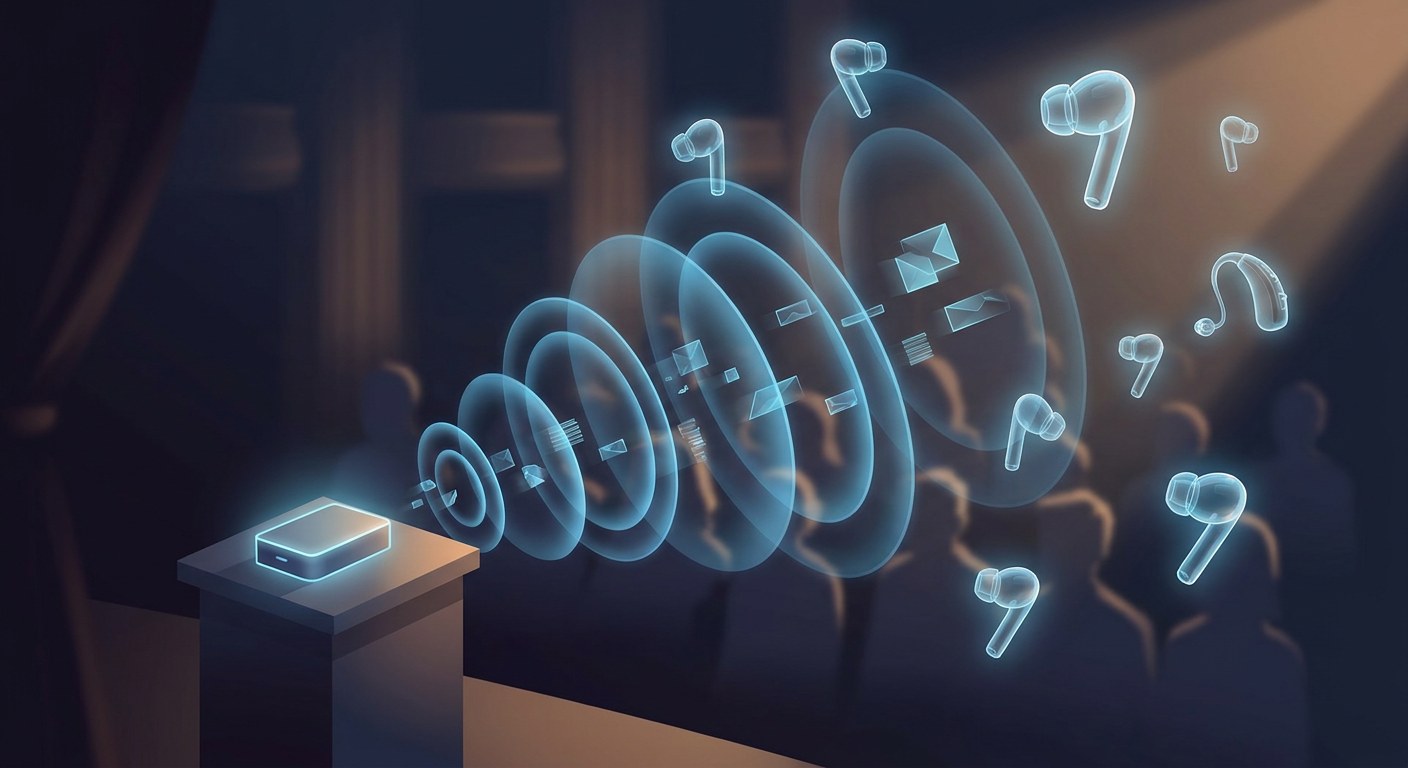
For nearly two decades, consumer wireless audio has lived inside an architecture designed for something else: Bluetooth Classic, conceived in the early 2000s to replace the cable on a hands-free headset. That design carries two limitations users notice every day. The first is pairing: a point-to-point, one-to-one link that has to be negotiated before anything plays. The second is latency: 150 to 200 milliseconds at best, enough to make watching a show with headphones and badly synced lips uncomfortable. Bluetooth LE Audio was created to break both, and its most visible piece is Auracast, the ability to broadcast audio to an unlimited number of receivers as if it were a radio station.
From SBC to LC3: the codec is not a detail
Bluetooth Classic compresses audio with SBC, a codec from 2003 that works with frames of about 2.5 milliseconds and typical bitrates of 328 kbps. It is robust and cheap, but wasteful: it models the signal with a relatively coarse filter bank and does not exploit psychoacoustics well. LE Audio replaces SBC with LC3, a codec specified in 2020 that uses 7.5 or 10 millisecond frames, supports sample rates from 16 to 48 kHz and configurable bitrates between 16 and 320 kbps. The practical consequence is that at 96 kbps LC3 delivers quality SBC needs considerably more bits to match. Fewer bits per second means less radio time per packet, and that translates directly into lower power draw: the specification cites up to 50 percent less energy for the same perceived quality, something you notice in the daily battery life of a button-sized hearing aid.
LC3 also has a low-complexity mode aimed precisely at hearing aids, where the compute and battery budget is minimal. That is why LE Audio is not just an upgrade for expensive earbuds, but the first Bluetooth architecture that assumes by default that a two-gram medical device has to fit inside it.
Isochronous channels: synchrony is negotiated, not improvised
The structural novelty sits below the codec. LE Audio introduces Isochronous Channels (ISO), a link type designed for traffic with a fixed deadline: every packet has a presentation window and, if it does not arrive in time, it is discarded rather than played late. There are two flavours. CIS (Connected Isochronous Streams) are point-to-point links, but they are grouped into a CIG (Connected Isochronous Group) sharing a common clock: this way both earbuds receive independent, perfectly aligned streams without relying on the classic trick of relaying from one ear to the other. That removes the asymmetric delay that used to leave one ear a few milliseconds behind the other.
BIS (Broadcast Isochronous Streams) are the other flavour, and they are the foundation of Auracast. Here there is no connection: the transmitter creates a BIG (Broadcast Isochronous Group) and publishes its parameters through periodic advertising, a broadcast channel that repeats synchronisation information at regular intervals. Any receiver that tunes into those advertisements can work out when the next audio packet will arrive and join the stream with no prior handshake. The profile layer that ties it together is BAP (Basic Audio Profile), resting on specific GATT services: PACS publishes the device capabilities (sample rates, frame lengths, supported bitrates) and ASCS controls the state of each stream, with configuration, enabling and disabling operations.
Auracast in practice: an identifier and, if you want, a password
An Auracast broadcast is identified by a 24-bit broadcast_id and a human-readable name. The receiver needs nothing else: the so-called Auracast assistant, which can be the phone app or the earbuds menu itself, scans the advertisements, shows the list of available broadcasts and hands the chosen identifier to the device. From there the receiver synchronises with the BIG and starts decoding.
The system supports optional encryption. A transmitter can protect the stream with a key derived from a broadcast code (the equivalent of a meeting PIN), so only those who know it can decrypt the audio. Without a code, the broadcast is open: anyone in range can listen. It is exactly the FM radio model, except the stream here is digital, with error correction and the ability to carry several tracks or languages in parallel inside the same BIG.
What changes for users and what is missing
The use cases are quite concrete. At an airport, announcements can be broadcast over Auracast and reach the hearing aids of whoever needs them, with no induction loops or special counters. In a gym, each treadmill can offer the audio from its own television. In a conference hall, the interpreter broadcasts their channel and every attendee picks theirs. And at home, a television can feed several headphones at once without pairing them one by one, something that is a headache today in families with people who have hearing loss.
Latency also drops to roughly 20 to 30 milliseconds in typical configurations, well below the threshold at which the brain detects a mismatch between picture and sound. That opens the door to using LE Audio for gaming or stage monitors, ground where Bluetooth Classic was never welcome.
The brake is not technical, it is installed base. LE Audio requires new radios and protocol stacks: Bluetooth 5.2 or later, with support for isochronous channels and LC3, plus firmware implementing BAP and, for Auracast, the assistant profile. High-end phones have shipped it since 2022 and 2023, but cheap earbuds and home audio gear lag far behind. While both worlds coexist, chipsets will juggle dual stacks, and that is why the shift feels slow even though the specification has been closed for years.
The story is, at bottom, a familiar one: Bluetooth Classic was born for a narrow use case and ended up carrying all the wireless audio on the planet. LE Audio does not add a feature; it changes the starting assumption. It stops assuming two devices talking to each other and starts assuming a transmitter and an audience. When the installed base catches up, listening in public may feel less like pairing and more like tuning in.