

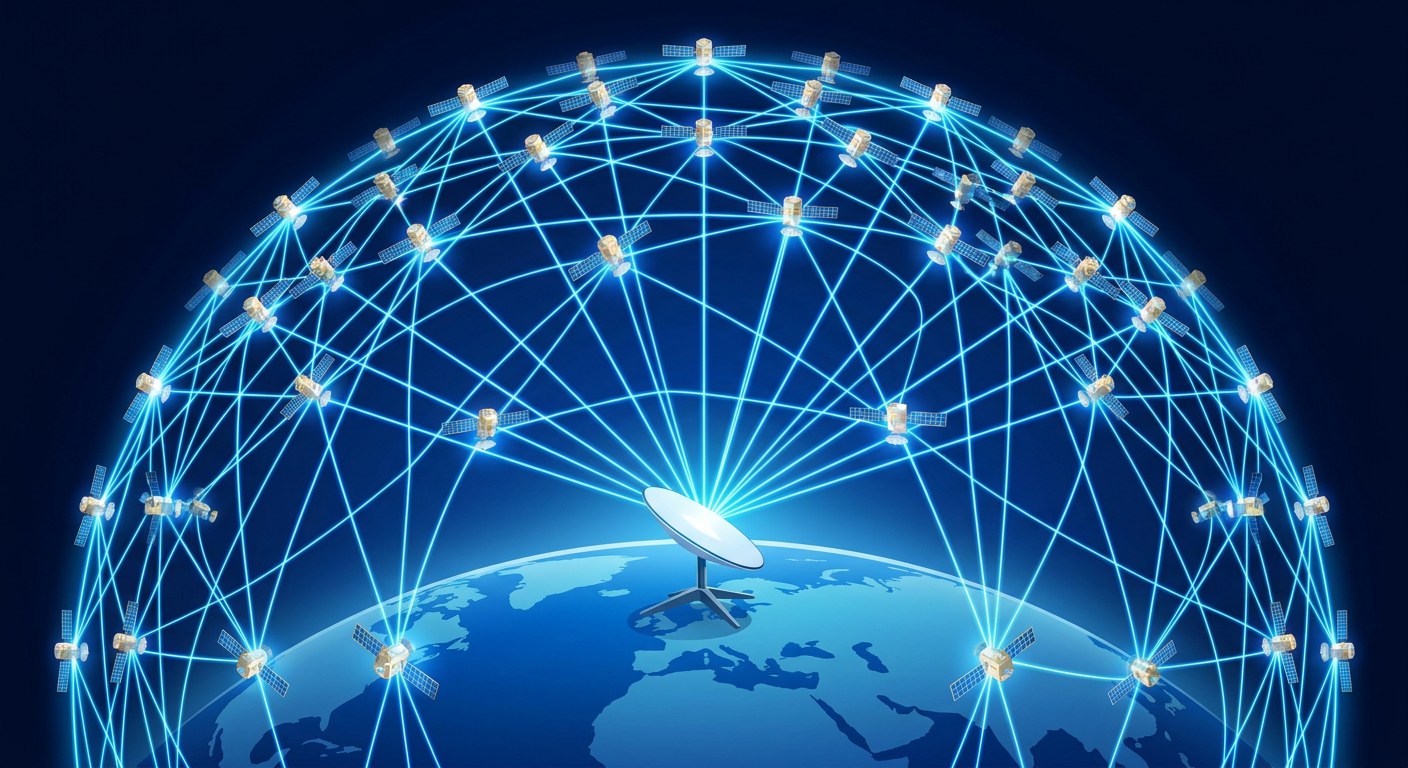
99% of the internet travels along the ocean floor, but that cable has one countable limit: the last mile, the stretch between the exchange in town and your living room, is the most expensive path in the world. To reach the places with no trench, mountain villages, ships or homes without fiber, a growing share of traffic now comes down from the sky, from constellations of satellites orbiting 550 kilometres away that pass your packets to one another like relay runners. This is what happens when your connection hops from satellite to satellite.
Neither too high nor too low
Classic communications satellites are geostationary (GEO): they hang at 35,786 kilometres, where the orbital period matches the Earth’s rotation and the satellite seems nailed over one spot on the equator. The toll is physics: light travels at 300,000 kilometres per second, and a round trip to that orbit costs about 477 milliseconds of latency, the delay (RTT) that measures how long a packet takes to go and come back. You can feel it in a video call.
Low Earth Orbit (LEO), between 340 and 1,200 kilometres, shortens that distance: from 550 kilometres the RTT drops to 20-40 milliseconds, in the same league as a good fiber connection. The price is that the satellite does not stay still: it completes an orbit in about 96 minutes at 27,000 km/h. Seen from space, your rooftop horizon gives it only a few minutes of visibility before it disappears on the other side.
An antenna that aims without moving a single part
Chasing a satellite across the sky with a classic parabolic dish, with its motor and mount, is slow and impractical. That is why the user terminal’s “dish”, a half-metre panel, has not a single moving part: it is a phased array. Hundreds of tiny antennas radiate the same signal with calculated delays (phase differences); through constructive interference the set behaves like one huge steerable antenna, and changing those delays redirects the beam in microseconds, with nothing physically moving.
That electronic steering solves the problem of a moving satellite: the same panel receiving from the satellite rising in the east is already calibrated for the one rising in the west by the time the first sinks below the horizon.
Microwaves that sweat when it rains
The link comes down as microwaves in the Ku band (about 12 GHz) and the Ka band (about 28 GHz), frequencies at tens of gigahertz where far more bandwidth fits than in the C band used by 1980s satellites (3-4 GHz). In exchange, the higher the frequency, the more rain attenuates it: water droplets absorb and scatter microwaves (rain fade), which is why a high-frequency satellite link can lose quality during a downpour.
Each satellite casts over the ground a mosaic of narrow beams (spot beams), as if it lit the map with dozens of torches. Every beam reuses the same frequencies as its far-away neighbours, a spatial reuse of the spectrum that multiplies the constellation’s total capacity.
The relay in mid-flight
From your rooftop, a satellite 550 kilometres up is visible for only about five minutes. Keeping the connection alive means the network must decide who serves you next and switch the link before the current one disappears: that is a handover, the same mechanism your phone uses when it changes 5G antenna, except that here the relay happens every few minutes, 24 hours a day, across thousands of satellites at once.
That orchestration is a software problem, not a radio one. Every satellite continuously reports its position and its load; a network control system computes routes and reprograms the beams: which satellite serves which user, when and with which beam. In that sense the constellation is a truly software-defined network (SDN).
Lasers between satellites
The most spectacular piece never shows up at your antenna. At 550 kilometres there is no atmosphere left to scatter light, so satellites talk to each other with inter-satellite links (ISL): infrared laser beams carrying tens of gigabits per second, like tiny fiber-optic cables laid in vacuum.
Thanks to those links, a packet born on a ship in the Atlantic can hop from satellite to satellite, sometimes crossing whole continents through space, until it lands at the gateway with terrestrial fiber closest to its destination. A spatial routing mesh that shortens distances: two remote stations can talk with city-level latency without the traffic ever touching the ground.
Routers with solar panels
It helps to be clear about what each satellite is: not a passive repeater, but a computer with panels, thrusters and radios. It runs a real operating system, reconfigurable mid-flight, and acts as a mesh router: it receives packets, looks at their destination and decides whether to send them by radio down to Earth or by laser to the next satellite.
The scale is new too. Starlink is past 7,000 active satellites and dominates the business; OneWeb, now owned by Eutelsat, and Amazon’s Kuiper constellation are following, and the allocation of frequencies and orbits is coordinated by agencies such as the ITU and the FCC under a first-come, first-served rule.
None of this replaces fiber: each beam’s capacity is shared among every user below it, and a forest of satellites cannot compete on raw speed with a 100-gigabit cable. But fiber only reaches where someone is allowed to dig. Satellites, instead, reach the last mile from the last million metres, which is why the future of the internet is not one or the other: it is a cable under the sea and a laser in orbit, working together.