

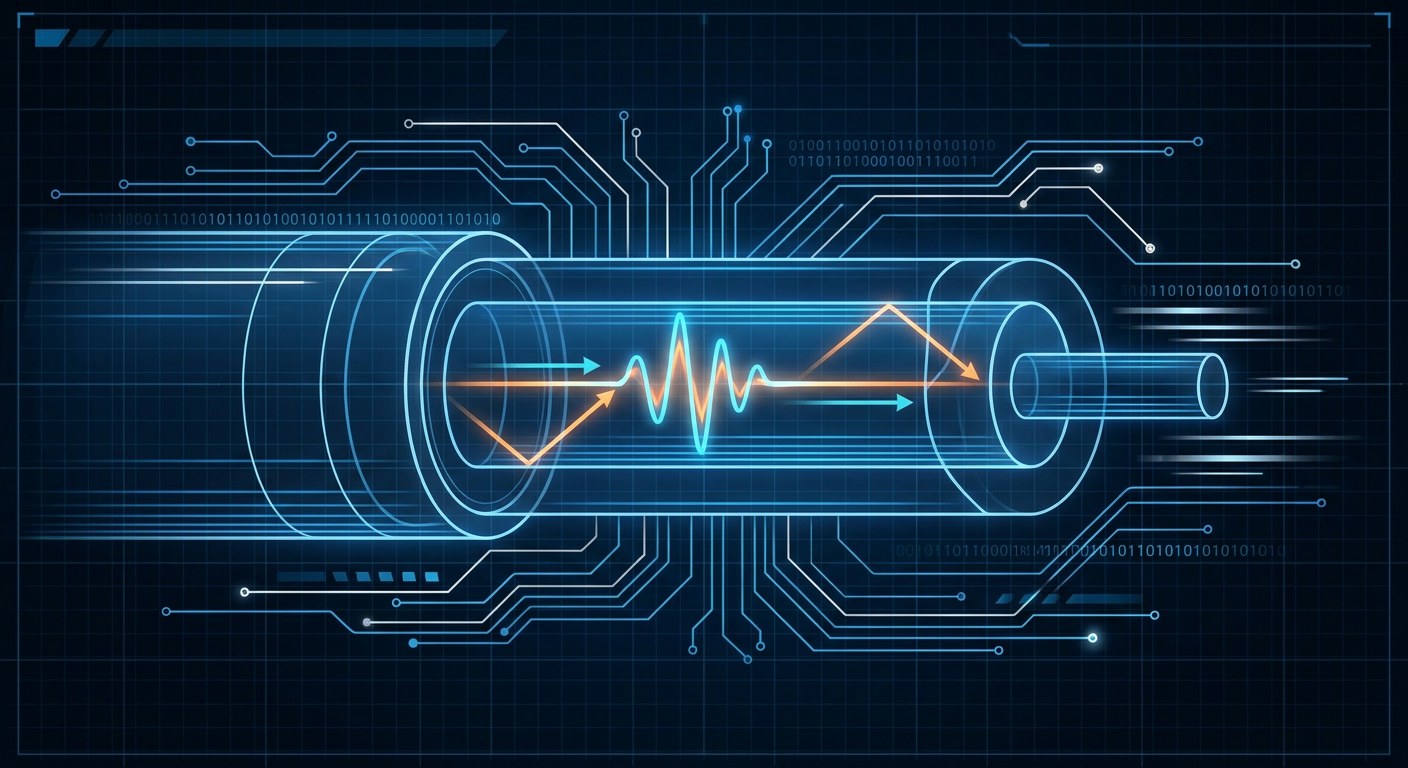
When your operator promises a “symmetric 1 Gbps fiber” connection, that promise rests on physics that has little to do with electricity. A fiber optic cable does not carry electrons: it carries photons, particles of light, at nearly 300,000 kilometers per second along a glass filament thinner than a human hair.
The real technical question is why that strand of glass beats copper so overwhelmingly. The answer lies in how light behaves when it changes medium: the phenomenon known as refraction, described by Snell’s law, and the property that lets you trap light inside glass: total internal reflection.
The trick: making light bounce without escaping
An optical fiber is a cylinder of two concentric layers of glass with different refractive indices. In the core the index is slightly higher than in the cladding. When a light beam travels through the core and reaches the cladding boundary at an angle closed enough relative to the surface, it does not refract outwards: it reflects back into the core with no loss, and keeps bouncing tens of thousands of times across kilometers.
That limiting angle is computed with Snell’s law, n₁·sin(θ₁) = n₂·sin(θ₂). If the angle of incidence exceeds the critical angle, the component of the wave that should escape has a sine greater than 1, a value that does not exist in real refraction physics, so the only mathematical way out is complete reflection. Engineers make the ray travel as if the glass were a corridor of mirrors.
Single-mode versus multimode
There are two families of fiber. In multimode fiber, with a wider core, several propagation modes travel at once — light bouncing at different angles. It is cheap and enough for short links inside buildings or data centers, but when each mode follows a slightly different path, pulses arrive out of sync: that is modal dispersion, which degrades the signal over long distances.
In single-mode fiber, whose core is only about 9 microns across, the diameter is so small that the optics force light to propagate in a single mode, in a straight line. It suppresses modal dispersion and reaches far higher speeds and distances; that is why it wins in telecom networks and in intercontinental submarine links.
Multiplying bandwidth: WDM
A single light pulse is one bit of data. But white light is a mixture of many colors, and each color is a wave with its own frequency. The technology called WDM (wavelength-division multiplexing) exploits that property: it turns each color into an independent data channel traveling simultaneously through the same fiber.
With dozens or hundreds of multiplexed wavelengths — each additionally modulated in amplitude and phase through schemes such as QAM (quadrature amplitude modulation) — a single fiber carries several terabits per second. At the far end, optical filters separate each color again and deliver it to its receiver.
The signal does not make it alone: attenuation and amplification
No material is perfect: glass also absorbs and scatters part of the light, and that loss, the attenuation, is measured in decibels per kilometer. Modern technology achieves values as low as 0.2 dB/km, but over hundreds of kilometers the signal weakens and must be regenerated without converting it back to electricity: it uses erbium-doped fiber amplifiers (EDFA), which inject pump light to excite the ions and optically amplify the weak signal.
Combining minimal attenuation, optical amplification and WDM multiplexing, submarine cables join continents at speeds copper could never dream of. When you see “fiber optic” advertised, you are really looking at a complete photonics system: laser emitters, modulators, multiplexers, amplifiers and detectors working together so that a strand of glass carries the hardest part of the journey.
Copper will not disappear: it is perfect for powering equipment or distributing data over the last meter. But over the long haul, the physics of glass is unbeatable: no electrons colliding and heating up, just photons gliding at the speed of light.