
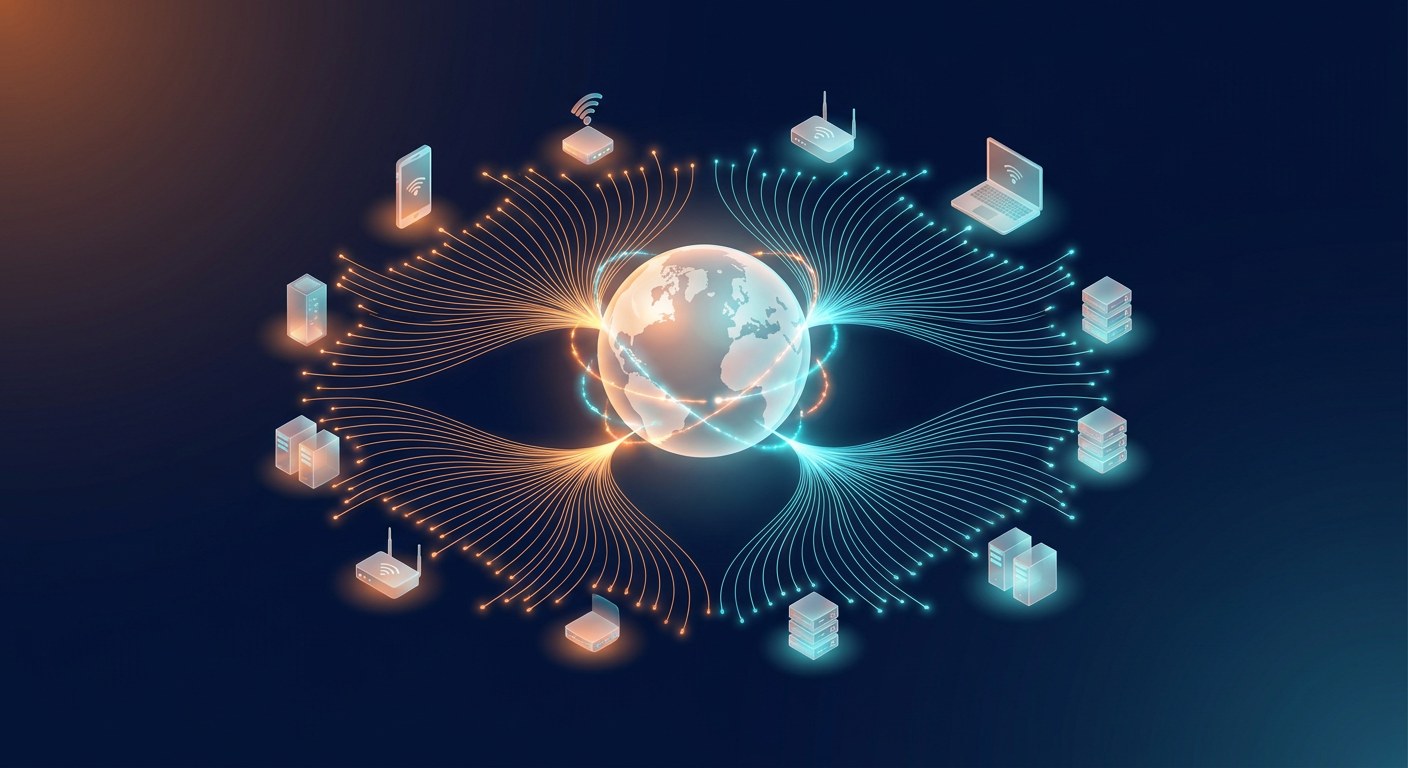
Your phone, your laptop, the living-room TV and the “smart” coffee maker share something: each one needs its own address to talk on the internet. And those addresses are a finite resource. The system we defined in the 1980s only allows 4,294,967,296 addresses, exactly 232, and we spent them all years ago. The solution has been rolling under your feet without you noticing: it is called IPv6.
An inventory that ran out
An IPv4 address is a 32-bit number, four groups of eight that we write as 192.168.1.1. Thirty-two bits give about 4.3 billion combinations. In 1981, when the protocol was defined (RFC 791), that looked like a luxury: there were only a few thousand computers in the world, and nobody imagined that one day every person would carry several connected devices in their pocket.
Exhaustion did not have a single date: the global pool managed by IANA ran out in 2011, and the five regional registries that distribute addresses by continent followed the same path at different times. Since then, IPv4 addresses are bought, sold and leased between operators like urban land. The internet did not die of thirst because we found a brilliant patch: NAT.
The patch that bought two decades of breathing room
NAT (Network Address Translation) is a camouflage trick. Inside your home, the router hands each device a “private” address from the ranges reserved in RFC 1918 (the 10.x, the 172.16-31.x and the 192.168.x), while keeping a single public address for the whole family. When a packet heads out to the internet, the router rewrites the source address and port and notes in an internal table who asked for what, so each response finds its owner. With 65,535 possible ports, one public IPv4 can sustain tens of thousands of simultaneous connections.
The trick worked so well that the internet split in two: a public part, growing smaller every day, and a huge private part hidden behind translation tables. But it has tolls: receiving an inbound connection means opening ports by hand (or resorting to UPnP, whose security reputation is doubtful), video calls and online games need helpers such as STUN or TURN, and mobile operators stack giant NATs, carrier-grade NAT (CGNAT), to share a single address among thousands of customers.
128 bits, just in case
IPv6 is not an improved IPv4: it is a new protocol, standardised in RFC 8200. Its addresses take 128 bits, and 2128 is such a huge number, about 340 sextillion (3.4 × 1038), that nobody even thinks about exhausting it: there are billions of addresses for every star in the observable universe.
They are written as eight groups of four hexadecimal digits separated by colons, 2001:db8:85a3::8a2e:370:7334, and the double colon (::) compresses runs of zeros. Some segments have specific roles: link-local addresses start with fe80:: and configure themselves automatically, global addresses hang from 2000::/3, the local loopback is ::1 and multicast lives in ff00::/8. The broadcast of IPv4, that special address a machine used to talk to everyone at once, is gone.
The packet header went from variable size to a fixed 40 bytes with no checksum field: routers no longer recompute the checksum at every hop, a small speed win on every leg of the journey. And if a packet exceeds the maximum size a link allows, the router no longer fragments it the way IPv4 did: it drops it and answers the sender with an ICMPv6 message asking it to resize. Less work for the network, simpler rules.
Who hands out the addresses
Here lies one of the most elegant differences. In IPv4, a DHCP server lent you your address and sometimes ran out of stock. In IPv6 the usual mechanism is SLAAC: the router announces its prefix with Router Advertisement messages, and each device builds its own address by combining that prefix with an interface identifier. Before using it, it runs DAD (duplicate address detection) to check that no neighbour already has it. No central server, no queues.
There was a privacy scare along the way: the classic identifier was derived from the MAC address, the physical identifier burned into your network card, which meant a device could be tracked from network to network. The privacy extensions of RFC 4941 fixed it: today each device rotates random identifiers periodically, and your phone changes address without you noticing. DHCPv6 exists for those who prefer centralised control, but with IPv6 it is optional.
The migration you cannot see
Almost nobody “migrated” to IPv6: what exists is coexistence. Most networks run dual stack, speaking IPv4 and IPv6 at the same time, and the operating system picks the protocol for each connection. Phones go one step further with translation mechanisms such as NAT64 and 464XLAT: your phone, which on some networks only speaks IPv6, translates its IPv4 requests into that format, the operator converts them back to IPv4, and the destination server never notices the manoeuvre.
The result is measured every month: Google publishes the percentage of its users who arrive over IPv6, and in 2026 it is around half. In some countries it is over 70%. The numbers do not rise on their own: they rise when an operator flips the switch and, overnight, millions of connections move to the new protocol without anyone touching a setting. It is probably the biggest change to the network in decades, and it behaves like a good plumber: it leaves no stain.
Security does not change; myths do not either
Let us bust one: NAT is not a firewall. It is a by-product of scarcity that happens to hide your equipment. With IPv6 there is no excuse to hide, and no need either: your operating system’s firewall blocks inbound connections by default, just as in IPv4. Security, though, does not come for free: IPsec encryption is still optional, and key messages such as Router Advertisements can be forged on an open Wi-Fi network, something managed switches mitigate with techniques like RA-Guard. Less NAT does not mean less security: it means every layer, firewall, encryption, monitoring, has to do its job explicitly.
Next time you connect your phone to a new network, think about it: that 128-bit address that was just assigned may be invisible to you, but it is proof that the internet found room to grow for a few more centuries.