
Smart glasses: the next computer will not have a screen
Smart glasses have been promising to replace the smartphone for years. Until now, almost all of them ended up in a drawer: too heavy, with too little battery, or at a price only early adopters could justify. But 2026 is marking a real turning point.
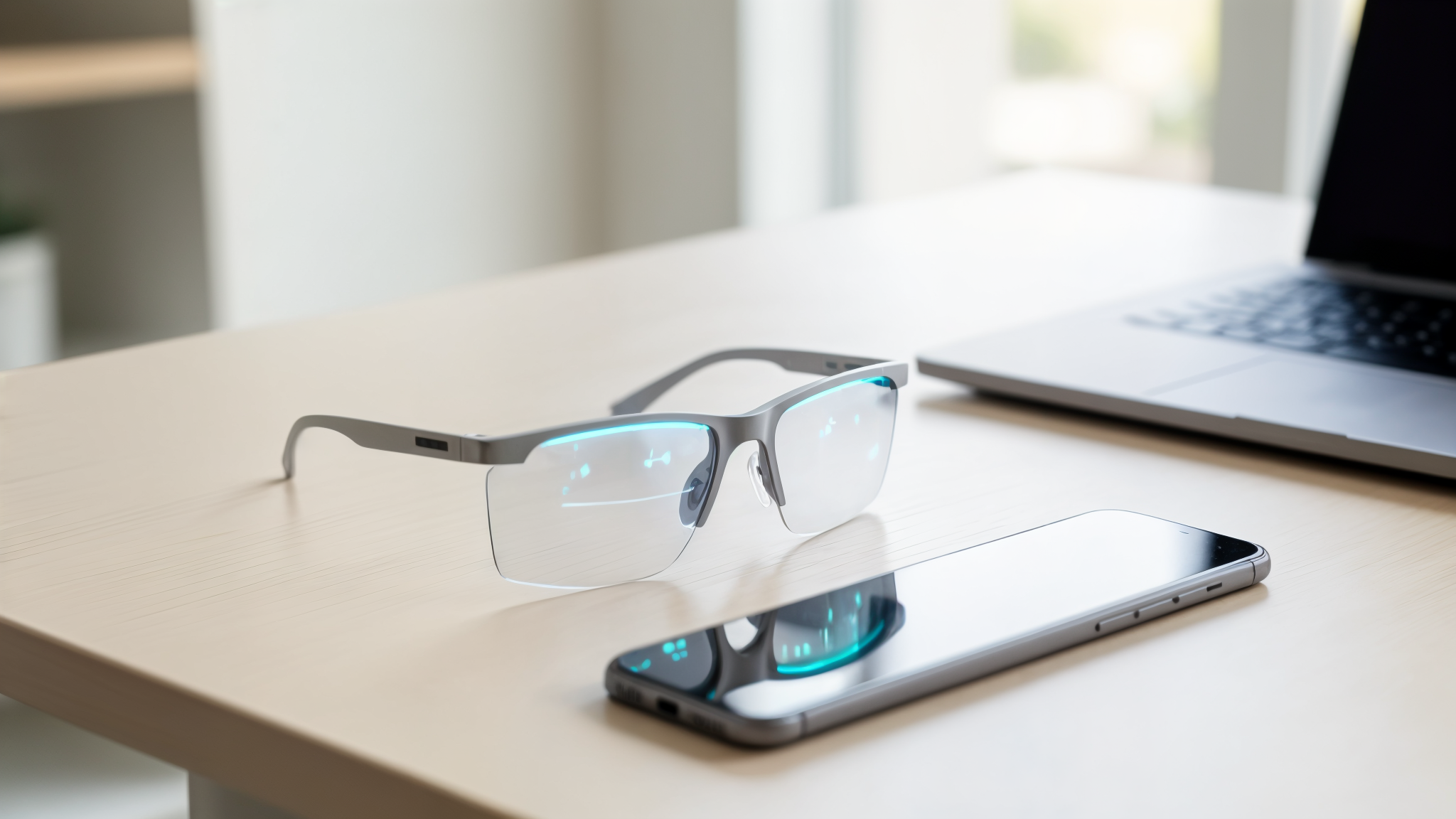
Apple Vision Pro proved that spatial computing works, although its headset format and its $3,500 price tag put it out of reach for the mass market. What is coming now is different: glasses that look like normal glasses, weigh less than 50 grams and project information directly onto transparent lenses.
Meta has shown its Orion prototype: silicon carbide lenses with a 70-degree field of view, eye and hand tracking, and a neural wristband that reads gestures from the wrist. There are no controllers, no visible external cameras. The goal is for the device to disappear: you put them on and see the world augmented with reminders, maps, real-time translations or a virtual 100-inch screen floating in front of you.
Snap, Xiaomi, Realme and even Samsung have their own versions in development. The race is not only about hardware: the challenge is the battery. A light pair of glasses only has room for a few measly milliamps. The solution is to split the device: the glasses only project and sense; the heavy processing and the battery live in your pocket, connected by an ultra-thin cable or an ultra-low-latency wireless link.
Software is the other half. Android XR and visionOS are laying the groundwork so that apps are not glasses apps, but rather your current apps —maps, messaging, email— adapt on their own to float in the space around you. You point at a restaurant and see the menu and reviews; you look at a street and navigation arrows appear glued to the ground; you receive a message and read it without taking out your phone.
When will they truly arrive? The first consumer glasses with this architecture (lens projection, externalized computing) will land between late 2026 and 2027 for under 1,000 euros. They will not replace the phone overnight, just as the smartphone did not kill the PC in a day. But they will change what we look at and how we interact with information: the screen will stop being a rectangle in your hand and become the whole world.