

Imagine a source of energy that does not pollute, that barely generates waste and that could power entire cities with a minimal amount of fuel. It is not science fiction: it is nuclear fusion, the same process that lights the stars, and which scientists have spent decades trying to master on Earth.
What nuclear fusion is
To understand it, think of its more famous cousin: fission, the one used by current nuclear power plants. Fission breaks large, heavy atoms, such as uranium, to release energy. Fusion does just the opposite: it joins light atoms, such as those of hydrogen, and in that process a huge amount of energy is released.
It is the same trick that keeps the Sun alive. There, millions of tonnes of hydrogen fuse every second, releasing the light and heat that make life on Earth possible. Reproducing that down here is the great challenge.
A sun in a bottle
Fusing atoms is not easy. They need to be heated to temperatures of more than 100 million degrees, hotter than the core of the Sun, so that they move fast enough to collide and merge. At those temperatures, matter becomes plasma, a kind of electrically charged gas that no material can touch directly.
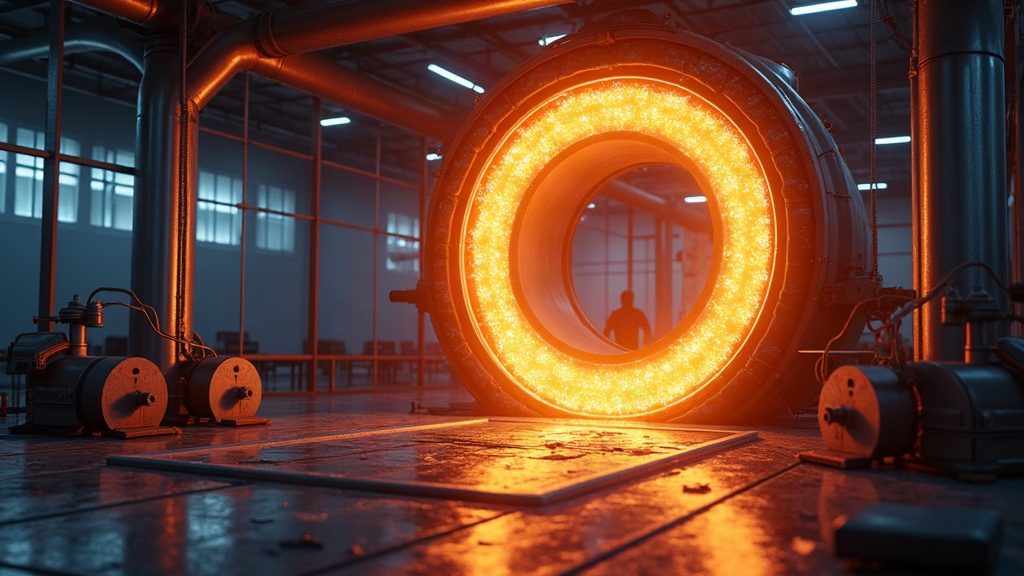
That is why scientists use giant magnetic fields to trap the plasma and keep it floating inside a doughnut-shaped chamber called a tokamak. It is like putting a tiny sun in a bottle made of invisible magnets.
Why it is so worth it
The advantages are enormous. The fuel, hydrogen, is obtained from seawater, so it is practically inexhaustible. It emits no greenhouse gases. And unlike current power plants, it leaves no radioactive waste that lasts thousands of years.
Moreover, it is safe by design: if something fails, the reaction stops on its own. There is no risk of a Chernobyl- or Fukushima-type accident. That is why many call it the “definitive clean energy”.
A global and gigantic project
The most ambitious example is ITER, a huge tokamak being built in the south of France with the collaboration of countries from all over the world. It is not a plant that will produce electricity for sale, but an experiment to demonstrate that fusion can generate more energy than it consumes.
And it is not alone. There are more and more private companies with their own designs, many of them smaller and faster, competing to be the first to achieve the milestone. Fusion has become a technological race with a capital T.
When will it reach our homes?
Let us be honest: it is not solved yet. The great challenge is still to get fusion to produce, stably and constantly, more energy than it spends, and then convert it into electricity that reaches the grid.
Optimists talk about the first commercial prototypes possibly arriving within a few decades. It is a long road, but every advance brings humanity closer to a source of energy that, if mastered, could change the world. The stars have been doing this trick for millions of years. Now, finally, we are learning to imitate them.