
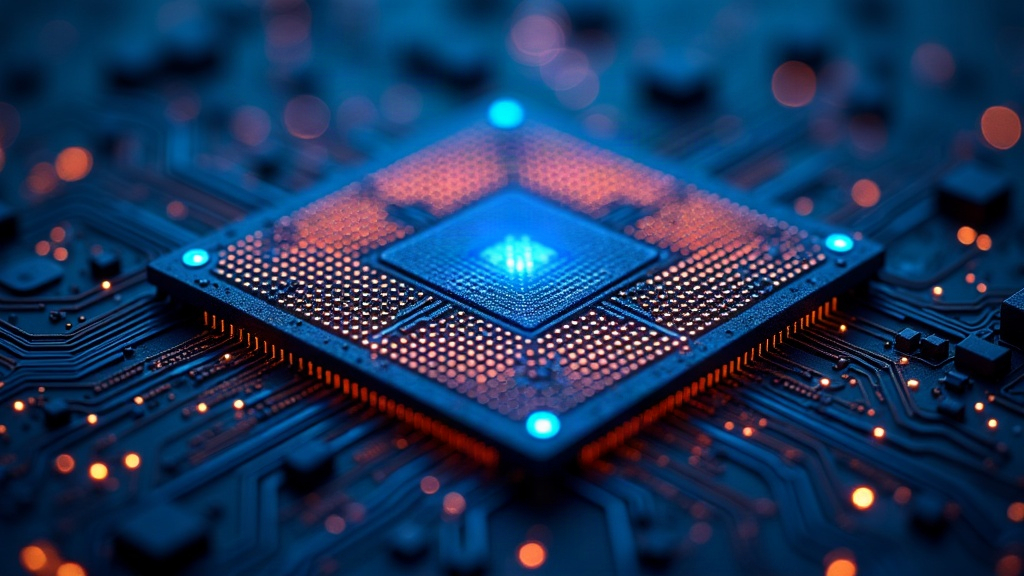
There is an idea that has been floating around computing for decades: what if a computer worked more like a brain than a calculator? Neuromorphic chips are the most ambitious bet to achieve this. They do not intend to imitate traditional processors, but to take inspiration from neurons and synapses to think in a different way.
What a neuromorphic chip is
A normal processor follows a very strict script: it receives an instruction, executes it and moves on to the next. It is fast, but it spends a huge amount of energy moving data from one place to another. A neuromorphic chip, by contrast, works with a network of units that activate and communicate with each other in a way similar to the neurons of our brain.
The key difference is that each artificial “neuron” can learn and react on its own. Instead of everything passing through a central unit, information travels through a network of connections that strengthen or weaken according to use. At heart, it is a small silicon brain.
Why efficiency matters
The problem with current artificial intelligence is consumption. Training and running models like the ones that generate images or chat with you requires entire data centres and enormous amounts of electricity. A human brain, with its billions of neurons, runs on barely 20 watts: the power of a low-energy light bulb.
Neuromorphic chips seek that same path. By processing information in parallel and in a distributed way, they consume far less than a conventional chip for similar tasks. That makes them ideal for small devices that must run on batteries for a long time.
Where they are already used
It sounds like science fiction, but these chips are already in a real development phase. Companies like Intel have been working for years on neuromorphic processors such as Loihi, and large research projects in Europe and the United States have created large-scale artificial brains, such as the European Human Brain Project with its SpiNNaker chip.
Their first applications are very practical: autonomous vehicles that react in milliseconds, drones that navigate on their own, robotic prostheses that adjust to a person’s movement, and systems that detect patterns in medical or financial data without exhausting the servers.
The advantages over traditional AI
Besides efficiency, neuromorphic chips stand out in two things: continuous learning and real-time processing. A chip of this type can keep learning on the fly, adapting to changes in the environment without needing to be retrained in a data centre.
They are also very good at handling real-world data, such as images or sounds, which arrive in a messy and ever-changing way. For vision or speech recognition tasks, they can be faster and more natural than traditional approaches.
The challenge: current limits
It is not all advantages. Neuromorphic chips are still difficult to program: their logic is so different that developers have to learn a new language. In addition, they are not yet able to replace conventional processors for everything; they are more of a complementary tool than a total replacement.
And of course, the human brain remains infinitely more complex. What these chips imitate is a very simplified version of how it works, enough to solve specific problems but still far from true artificial intelligence.
A future that is approaching
The most interesting thing about neuromorphic chips is that they do not seek to imitate the brain, but to take advantage of its tricks. They are proof that the technology of the future does not always consist of making faster processors, but of thinking differently.
With the explosion of artificial intelligence and the need to consume less energy, it is likely that in the coming years we will see these chips in more and more devices. We are moving from the computer that thinks like a calculator to the one that tries to think like us.