
Pair of earbuds, a car and a pacemaker have one thing in common: they all communicate through the same technology born almost three decades ago to remove cables: Bluetooth. Its name honours Harald Bluetooth, a 10th-century Danish king, and its success rests on an elegant paradox: so as not to collide with the rest of the radios, Bluetooth constantly changes channel.
The problem: the 2.4 GHz band is a permanent traffic jam
The 2.4 GHz radio spectrum Bluetooth uses is shared territory. That is where Wi-Fi, microwave ovens, Zigbee networks, wireless mice and smart-home hubs all live. If Bluetooth stayed on a single frequency, interference from an oven or a crowded Wi-Fi network would render it mute. Its strategy is not to compete for one channel but to never be twice on the same one.
Frequency hopping: 1,600 channels per second
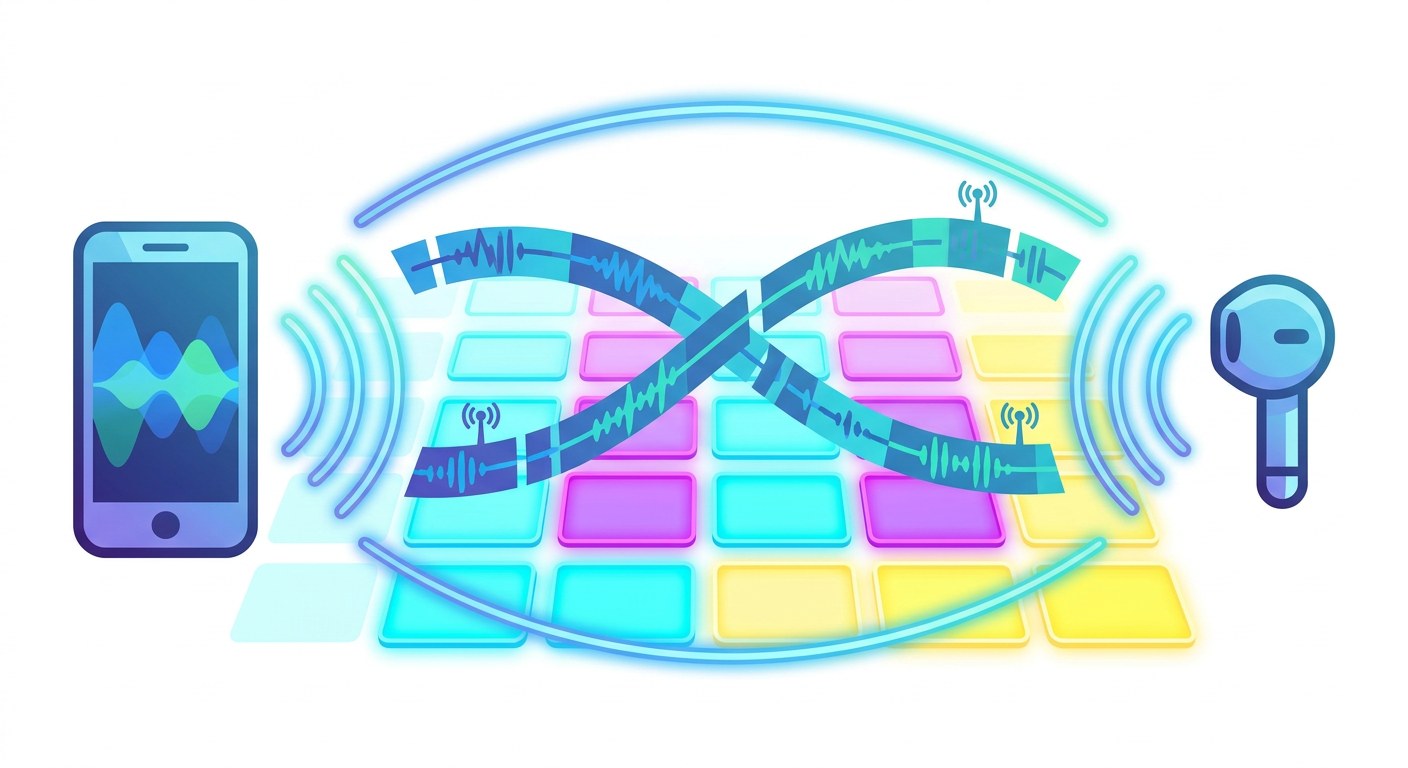
The technique is called frequency-hopping spread spectrum. Classic Bluetooth (BR/EDR) splits the band into 79 channels of 1 MHz and keeps jumping between them at a rate of 1,600 hops per second. Each hop takes a 625-microsecond time slot, and the sequence of channels is agreed by both devices with a pseudorandom formula: the receiver lands on the same channel as the transmitter at the same instant, almost like two dancers following the same choreography without looking at each other.
It is not a blind leap. The modern version includes adaptive frequency hopping (AFH): both ends measure each channel’s error rate and mark those suffering interference (for example, channels overlapping your Wi-Fi) as “bad”, excluding them from the sequence until they are clean again.
BR/EDR vs BLE: two siblings with different vocations
Do not confuse the two branches of the same family. Bluetooth Classic (BR/EDR) is built for continuous, higher-throughput streams such as audio: it reaches up to 3 Mbps and is what your earbuds and the car’s hands-free use. Bluetooth Low Energy (BLE) divides the band into just 40 channels of 2 MHz (3 advertising and 37 data) and trades speed for minimal power consumption, which is why fitness bands, tracking tags and sensors that must last months on a coin cell use it.
The topology is also curious. Devices organise themselves into piconets: a network in which one master coordinates up to seven active slaves, and a single device can belong to several piconets at once, forming a scatternet.
Pairing: encryption you cannot see
That two devices “see” each other does not mean they are safe. The modern generation uses Secure Simple Pairing (SSP) and, in BLE, LE Secure Connections, which exchange keys with the elliptic-curve algorithm ECDH (P-256) and then encrypt the transmission with AES-CCM. The detail you have most likely come across is the six digits: both devices show a number and you confirm they match. That is numeric comparison, designed to defeat the man-in-the-middle attack, in which a third party slips between your earbuds and your phone pretending to be both.
At higher levels, communication is organised by profiles: A2DP for audio, HFP for calls, HID for keyboards. In BLE the structure is more granular, with services and characteristics identified by UUID, each with read, write or notify permissions (GATT, the Generic Attribute protocol).
Why your audio arrives with delay
The latency you notice in your earbuds is no accident. Audio is compressed with codecs such as SBC, AAC, aptX or LDAC to fit the wireless link, packets are buffered to absorb channel hops and losses, and damaged data is retransmitted. More buffer, more stability; less buffer, less delay. That trade-off is what you feel as “game mode” or as the lag in videos.
Next time you pair a pair of headphones and those six digits appear, remember that behind them lie a choreography of 1,600 channel changes per second, an elliptic-curve key exchange and a swarm of protocols designed so two devices can talk without wires, even when everything around them is interference.