
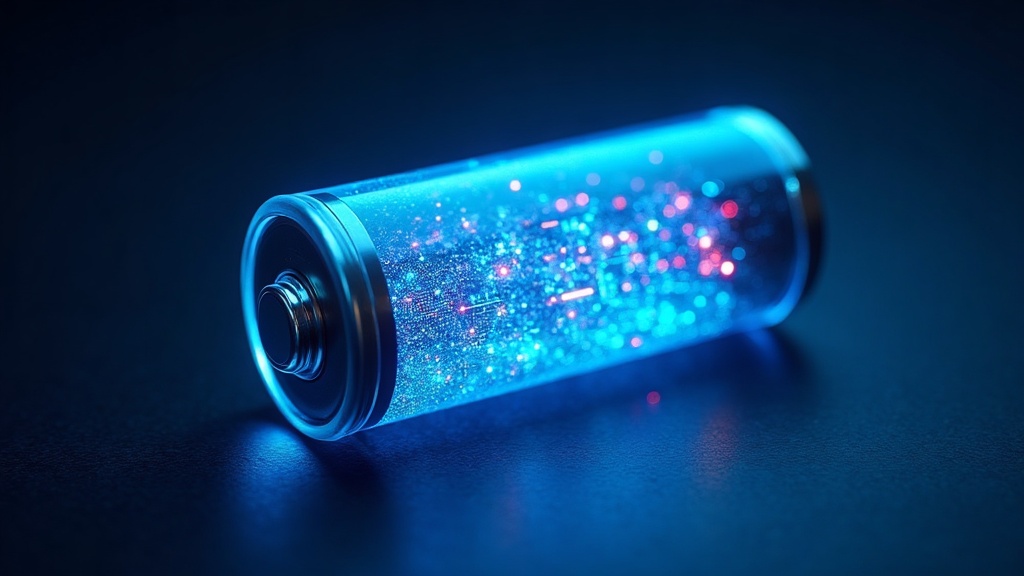
Can you imagine charging your phone in five minutes and the battery lasting a whole week? Or an electric car that travels more than a thousand kilometres on a single charge, without fear of catching fire? That is exactly what solid-state batteries promise, one of the most eagerly awaited technologies of the coming decade.
To understand what changes, you first have to look inside the battery you have in your pocket right now.
The battery we all know
Most current batteries, those in phones and electric cars, are lithium-ion. They work by moving charged particles (the ions) back and forth between two electrodes through a flammable liquid called an electrolyte.
This design has been with us for decades and works very well. But it has three fundamental problems: it takes hours to charge, it degrades over the years and, in extreme cases, it can overheat and catch fire. Engineers have spent years looking for ways to overcome those limits.
What a solid-state battery is
The idea is simple in theory: replace that liquid with a solid material, usually a kind of ceramic or polymer. That is where the name solid-state comes from, just as water in solid state is ice.
That small change opens the door to enormous improvements:
- More capacity: being solid, more layers can be stacked in the same space, storing much more energy without increasing the size.
- Faster charging: the ions travel faster, so charging to 80% in minutes is no longer science fiction.
- More safety: with no flammable liquid, the risk of fire practically disappears.
- More durability: they withstand many more charge cycles, which means they last more years.
Why are they so hard to manufacture?
If they are so good, why do we not have them on the market yet? Because manufacturing them at scale is much harder than it seems. The solid materials are more fragile, cost more to produce and are complicated to integrate into current assembly lines.
The challenge is to manufacture them cheaply and at scale, not just in a laboratory. That is why experts say their real arrival in cars could happen towards the end of this decade, and in phones a little later.
The big brands are already in the race
Practically all the big names in the industry are investing in this technology. Car manufacturers, battery companies and technology firms have spent years building laboratories and pilot plants dedicated to solid-state batteries.
There are also very active startups that have presented promising prototypes. The competition is fierce because the prize is enormous: the company that manages to master this technology will have a key advantage for years.
What will change in your daily life
If the promise comes true, the impact would be remarkable. The phone would stop being an object you have to charge every night. The electric car would lose its biggest fear, the range and the charging time. And we might even see smaller, lighter batteries in devices we cannot even imagine today.
That said, it is worth staying calm. The history of technology is full of promises that took longer than expected to arrive. But in this case there is something different: most experts agree that it is not a question of whether they will arrive, but when.
The next time you look at the battery percentage on your screen, think that you are seeing the end of an era. The solid-state revolution is already under way, and when it arrives, we will probably never look at a charge the same way again.