

You carry an ever more powerful phone, but perhaps you have not stopped to think about the network through which your data travels. 5G has been with us for a few years, and now the industry is already looking further. It is called 6G, the first network that is not limited to connecting people, but aims to connect everything around you: cars, glasses, wearables, robots, entire cities. And it does so at speeds that today sound like science fiction.
What exactly is 6G
Before talking about figures, it is worth clarifying what the letter “G” means. Each generation of mobile networks represents a leap in how data is transmitted. 1G was voice, 2G added messages, 3G brought the internet to the phone, 4G brought streaming video and 5G brought low latency. 6G would go one step further: not only faster, but capable of connecting billions of devices at once with almost instant response.
It is not a simple improvement over 5G. Engineers talk about a paradigm shift, a network that integrates artificial intelligence to manage itself and that works on frequencies of the spectrum that are not used for telecommunications today. The goal is ambitious: for the connection to seem not to exist, to be as immediate as thought.
Speeds that multiply your fiber by a hundred
The numbers are dizzying. If theoretical 5G reaches tens of gigabits per second, 6G aspires to terabits: between 100 and 1,000 times faster. Translated into everyday life, it would mean downloading a high-definition movie in less than a second, or streaming 3D video with extremely high quality without any delay.
But speed is almost the least of it. What most excites experts is latency, that is, the time it takes for a piece of data to go and come back. We are talking about a latency of less than a millisecond, imperceptible to the human eye. It is what makes remote surgery possible, where the surgeon operates a robot located in another hospital, or that two autonomous cars communicate with each other to avoid a collision in fractions of a second.
Beyond the phone: the new frontiers
The real impact of 6G will not be on your phone, but on everything around you. Let us think about autonomous driving: a car needs to process in real time what is happening around it and coordinate with other vehicles. With 6G, that coordination would be instant and reliable, a key step for driverless cars to truly become widespread.
Industry will also benefit. In a factory, thousands of sensors could monitor every machine and every part in real time, detecting breakdowns before they happen. In healthcare, the wearables you are wearing could send your vital signs to a hospital in real time, enabling preventive diagnoses. And in the home, today’s “dumb” objects would give way to a house that anticipates your needs.
A key option: sensors as part of the network
One of the most striking ideas of 6G is that the radio waves themselves will be used to “see” the environment, without the need for cameras. The signals will bounce off objects and allow detecting presence, movement and even gestures. It is what is called radio sensing: the network becomes a large sensor that knows who and what is in each space.
This opens fascinating doors and also delicate questions. It could detect an elderly person who has fallen in their home and alert emergency services, or adjust the lighting of a room depending on who is inside. But it also poses serious privacy challenges, because the network will know your position and even your gestures at all times. How that information is managed will be one of the great debates of the next decade.
When it will really arrive
Although the first laboratory tests already work, 6G is still far from your pocket. International standards will not be closed until 2028 or 2029, and real commercial deployments will arrive from 2030 onwards. First there will be pilot tests in specific areas, then nodes in large cities and, little by little, a wide coverage that will gradually replace 5G.
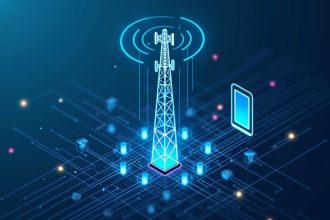
There is, moreover, an important infrastructure challenge. 6G will use very high frequencies that barely travel distance and do not go through walls, so a much denser network of antennas and small stations will be needed, integrated into streetlights, traffic lights and facades. It is a costly deployment that will take years and enormous investments.
The future it is preparing for us
6G is, deep down, the promise that the physical and digital worlds will finally merge. Speed will stop being a problem and move into the background; what will matter will be the intelligence of the network and its ability to understand the environment. All of it with the same naturalness with which we use wifi today: we will take it so much for granted that we will not think about it.
The road is still long and not free of technical and ethical doubts. But if the promises are fulfilled, in a few years we will see a revolution similar to the one of going from a phone only for calling to the smartphone. And it will all have begun, as almost always, with an idea that today seems exaggerated.