
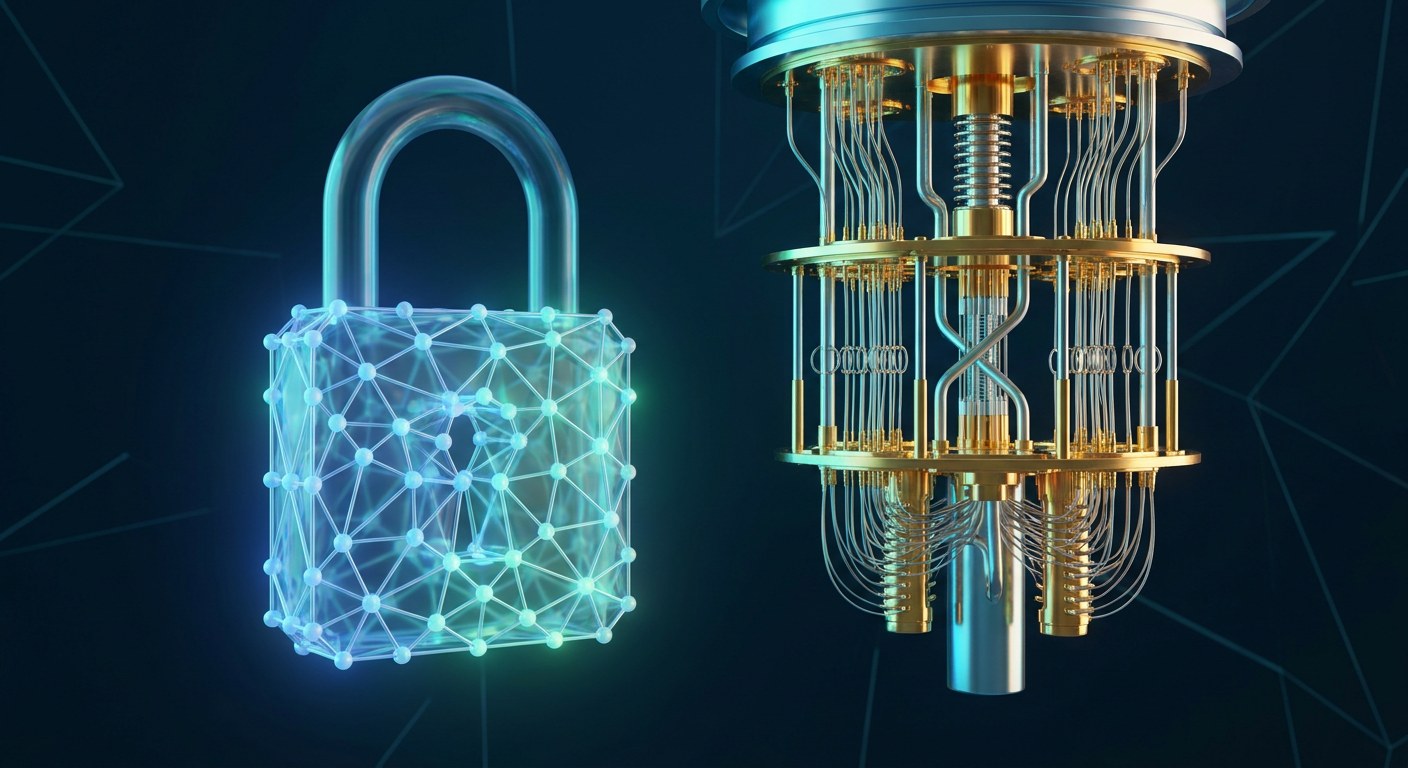
In November 2024 Chrome started doing something different in the very first message it sends to any HTTPS website — the ClientHello of TLS 1.3. Instead of proposing only the classic key exchange based on elliptic curves, it added a second proposal built on lattice cryptography, a branch of mathematics no current computer knows how to attack. Firefox followed almost simultaneously, Apple built it into iOS and macOS in October 2025, and OpenSSL turned it on by default in version 3.5. Nobody had to update anything by hand or click through a warning: the change happened silently. By April 2026, more than two thirds of the TLS 1.3 traffic reaching Cloudflare’s network already used that hybrid exchange.
The paradox is obvious: no quantum computer capable of breaking today’s encryption exists, yet half the internet is already changing its locks. The reason is not technological haste but the arithmetic of time.
What a quantum computer actually breaks
Almost all of the internet’s security rests today on two mathematical problems we consider hard: factoring large integers, which underpins RSA, and the discrete logarithm over finite groups, which underpins Diffie-Hellman and elliptic-curve cryptography (ECC). A modern HTTPS server negotiates its keys with X25519, a 255-bit curve; a website signature is usually ECDSA P-256. Both schemes offer roughly 128 bits of symmetric-equivalent security today: not even the entire computing capacity of the planet could break them by brute force.
Shor’s algorithm changes the equation. Exploiting superposition and entanglement, it turns factoring and the discrete logarithm into period-finding problems solvable in polynomial time. To grasp the scale: going from 128 bits of security to zero. There is no gradual degradation and no room to react; the day a cryptographically relevant machine exists, RSA-2048 and ECC stop working at the same time. Symmetric cryptography, by contrast, holds up: Grover’s algorithm offers only a quadratic speed-up, so AES-256 keeps 128 effective bits and remains safe.
The problem is not the future, it is today’s traffic
If the risk only arrived when the quantum computer was ready, it would be enough to wait and migrate then. But session encryption has an uncomfortable property: it can be recorded now and decrypted later. An adversary with massive storage — an intelligence service, say — can capture terabytes of encrypted traffic today and keep it until it owns the machine capable of opening it. It is called a harvest now, decrypt later attack.
That sets the real calendar. Any data whose useful life exceeds the estimated arrival date of the quantum computer is already exposed. A medical history, an industrial secret, a software signing key or a diplomatic cable from five years ago will still be sensitive in twenty. And the traffic recorded today also includes the session keys, derived from that initial exchange: if the exchange falls, everything encrypted with it falls too.
How to build a lock that qubits cannot pick
The answer NIST standardised in August 2024 in documents FIPS 203, 204 and 205 does not rely on factoring or logarithms but on lattices: arrangements of points in many-dimensional spaces where certain problems — finding the shortest vector, the one closest to a given point — become computationally intractable. What is interesting is that their hardness is not proven for a specific instance but rests on worst-case reductions: if you could break the scheme used for encryption, you could also solve the hardest version of the problem in any lattice. That is a stronger guarantee than RSA’s, whose hardness nobody has proven either, but which at least does not fall to a known algorithm.
The flagship key-exchange scheme is ML-KEM, formerly Kyber (FIPS 203). It works over module lattices — polynomials in a ring — with a variant of the Learning With Errors problem in its modular form (MLWE): small noise is added to a system of linear equations and the task is to recover the secret. Without the noise it is trivial linear algebra; with noise, it is a lattice problem. Its basic operations are polynomial additions and a fast transform, the NTT (number-theoretic transform), the finite-field cousin of the FFT that multiplies degree-256 polynomials in microseconds. ML-KEM-768, the recommended level for general use, has a 1,184-byte public key, a 1,088-byte ciphertext and a 2,400-byte private key. All of that fits on a digital business card, and that is where the engineering problem begins.
For signatures there are two families: ML-DSA (FIPS 204, formerly Dilithium), also lattice-based and fast, with 3,309-byte signatures at level 65; and SLH-DSA (FIPS 205, formerly SPHINCS+), hash-based, with signatures up to 7,856 bytes and tiny public keys. SLH-DSA is painfully slow and huge, but its security depends only on SHA-2 or SHA-3 holding up, not on lattice hardness. It is the safety net in case someone finds an attack on the algebraic structures tomorrow.
The hybrid trick: two locks at once
Nobody in their right mind bets everything on new mathematics today. If ML-KEM turned out to have a structural weakness — and the history of cryptography is full of schemes that looked solid and fell — migrating blindly would be worse than doing nothing. Hence the hybrid approach: browser and server run the classic X25519 exchange and ML-KEM-768 at the same time and combine both secrets with a key-derivation function. The result is secure as long as either one is. If a quantum computer appears, X25519 falls and ML-KEM holds; if cryptanalysis breaks the lattices, ML-KEM falls and X25519 stands.
In TLS 1.3 this fits into the key_share mechanism of the ClientHello: the client sends its half of the exchange in the first message and the server answers with its own, with no extra round trip. The group is called X25519MLKEM768 and its client share takes 1,216 bytes, against 32 for plain X25519. It is the equivalent of sending a suitcase instead of an envelope, and on a high-latency link that can be felt. Cloudflare has documented the messier detail: some servers and middleboxes reject groups they do not recognise and force a HelloRetryRequest, an extra round trip that ruins the TLS 1.3 advantage. To avoid it, browsers have had to split and pad the ClientHello and accept a regression budget: Chrome set a 10% cap on handshake-time increase.
The beauty of the design is that it requires no changes to certificates or application settings. Key exchange is negotiated per connection, so deploying it is a matter of updating server and client. On the server side, Cloudflare enabled it across its network in October 2024 and now offers it by default; OpenSSL 3.5, recent Nginx, HAProxy and the Google and AWS libraries already support it. In SSH, OpenSSH has used a hybrid by default since version 9.0 — sntrup761x25519 — and newer releases add ML-KEM.
The hard part is not the exchange, it is the signatures
With session keys solved, the bone remains: authentication. When your browser checks that tech.atrilit.com is who it claims to be, it validates a chain of certificates signed with RSA or ECDSA. Changing that means certificate authorities issuing ML-DSA certificates, browsers trusting them, and chains not blowing up to absurd sizes: an ML-DSA-65 signature weighs ten times more than an ECDSA P-256 one, and across a three-certificate chain plus proof-of-possession data (OCSP, SCT) the handshake balloons past 10 KB. Work is under way on hybrid certificates and on intermediate authorities signing in both schemes, but deployment lags years behind key exchange.
There is also an inventory problem. Certificates live on servers, but private keys live in HSMs, cryptographic smart cards and the firmware of devices nobody updates: smart meters, medical equipment, industrial PLCs, car modems. Many of those gadgets have a fifteen- or twenty-year life and cannot switch algorithm without replacing the hardware. NIST published draft IR 8547 in 2024 with the indicative timetable: RSA and ECC become deprecated after 2030 and disallowed after 2035. The NSA is more aggressive in its CNSA 2.0 profile for national security systems: post-quantum signatures by 2030 and the whole system by 2033.
What an administrator can do tomorrow morning
The good news is that diagnosis is cheap. A Linux server with OpenSSL 3.5 can check whether a site negotiates the hybrid group with one command: openssl s_client -connect example.com:443 -servername example.com -tls1_3 -groups X25519MLKEM768. If the server answers with that group, the exchange is solved. If it fails, the site still relies on ECC alone for today’s traffic, with deferred harvesting as the only threat. On the server, enabling the group is usually one configuration line in Nginx or Apache with a modern OpenSSL, plus keeping the operating system current.
Then comes the rest: inventorying which systems hold data with more than a decade of useful life, checking whether the HSM or PKI vendor has a post-quantum roadmap, and avoiding signing firmware with keys that expire in 2040 using an algorithm that will break before they do. The migration will not be an event but a decade of quiet work in which the visible half — the browser padlock — is already done, and the invisible half — signatures, hardware, archives — has barely started.
Which is why the right headline is not that the internet is going to change: it is that it is already changing, and most of the people using it have not noticed. The green padlock still looks the same. Underneath, the first message of every connection has carried for eighteen months a key that is not needed yet and that, when it is, will be the only one still standing.