The “keyless” car key has carried a textbook Achilles’ heel for years: the vehicle was not measuring distance, it was measuring signal strength. And radio strength can be amplified with two hundred-euro gadgets. The fix the industry is rolling out is not better encryption in the fob, but something far more physical: timing how long a radio pulse takes to travel there and back, with nanosecond precision.
The two-repeater heist
The attack is called a relay attack and it requires no cryptographic knowledge at all. One thief stands near the house with a receiver that picks up the fob’s signal; another waits by the car with a transmitter. The two devices are linked over mobile internet or a long-range radio, so the car receives a faithful copy of the original signal — encryption and authentication codes intact — and wrongly concludes that the owner is a metre from the door handle.
The traditional system could only defend itself by measuring received signal strength (the RSSI, Received Signal Strength Indicator) against a threshold. But strength depends on transmitter power, antenna and environment: a repeater with an amplifier raises it effortlessly. It is like trying to tell how far away someone is by how loudly they shout, when anyone can carry a megaphone.
Measure time, not power
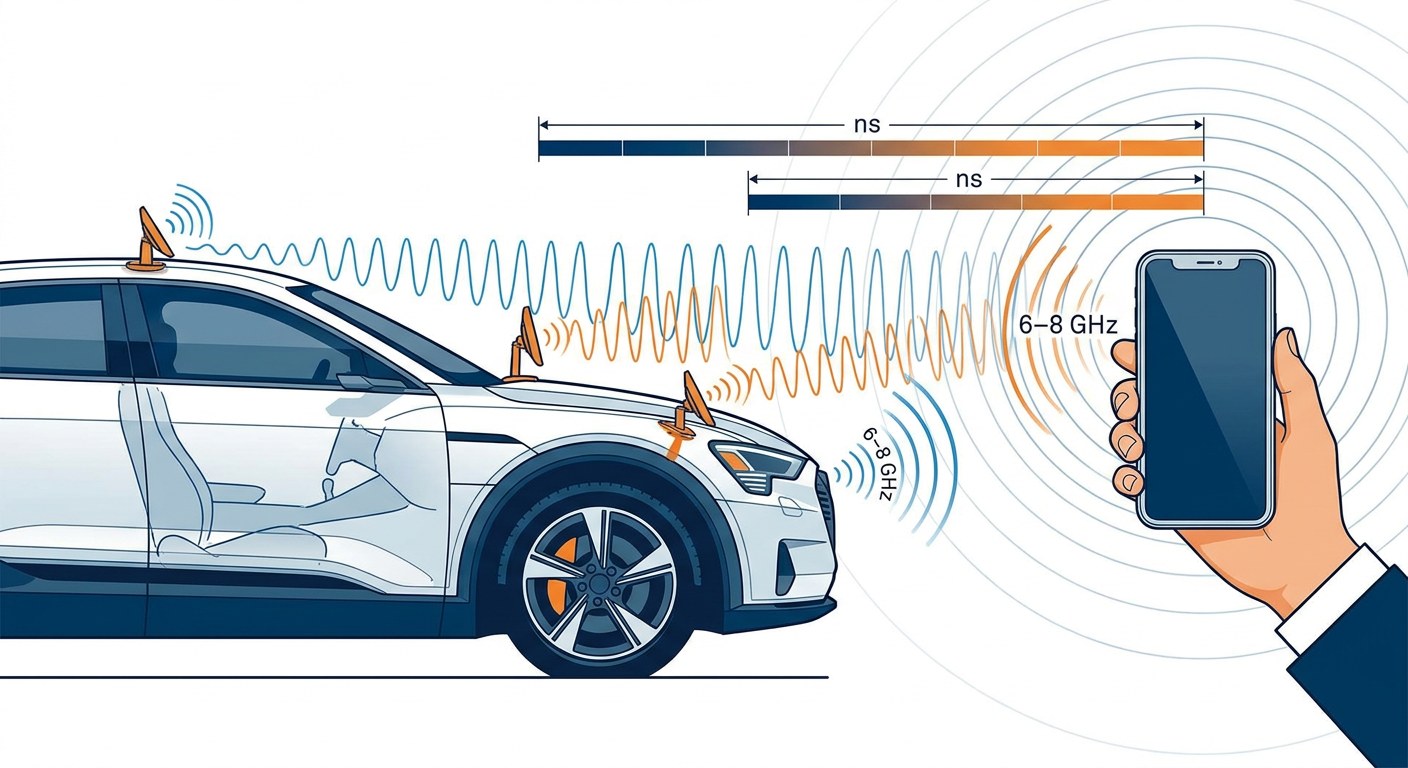
The alternative is measuring time of flight. Light and radio waves travel about 30 centimetres per nanosecond; if the car can measure the round-trip delay to within two nanoseconds, it gets a distance accurate to tens of centimetres. And amplification is useless to a repeater: any retransmission adds latency, and that latency translates directly into extra metres.
The arithmetic is simple: the car sends a pulse, the fob receives it, waits a known processing time and answers. The car subtracts that fixed time from the total delay and divides by two. The key point is that the processing time must be bounded and verifiable: if the reply arrives after the maximum allowed for the required range, it is rejected outright. This scheme is known as distance bounding.
Two-nanosecond pulses
Bluetooth or Wi-Fi cannot clock this: their signals are broad in time and their resolution is measured in metres. The answer is UWB (Ultra-Wideband), an impulse radio that emits trains of two-nanosecond pulses across 499.2 MHz channels inside the 6 to 8.5 GHz band in Europe. A radio’s theoretical resolution is inversely proportional to bandwidth — on the order of 30 centimetres with 500 MHz — and with leading-edge detection and averaging over several pulses it drops to about 10 centimetres.
Because the pulses are extremely short and the duty cycle very low, their average power sits below the noise floor of other systems: UWB can coexist with Wi-Fi and mobile telephony without interfering. The price is range, limited to tens of metres and highly dependent on line of sight.
The sequence that cannot be jumped ahead
Timing is not enough if an attacker can predict the pulse and answer before receiving it. That trick is known as a cicada attack and it worked against early implementations: if the challenge pulse is always the same, you can simply broadcast the answer blind and “shorten” the distance artificially.
The IEEE 802.15.4z standard, approved in 2020, added the STS (Scrambled Timestamp Sequence): a pseudorandom sequence of thousands of chips generated with AES-128 in counter mode from a key derived during the preceding exchange, inserted into the physical layer itself. A receiver only gets a correlation peak if it knows the exact sequence for that exchange and that instant. A repeater can copy the signal, but it cannot get ahead of it or forge it without the key — and every session uses a different sequence.
Four antennas and an angle
Distance alone does not settle everything: what matters is where the key is. Cars carry between four and six UWB antennas across bumpers, mirrors and console. By comparing the arrival phase of the same pulse at several antennas — phase difference of arrival, PDoA — the angle is computed, and two or more pairs give a three-dimensional position. That allows zones to be defined: welcome at two metres, unlock at one and a half, engine start only if the key is inside the cabin, and boot lockout if the phone was left on the seat.
Bluetooth discovers, UWB measures, NFC rescues
In practice no system relies on a single radio. The CCC Digital Key 3.0 specification, from the Car Connectivity Consortium — with carmakers, Apple, Google and the big automotive suppliers involved — uses Bluetooth Low Energy for discovery and pairing, UWB for ranging and localisation, and NFC as a fallback when the phone is out of battery or the antenna is covered. Keys live in a secure element in both phone and car, can be shared with a relative or a workshop, and are revoked from the manufacturer’s cloud.
What still breaks
UWB is not magic. The human body absorbs part of the band, the vehicle’s own metal creates multiple reflections, and in a car park full of pillars the signal bounces. Receivers apply time windows to keep the first wavefront and discard echoes, but an attacker with laboratory-grade equipment still has room: the literature describes distance-reduction variants that exploit the preamble and fine synchronisation. Hence the standard makes STS mandatory and manufacturers add motion and behavioural checks.
The same technology that opens the car sits behind the precise finding of AirTag-style trackers or smart locks: a two-nanosecond pulse, a stopwatch that forgives nothing, and a sequence that changes on every attempt. The next time the car unlocks itself only when you are a metre and a half away, remember that it has not recognised you: it has measured you.