
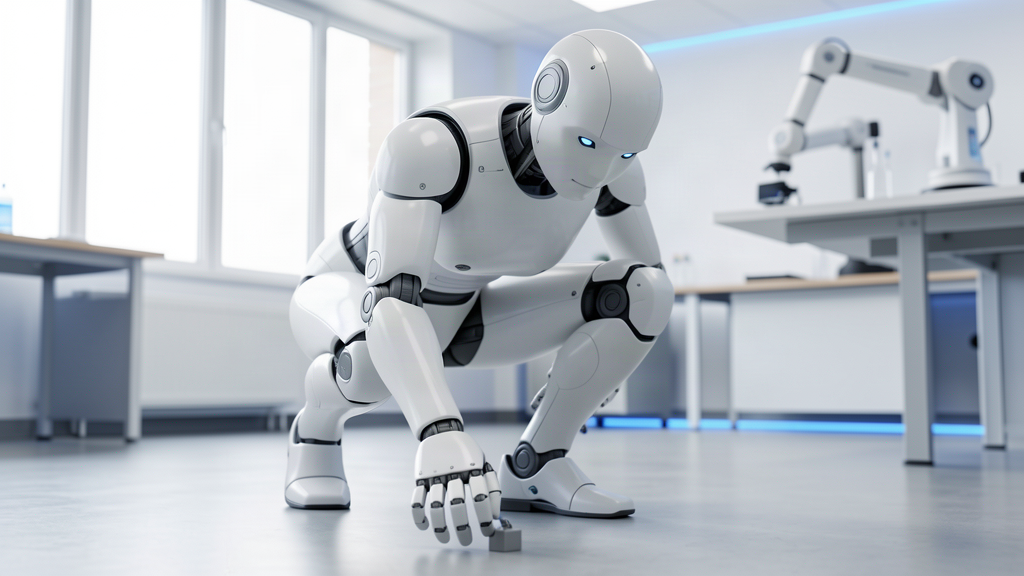
For decades, humanoid robots have been a half-promise: machines capable of walking on a stage, but incapable of entering a messy room and starting to tidy it up. Google DeepMind has just taken a step to close that gap. The company has presented Gemini Robotics 2, a new family of models that, for the first time, controls a robot’s entire body: from the feet to the fingertips.
The announcement, signed by Carolina Parada, head of robotics at DeepMind, describes the system as “the intelligence layer that powers the next generation of truly adaptable robots”. The difference from previous versions is not cosmetic: until now, Gemini Robotics governed the upper body —arms, hands, vision— while the legs and balance were handled by classic controllers programmed separately. Now everything hangs from a single learned policy.
Three models for one brain
DeepMind has not released one model, but three pieces that fit together:
Gemini Robotics 2
This is the VLA (vision-language-action) model: it translates what the robot sees and what it is told into concrete motor commands. It is what makes it possible to control full humanoids and dual-arm robots, both with five-finger hands and with conventional grippers.
Gemini Robotics ER 2
The embodied reasoning model. It acts as the planner: it talks with people, understands the physical world, breaks down multi-minute tasks into steps and —the most striking novelty— coordinates several robots working as a team on a single assignment.
Gemini Robotics On-Device 2
The lightweight version, designed to run on the robot’s own hardware, without a cloud connection. DeepMind says it adapts to completely new robotic bodies with just a few hours of data, something that until now required weeks of retraining.
The numbers: neither magic nor smoke
The most interesting part of the announcement is that Google publishes its success rates without polishing them. The tests were carried out on three different bodies —the Apollo 2 humanoid from Apptronik with SharpaWave hands, the same Apollo with Inspire hands, and a Franka Duo with a Robotiq gripper— using the model’s same control point, without retraining for each machine.
In whole-body manipulation, Apollo manages to pick an object off a shelf 76.3% of the time, off a table 68.4% and off the floor only 45.7%: bending down without losing balance and getting it right remains difficult.
Five-finger dexterity is where the system shows its seams. Unscrewing a light bulb works in 92% of attempts, but screwing it back in drops to 36%. Tying a garbage bag stands at 44%, closing a ziplock at 40% and sweeping with a dustpan at 32%. By contrast, with a simple gripper the figures rise: precision insertions at 89.6% and tool-kit preparation at 78.9%.
The reading is clear: the problem is no longer that the robot does not understand the task, but that the hand is still not up to the level of the brain. DeepMind itself acknowledges that “multi-finger manipulation remains a challenge”.
Why it matters beyond the lab
The technical detail that carries the most weight in the medium term is transfer between bodies. Until today, each manufacturer trained its robot from scratch: what one industrial arm learned was of no use to a humanoid. If a single model can pilot an Apollo, a Franka and, in a few hours, a machine it has never seen, robot development stops being a craft and starts to look like software.
DeepMind cites Apptronik, Boston Dynamics and Agile Robots as partners, three names that point directly at the factory and logistics rather than the living room. Apptronik celebrated the launch, calling it a “huge leap” upon seeing Apollo 2 solve whole-body tasks with advanced reasoning.
Still, expectations should be tempered. A 45% success rate picking things up off the floor is not enough for a home environment, where failure has consequences. What does fit is the repetitive, supervised industrial scenario, with humans nearby correcting. Gemini Robotics 2 does not put a butler in the hallway, but it does mark the moment when robot software begins to travel between different bodies. And that, historically, is the change that precedes scale.