

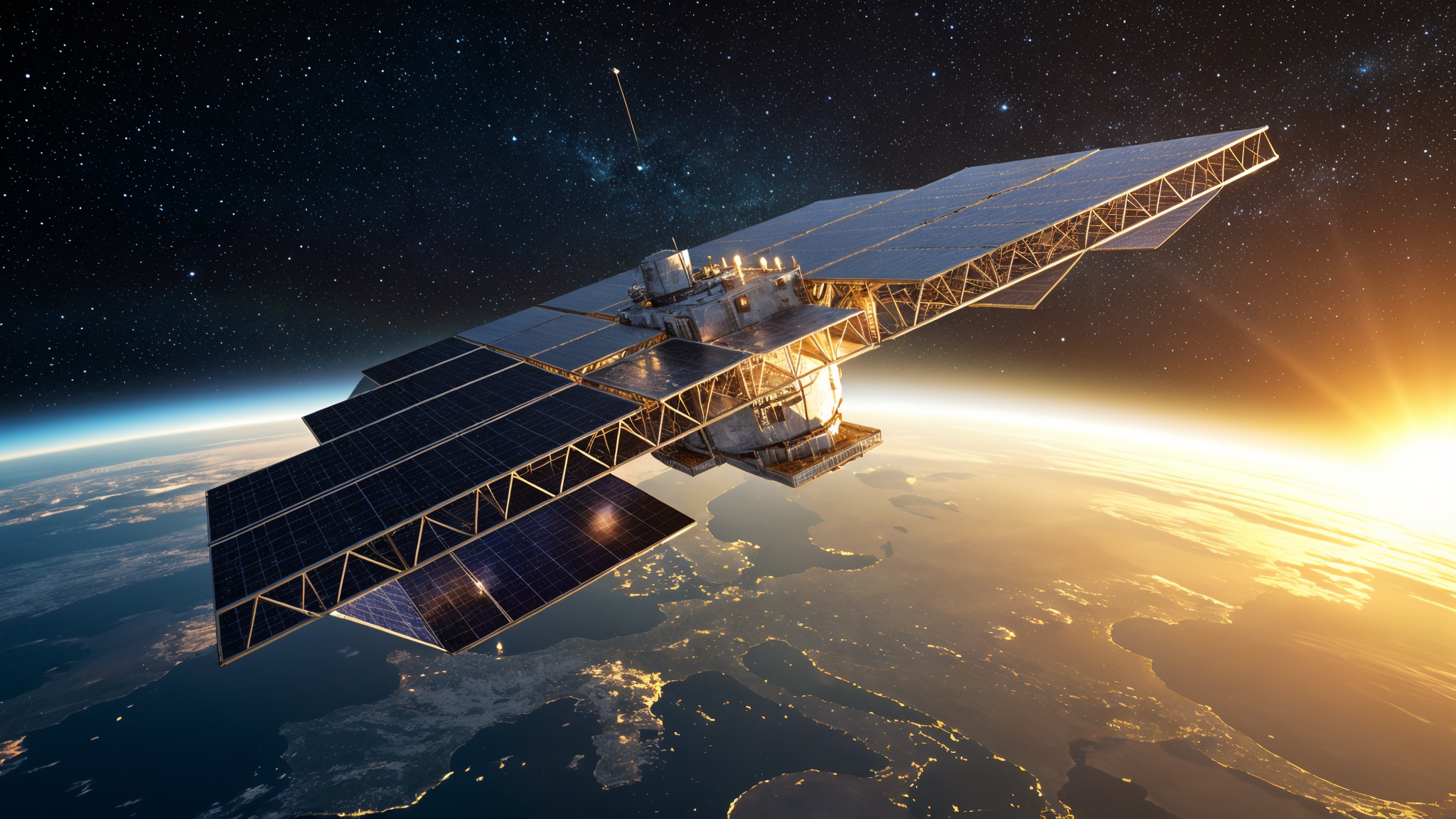
Your mobile will have signal even where there is no coverage: the new satellites that will make it possible
Imagine you are in the middle of a mountain, in a village with no coverage or out at sea, and your phone still has bars to call or text. Until now that was impossible. But it is about to change.
In early August 2026, the American company AST SpaceMobile launched three new satellites into space, numbers 11, 12 and 13 of its BlueBird fleet. Its rocket, a Falcon 9 from the company SpaceX, took off from Florida at 3:49 in the morning (US East Coast time) and left them in orbit a few minutes later.
It is not their first launch: the company had already put other groups of satellites into space before. But each batch brings closer a dream that until recently seemed like science fiction: that your ordinary mobile phone connects directly to the sky.
What is special about what is happening?
To understand it, think about how your phone works today. When you call or browse, your mobile sends the signal to a nearby antenna, usually on a tower installed on a rooftop or by the road. That antenna forwards your call until it reaches its destination.
The problem is that those towers are not everywhere. If you go deep into the countryside, the mountains or the sea, there comes a point when there is no antenna nearby. And without an antenna, there is no signal. It is like if the light in a room depended on a single bulb: when you move away from it, you are left in the dark.
What AST SpaceMobile wants to do is different. It wants there to be «bulbs» in the sky. Its satellites, which carry huge antennas, can capture the signal of a normal phone directly, without you needing any extra device.
A giant antenna in space
The key is in the size. Each of these satellites, once deployed, has a communication antenna of about 2,400 square metres. To give you an idea, that is roughly half a football pitch. It is the largest commercial antenna ever put into orbit.
That size is what allows it to ¬hunt down» the weak signal of a normal phone from hundreds of kilometres up. It is the difference between listening to a whisper from far away (which needs a very fine ear or getting very close) and being able to hear it from far away because you have a huge ear.
The company manufactures these satellites on an assembly line, like in a car factory. In fact, its boss explained that they already have production running up to satellite number 42. And the next three, numbers 14, 15 and 16, are already ready to be launched shortly after.
What is this useful for in real life?
The advantages are many and very practical:
Safety. If you get lost on a mountain trail or break down on a quiet road, being able to call for help can save lives. Today, in those areas, your mobile is useless.
Work and communication. People who live or work in small villages, on fishing boats or in rural areas could always be reachable.
Travel. You could go to a remote place on holiday and still be able to let people know you arrived safely, without depending on finding somewhere with coverage.
Besides, you would not need to buy a new phone or any special gadget. The idea is that it works with the mobile you already have in your pocket.
When will it reach our daily lives?
There is still a wait. The company is gradually building its satellite network, and enough satellites need to be in the sky for the service to be reliable and continuous. The path is already advanced, but it is not going to happen overnight.
You also have to count on each country’s permission to provide service on its territory. As with any big project, it will have to go step by step.
The conclusion
That a normal mobile connects directly to a satellite means one very simple thing for you: that one day, not too far off, the phrase «no signal here» could cease to exist.
It is a huge step for the whole planet, because there are still millions of people living in areas where having signal is impossible today. If these satellites deliver what they promise, that «hole» in the communications map will start to close.