
You have probably heard that quantum computers are going to solve everything: crack any password, discover impossible drugs, simulate the entire universe. Part of that is true. But it is worth separating reality from the hype, because quantum computing is one of the most fascinating and, at the same time, most misunderstood technologies of our time.
To understand it, forget for a moment about zeros and ones. All the computing you know is based on bits: units that can only be 0 or 1, like a switch turned on or off. It is powerful, but it has a limit: to solve a problem with many possible combinations, the computer ends up testing them one by one. And there are problems where those combinations are so numerous that not even the world’s best supercomputer would finish them in a thousand years.
What is a qubit?
Here comes the star of the story: the qubit. Unlike a normal bit, a qubit can be in both states at the same time thanks to a physics phenomenon called superposition. It is not that it “thinks” in 0 and 1 alternately: it is in both states simultaneously. It sounds like magic, and partly it is.
But there is a nuance that almost no one explains. You cannot simply read that information without the qubit “settling” into a specific state; that is what is called collapse. The trick is not in trying everything at once, but in combining many qubits so that probabilities add up where it matters and cancel out where it does not. That is what physicists call quantum interference, and it is what allows an algorithm to reach the correct answer without checking every option one by one.
What it can do and what it cannot
This is important: quantum computers are not “faster” computers for everything. For sending an email, editing a video or gaming, your laptop would run circles around them. Their advantage is very specific and is concentrated on problems with a gigantic number of possible combinations.
That is where they shine. For example, simulating molecules to design new drugs and materials, optimizing delivery routes, investment portfolios or supply chains, and performing certain cryptographic calculations that today are simply unfeasible. These are problems that would take a classical computer an eternity and that a quantum one solves in seconds or minutes.
Real machines, but fragile
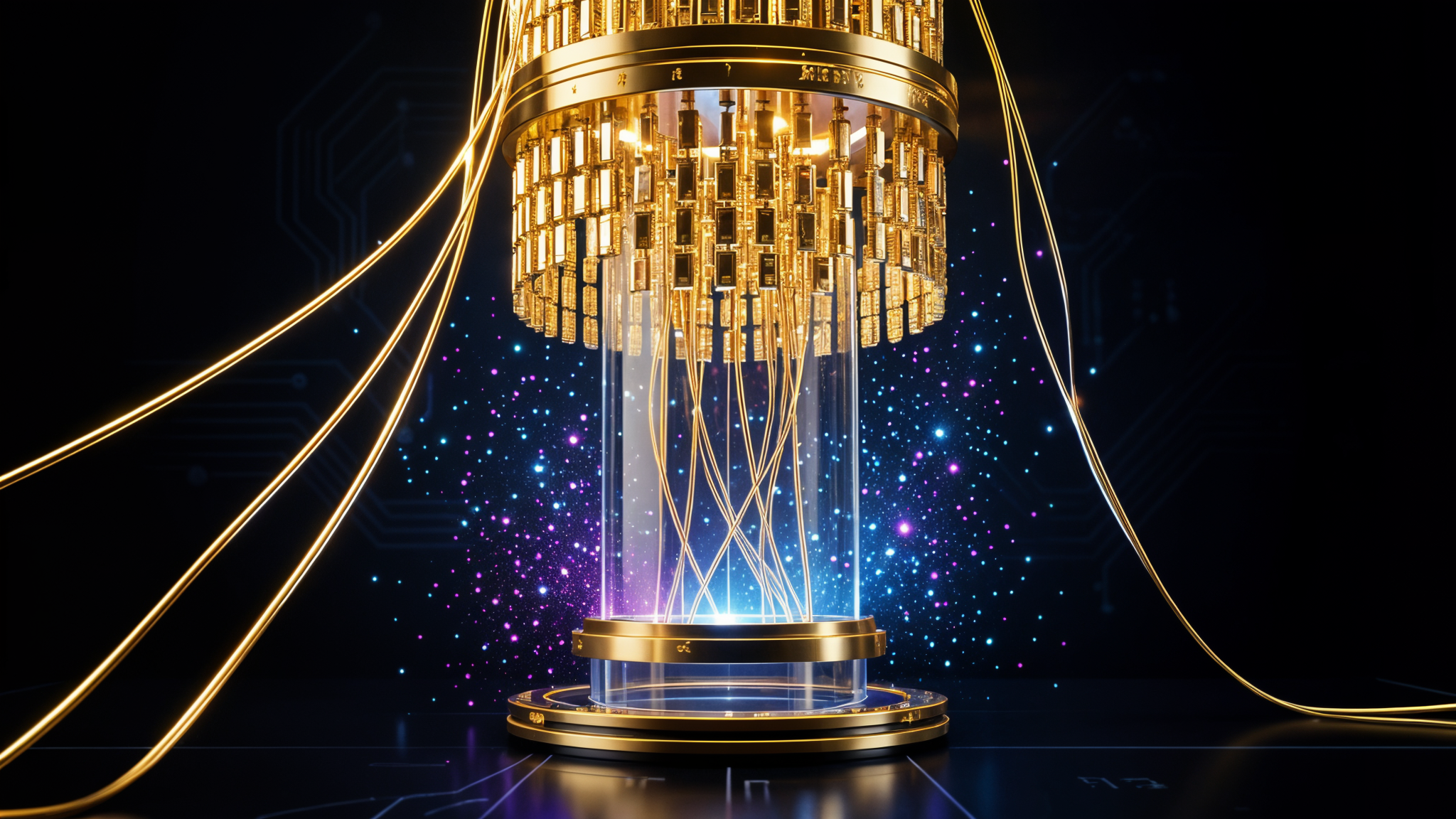
This is no longer theory. IBM, Google and several companies have working quantum computers that can be accessed over the internet. Researchers already use quantum simulations to study batteries, new materials and drugs. But these machines are extremely delicate.
Qubits are extremely sensitive. Any vibration, heat or magnetic field destabilizes them in the blink of an eye: that is what is called decoherence, and it corrupts the calculations. That is why they are cooled to temperatures colder than outer space and locked in shielded chambers. That is also why, today, dozens of physical qubits have to be combined to form a single reliable “logical qubit”. This is the noisy era, which experts call NISQ, and the medium-term goal is to achieve truly error-tolerant machines.
Why it will not replace your phone
You may be wondering whether one day you will have a quantum computer at home. The short answer is no, and that is fine. An airplane does not replace a bicycle: each tool serves its purpose. The same happens here: your phone will remain perfect for everyday tasks, and quantum computers will live in data centers, solving the problems that no classical computer can touch.
The quantum revolution will not be a product you buy in a store. It will be silent and will arrive hidden inside the servers of pharmaceutical companies, banks, research centers and logistics firms. But we will all feel its effects: new drugs, longer-lasting batteries, more efficient routes and a cybersecurity that will have to reinvent itself to withstand its power.
When will it truly arrive? Experts prefer to talk in decades rather than years. But the path is already set, and every advance makes clear that, when quantum computing matures, it will change the way humanity solves its most difficult problems.