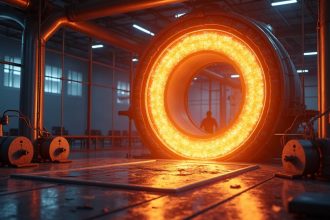


The Sun has been burning for five billion years without going out. It does not burn like a bonfire: it fuses hydrogen nuclei to turn them into helium. Every second it turns four million tons of matter into energy. Replicating that process on Earth is the dream of clean energy, and science has been one step away from achieving it for decades. Why is it so hard and why is it worth it?
Fusing atoms is not easy. Nuclei have a positive charge and repel each other. To bring them close enough for them to fuse requires a temperature of about 150 million degrees, ten times more than the center of the Sun. At that temperature, matter turns into plasma, a gas of charged particles, and keeping it confined without it touching the reactor walls is the great challenge of physics.
There are two main paths. The first is magnetic confinement: gigantic magnetic fields that trap the plasma in a doughnut shape inside a reactor called a tokamak. This is the approach of the international ITER project, which has been under construction in France for years, and of private companies such as Commonwealth Fusion Systems, which has already achieved magnetic field records. The second is inertial confinement: firing ultra-high-power lasers at a small fuel capsule to compress and heat it in fractions of a second. This is the path of the National Ignition Facility, in the United States, which in December 2022 managed for the first time to produce more energy than the laser injected.
The promise is enormous. The fuel, deuterium and tritium, is obtained from seawater and lithium, so there is no scarcity or dependence on specific countries. Fusion emits no carbon dioxide, leaves no long-lived radioactive waste and cannot suffer a meltdown accident: if something fails, the plasma cools and goes out on its own. A single gram of fused fuel releases the energy of about ten tons of coal.
The advances of recent years have changed the tone of the debate. For decades, fusion was the classic “always thirty years away”. But the recent milestones — the NIF ignition, the plasma records of European tokamaks, the private money that has flowed into dozens of startups — have shortened the timelines. Several companies promise to connect a reactor to the electricity grid in the 2030s. ITER, more conservative, aims to demonstrate net energy production by the end of that same decade.
There remain serious engineering challenges. Keeping a reactor running continuously for months, extracting the energy without damaging the materials, and getting the tritium — scarce and radioactive — to be produced inside the reactor itself. Fusion is not going to solve the climate crisis overnight, and while it arrives, renewables and storage remain the main path. But if it is achieved, it would change the rules of the game: abundant, cheap and clean electricity for everyone.
Humanity’s path toward fusion is not a laboratory whim. It is the same energy that moves the stars, and taming it would be like having a small Sun in every plant. There is work left, but the goal no longer seems like science fiction: it is a matter of engineering and time.