Imagine being able to manufacture an object at the press of a button. Not buying it in a shop or ordering it online, but “printing” it at home, like printing a document. That is what 3D printing promises, a technology that for years has been ceasing to be a laboratory curiosity and becoming a real tool that is increasingly present in our lives.
What exactly is a 3D printer?
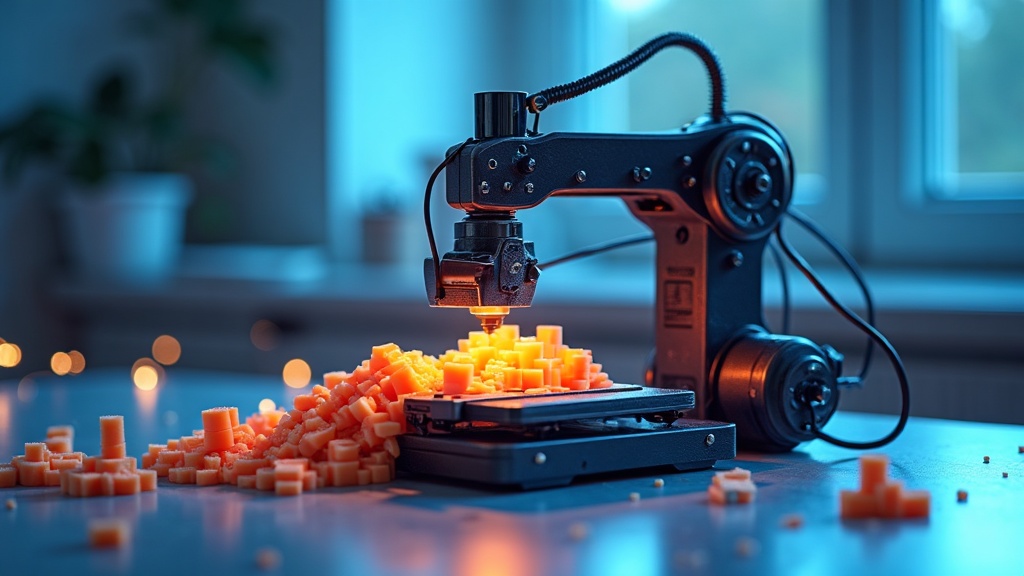
A 3D printer does not print ink on paper: it builds physical objects, layer upon layer. It works as if you were stacking very thin slices of a material until the complete object takes shape. That is why it is called “additive manufacturing”: instead of removing material from a block (as a milling machine does), it is added little by little until the desired part is achieved.
The starting point is a digital design created on the computer. That file is divided into thousands of horizontal slices and the printer reproduces them one by one. The result can be a plastic part, a spare tool, a model or even a replacement part for your washing machine.
The materials: no longer just plastic
Plastic was the first big protagonist, and it is still the most common. But the list has grown enormously: there are printers that work with resins, metal, ceramic and even special materials such as carbon fibre. Each material has its own trick, from those that melt with heat to those that harden with light.
This variety is the key to the technology having left the hobbyist’s garage. Today, everything from racing car parts to aircraft components is printed, as well as surgical implants made to measure for each patient.
Control systems: the brain of the machine
A modern 3D printer is, at heart, a machine governed by software. The algorithms calculate the path of the print head, monitor the temperature, adjust the speed and detect errors before they ruin the part. The more precise that “orchestra of code” is, the better and stronger the objects that come out of it will be.
It is this combination of hardware and program that allows increasingly complex prints with minimal tolerances, capable of creating parts that would be very difficult or expensive to make by traditional methods.
What is it really used for today?
Although home 3D printing remains a great hobby, the most impressive uses are in industry and medicine. Doctors print exact replicas of organs to practise before an operation, and personalised prostheses and implants are already being manufactured for each person. In construction, there are teams that print entire houses in a few days. And in space, agencies are studying how to print tools and spare parts without having to bring them from Earth.
It is also revolutionising shops: there are brands that print shoes, spectacle frames or spare parts only when the customer orders them, reducing warehouses and waste.
Advantages: less waste and more customisation
One of its great virtues is the saving of material. By manufacturing only what you need and in the exact quantity, far less waste is generated than with classical methods. In addition, it allows total customisation: each part can be unique and adapt exactly to whoever is going to use it, something impossible in a traditional assembly line.
For many small businesses and creators, it is also a gateway: you can design and launch a product without needing enormous factories, just with a printer and good design.
The challenges that still remain
Challenges remain to be solved. Speed is still slow for mass production, and some materials are expensive or difficult to handle. There are also doubts about the durability of certain printed parts and their recycling. And legally, issues such as the printing of weapons or counterfeit products force clear rules to be established.
A factory that fits on a table
3D printing represents a fundamental change in our relationship with objects: instead of consuming what others mass-produce, we are increasingly closer to being able to manufacture what we need, when we need it. It will not replace industry, but it is putting in our hands a capacity that only large factories had before.
The future, probably, will not be a world where everything is printed at home, but one where 3D printing coexists with traditional manufacturing and contributes exactly what the latter cannot: speed to test an idea, precision for a made-to-measure prosthesis and the possibility of creating objects that would be impossible any other way.