

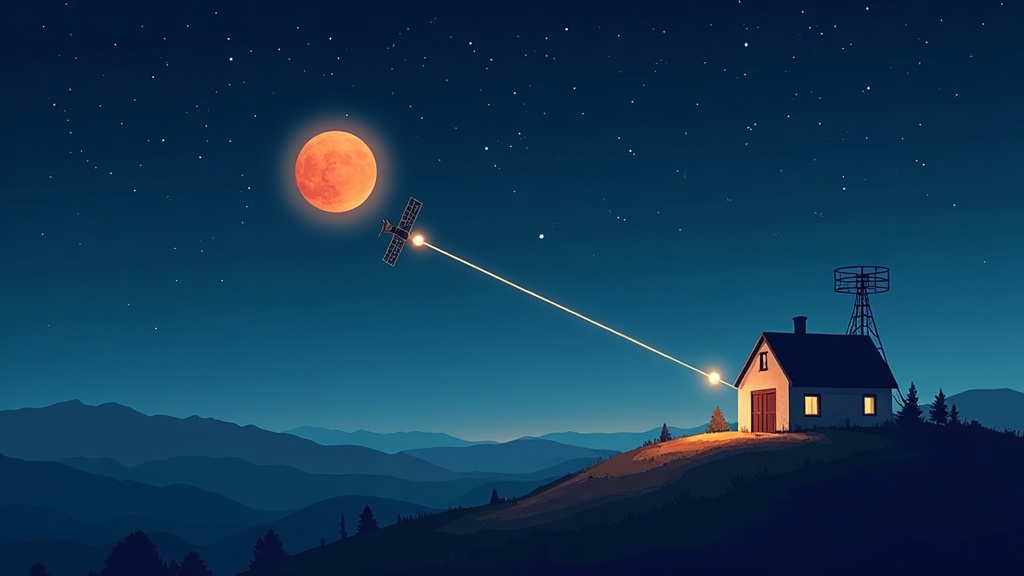
There are towns where fibre optics will never arrive, mountains without coverage and ships lost in the middle of the ocean. For all of them, the cable is not an option. The solution is not buried underground, but travels hundreds of kilometres up: they are the satellite constellations that are bringing internet to every corner of the planet.
From the giant satellite to miniature swarms
Communication satellites are not new. For decades they have transmitted television, telephone and data signals. But they were big, expensive and so far from the Earth —about 36,000 kilometres— that the signal took a while to arrive and the delay was noticeable. They served to connect continents, not to give wifi to a house.
The idea that changed everything was simple and radical at the same time: instead of a few enormous satellites, launch thousands of small satellites much closer to the ground, at around 500 to 1,200 kilometres. That swarm, coordinated as a network, is what we now call a constellation. Companies such as SpaceX, with its Starlink network, have turned this idea into a reality already in use in dozens of countries.
Why does being closer change so much?
Distance matters because light and radio signals travel at a maximum speed: the speed of light. The further away the satellite is, the longer each message takes to go and come back, which is felt as delay or latency. A satellite at 36,000 kilometres can take more than half a second to answer, which is annoying for a video call or an online game.
By bringing the satellites closer, that delay collapses to values similar to those of a fibre connection. The signal travels less distance, so the experience becomes much more fluid. That is why these networks are not just for having “some internet”, but for having real internet, fast and stable, in places where it was previously impossible.
This is how your data’s journey through space works
When you request a web page from a house in the middle of the countryside, the story is as follows: a small antenna on your roof, the size of a pizza, points at the satellite passing right overhead. That satellite receives your request and forwards it to another satellite or sends it down to a ground station connected to the internet. The response makes the return trip.
The tricky part is that the satellites are not still: they move quickly around the Earth, completing an orbit in a little over an hour. That is why so many are needed. When one disappears over the horizon, another is already arriving to take over. The software decides at each moment which satellite your antenna will use, as if it were changing “towers” invisible in mid-flight.
Whose life does it really change?
The great beneficiary is whoever lives far from the cities, where laying cables is very expensive or simply impossible. In rural areas, on ships, in aircraft or in emergency deployments after a natural disaster, this technology makes the difference. It has also been key to connecting schools, clinics and businesses in regions that had always been left off the digital map.
It is not a promise for the future: millions of people and businesses are already connected by satellite today, from farmers checking the weather to remote communities that can finally telework or study online.
Lights, shadows and what is to come
Not everything is advantages. Launching thousands of satellites has an environmental and economic cost, and some scientists worry about “space traffic”: more objects in orbit means more risk of collisions and more space debris. There is also debate about the brightness of these satellites, which can interfere with observation of the night sky.
Even so, the pace does not stop. The constellations grow, the antennas get cheaper and more and more fit inside a car or a backpack. The race to connect the planet from the sky is no longer a science-fiction idea: it is a network that, literally, wraps around the Earth.
A network that borders the planet
Satellite internet will not end fibre optics, which will remain the best option in cities. Its great contribution is reaching where the cable does not, and doing so with a quality that until recently seemed reserved for large cities. In the end, the story of these constellations is the story of a simple goal: that the connection stops depending on where the antenna is born and starts to be, simply, in everyone’s sky.