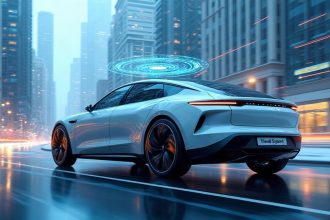

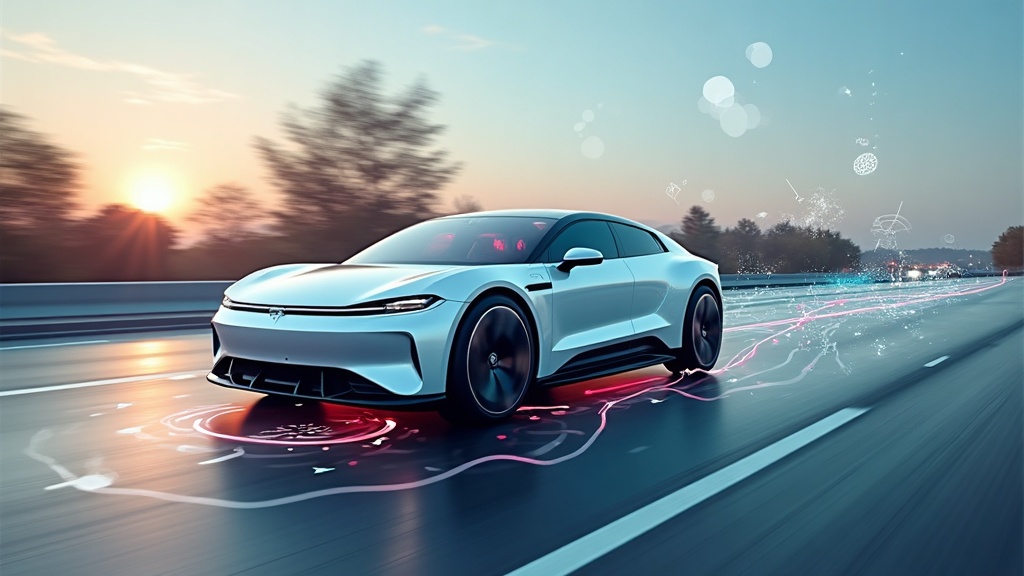
Imagine getting into your car, telling it where you want to go and never touching the wheel again. The vehicle accelerates, brakes, turns and dodges obstacles on its own. It is no longer science fiction: autonomous cars are driving around in many cities around the world and the technology is advancing faster than we think.
But how does the car “see”? How does it know that a pedestrian is about to cross or that there is a bicycle hidden behind a truck? The answer is a combination of sensors, cameras, maps and, above all, artificial intelligence.
The car’s eyes: sensors and cameras
An autonomous car does not have a single eye, but several. It carries cameras that capture the colour and shape of what surrounds it, as a human driver would. But cameras have a limit: they fail with fog, heavy rain or when there is little light.
That is why the vehicles add other sensors. Radar, the same system used by aircraft, measures the distance to moving objects. And the laser, called LiDAR, fires millions of light pulses per second to build a three-dimensional, highly accurate map of the surroundings.
Together, these senses form a complete picture of the road, the cars, the signs and the people, even in difficult conditions.
The brain: artificial intelligence
Having data is not enough if no one interprets it. This is where the key role of artificial intelligence comes in. The car does not follow a fixed script: it learns. Engineers train the algorithms with millions of driving situations, both real and simulated.
From seeing so many examples, the system learns to distinguish a pedestrian from a sign, to predict whether a car is going to change lanes or to brake in time in the face of an unexpected event. It is continuous learning: every kilometre driven in the real world serves to improve the behaviour of the whole fleet.
Levels of autonomy
Not all cars “drive themselves” the same way. Experts distinguish five levels. At level 1, the car only controls one thing, such as speed. At level 2, which we already see in many modern cars, it combines speed and steering, although the driver must keep their hands on the wheel.
From level 3 onwards, the car can drive on its own in certain situations, but the human must be ready to take back control. And only at levels 4 and 5 is the vehicle capable of driving without human intervention, first in limited areas and, eventually, anywhere.
The challenges that remain ahead
The technology is advancing, but there are still obstacles. The biggest is not technical, but human: getting people to trust that a computer drives better than a person. There are also legal doubts, such as who is responsible in the event of an accident, and ethical dilemmas, such as what decision the car should make in a situation with no clear way out.
Even so, experts agree that autonomous cars promise safer roads, fewer traffic jams and greater mobility for those who cannot drive. It is a revolution that is approaching step by step, even if we do not see it moving.
The future of driving is getting closer every day. And perhaps, sooner than we think, the phrase “set the destination and relax” will stop being a promise and become a routine.