

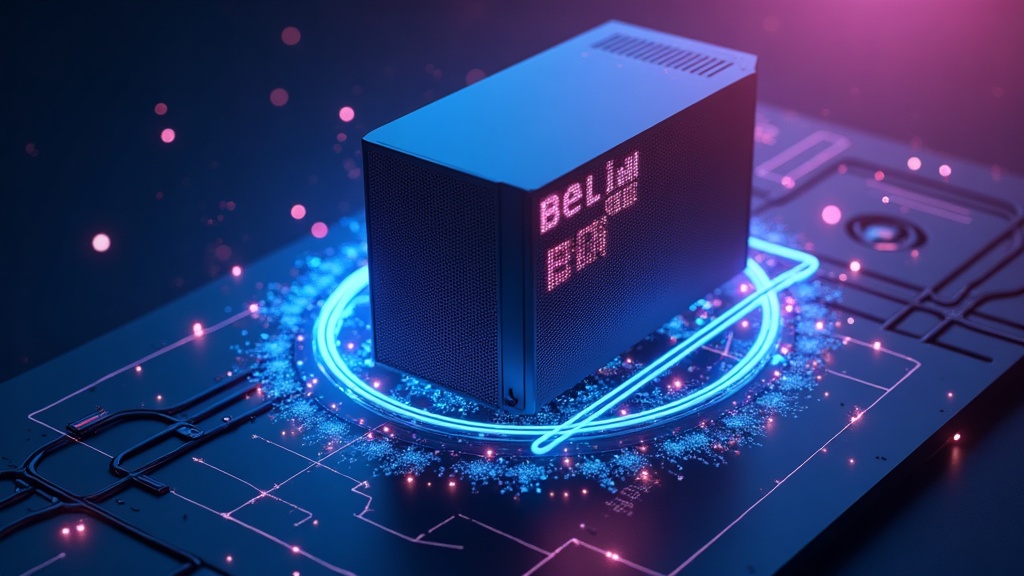
Did you know that the most powerful computer on the planet does not fit in a room, but in a need for almost laboratory-level cold? We are talking about the quantum computer, a machine that promises to solve in minutes problems that would take a traditional supercomputer centuries. It sounds like science fiction, but it is already a reality in the middle of a race among the big tech companies.
A computer that does not use ones and zeros
The everyday computer works with bits: minimal units of information that can only be a 0 or a 1. It is like a switch: on or off. Everything you do with your phone or laptop, however huge the sum, boils down to millions of these switches in action.
The quantum computer plays in another league. Instead of bits it uses qubits, which can be 0, 1 or a mixture of both at the same time. It is what physics calls superposition. Imagine a coin spinning in the air: it is neither heads nor tails, but a bit of both until you catch it. That is how each qubit behaves, and that is where all the magic lies.
Why so many at once is so powerful
The key is not in a single qubit, but in the fact that they work as a team. When you add qubits, the number of operations that can be done in parallel shoots up brutally: 2 qubits, 4 possibilities; 3 qubits, 8; and so on up to astronomical numbers. That is why these machines are so coveted: their power grows far faster than that of a classical computer.
That does not mean it will replace your laptop. To send emails or watch videos you do not need a quantum computer; it would be using a cannon to kill a fly. Its territory is the giant problems: simulating new molecules, optimising routes and networks, or cracking cryptographic systems. Things that today are impossible or would take too long.
The challenge: keeping it at almost -273 degrees
If it is so good, why do we not have one at home? Because it is incredibly delicate. Qubits break with any interference, such as heat or a vibration. To keep them stable they must be cooled to temperatures close to absolute zero, colder than outer space. That is why these machines live in giant golden tubes that look like they came out of an art gallery.
Moreover, today they are full of errors. Writing the code that controls them is a first-class mathematical challenge, and companies such as IBM and Google are investing billions in correcting those faults. They are not yet general-purpose machines, but experimental laboratories in constant evolution.
When will it reach your life?
You will not see it on your desk, but you will notice its effects. Banks are already researching how to protect your data against these computers, pharmaceutical companies want them to speed up drug discovery and logistics companies plan to use them so that your packages arrive sooner. The next time an aeroplane optimises its route or a new material is stronger, perhaps a quantum computer lent a hand in silence.
The quantum revolution does not ask permission: it arrives slowly, among golden cables and degrees below zero, but when it arrives it will change everything.