
There is a number almost nobody has seen that nonetheless sets the pace of millions of objects we carry: 32,768. It is not a round figure in decimal, nor a famous physical constant. It is simply two to the fifteenth power. And that arithmetic coincidence — not a physical one — explains why a wristwatch can count seconds for years on a button cell.
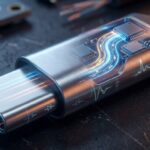
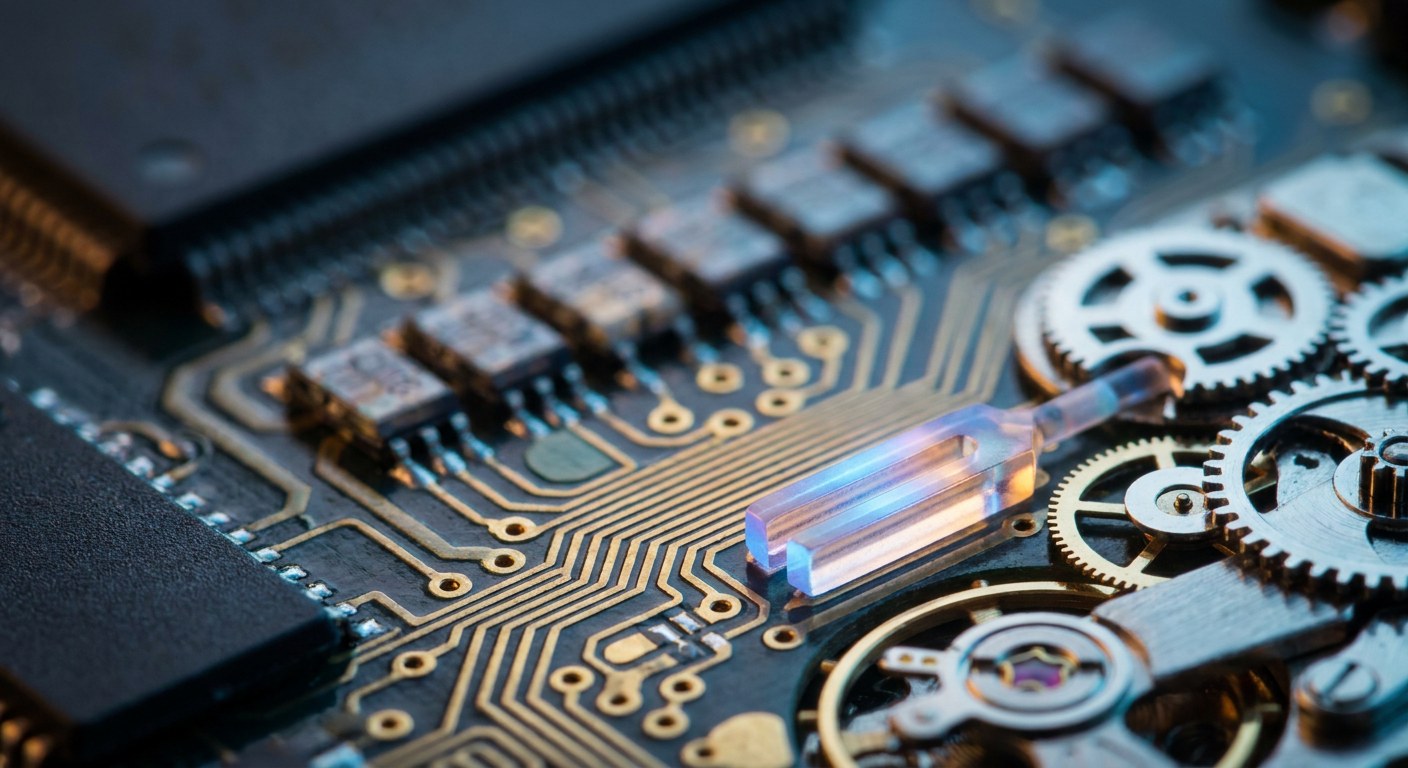
Inside the case, behind the dial, sits a quartz slab the size of a grain of rice cut into the shape of a tuning fork. It does not spin, it does not rub, it has no gears in the classic sense: it vibrates. Everything else in the watch — hands, date wheel, chronograph — hangs off that vibration.
A quartz tuning fork the size of a grain of rice
Quartz is crystalline silicon dioxide, and it has a property that holds up all of modern horology: it is piezoelectric. Deform it and electric charges appear on its faces; apply an electric field and it deforms. The two directions of the effect feed each other, and that is where an oscillator comes from.
The resonator in a watch is not a solid block but a tiny fork with two tines vibrating in opposition, one bending in while the other bends out. That flexural mode has its own mechanical frequency, fixed by the dimensions of the part and by the cut of the crystal: its orientation relative to the crystallographic axes. The usual watch cut is chosen, among other reasons, so that frequency changes as little as possible with temperature near 25 degrees Celsius.
The key is the quality factor. A well-made quartz fork has a Q in the tens of thousands: its resonance is so narrow that, once it is vibrating, the mechanical part sets the frequency, not the electronics driving it. It is the difference between a tuned bell and any loudspeaker. That is why the circuit can be cheap, mediocre and run at 1.5 volts and the watch will still keep time.
The circuit that makes it sing
Around the crystal there is very little: a CMOS inverter, a feedback resistor of several megohms that keeps it biased in its linear region, and two load capacitors, typically 6 to 12 picofarads, one on each side to ground. That pi-shaped network, together with the crystal, forms a Pierce oscillator. The inverter amplifies any initial noise, the crystal filters it and returns only its own frequency, and within milliseconds the loop locks.
Those two capacitors are not a detail: they are part of the frequency. Changing the load capacitance shifts the resonance by a few parts per million, the so-called pulling. Hence the manufacturer specifies the crystal for a given load capacitance (12.5 pF and 6 pF are the most common), and swapping a crystal for one with a different spec produces watches that gain or lose minutes a month with nothing actually broken.
Fifteen divisions by two
Here is the reason for the number. A digital counter divides by two with a single flip-flop: every edge of the input signal toggles the output. Fifteen flip-flops in a chain turn 32,768 pulses per second into exactly one pulse per second, with no comparators, no decimal counters and no adjustments. 32,768 is 215, so the division is exact and the logic fits in a chip costing pennies.
Had the frequency been 32,000 Hz — rounder to a human — it would need decimal counters, extra logic and a comparison stage; more silicon, more consumption and more places to go wrong. The industry did not pick the number for mathematical elegance but because the binary divider is the simplest digital circuit there is.
The other half of the decision remains: why that frequency and not another. A 1 Hz crystal would be a quartz bar of absurd dimensions for a wrist; at 32,768 Hz the fork is millimetres long and draws microwatts. And above that, every doubling forces a smaller, more fragile resonator that burns more power. 32,768 Hz is the point where the fork is still rugged, the button cell still lasts years and the division is still pure binary arithmetic. It settled with the first quartz wristwatches in the late sixties and early seventies, and it has not moved since.
At the divider’s output, the 1 Hz pulse drives a Lavet-type stepper motor: a magnet and a coil that advance one tooth per impulse. That is why quartz watches snap forward once a second, while a mechanical one beats four, five or eight times per second. It is not aesthetics: it is the output frequency of the counter.
Where the lost seconds come from
No quartz watch is perfect, and the error is measured in parts per million (ppm): one ppm is one microsecond per second, 0.0864 seconds a day. An ordinary wristwatch is specified at ±20 ppm, meaning up to 1.7 seconds a day, about 52 a month and a little over ten minutes a year. Good ones drop to ±5 ppm.
The errors do not come from the circuit but from the resonator itself:
- Temperature. The fork’s frequency follows a parabola with its vertex near 25 degrees. A typical coefficient of −0.035 ppm per degree squared means that at 40 degrees the watch drifts by around 8 ppm, and at 0 degrees by more than 20. Your wrist, at 30-odd degrees, is part of the error.
- Aging. The quartz mass and the electrodes change slowly over the years; a few ppm in the first year and less afterwards is typical.
- Load mismatch. If the circuit’s real capacitance does not match the value the manufacturer calibrated against, the watch starts with a fixed bias of several ppm.
- Shock and position. The fork is fragile and can be detuned; the vibration mode is also not fully immune to orientation, though far less gravity-sensitive than a mechanical balance wheel.
How it is corrected without touching the crystal
Compensation works by moving the frequency electrically, not mechanically. The classic answer is the TCXO: a varactor — a diode whose capacitance changes with voltage — is placed in series with the crystal, along with a thermistor network that generates the right correction voltage for each temperature. The quartz parabola is cancelled by an opposite curve, and the result falls to ±2 ppm or better across the operating range.
The modern digital version is cheaper: a microcontroller reads its own temperature sensor and switches a bank of internal capacitors, adjusting the load in fine steps. At the factory the error is measured at 25 degrees and the correction is written to memory. This is what computer RTCs do, with an important caveat: if the real-time clock is an RC oscillator instead of a crystal, it drifts by minutes a month, which is why good chips — a DS3231, for instance — integrate crystal and compensation in the same package and get down to ±2 ppm, about a minute a year.
A phone carries several clocks at once: the 32,768 Hz one for the RTC that keeps counting with the processor asleep, a TCXO in the tens of megahertz for the radio, and even better references for GNSS, which needs on the order of 0.1 ppm because one microsecond of error is 300 metres of position. None of them is used to “know the time” in the everyday sense: the network sets the time, and these oscillators only hold it between syncs.
Silicon alternatives exist, MEMS oscillators, with a micromachined resonator vibrating at tens of megahertz and divided down to the desired frequency. They survive shocks better and integrate with the rest of the chip, but they suffer more from phase noise and, in watchmaking, quartz still wins on cost, power and stability. After almost a century — the first laboratory quartz clock dates from 1927 — the 32,768 Hz fork is still the part holding the time of nearly everything we wear. When your watch loses a few seconds a month, nothing is probably wrong: it did its job, dividing by two, and the quartz noticed the cold.