
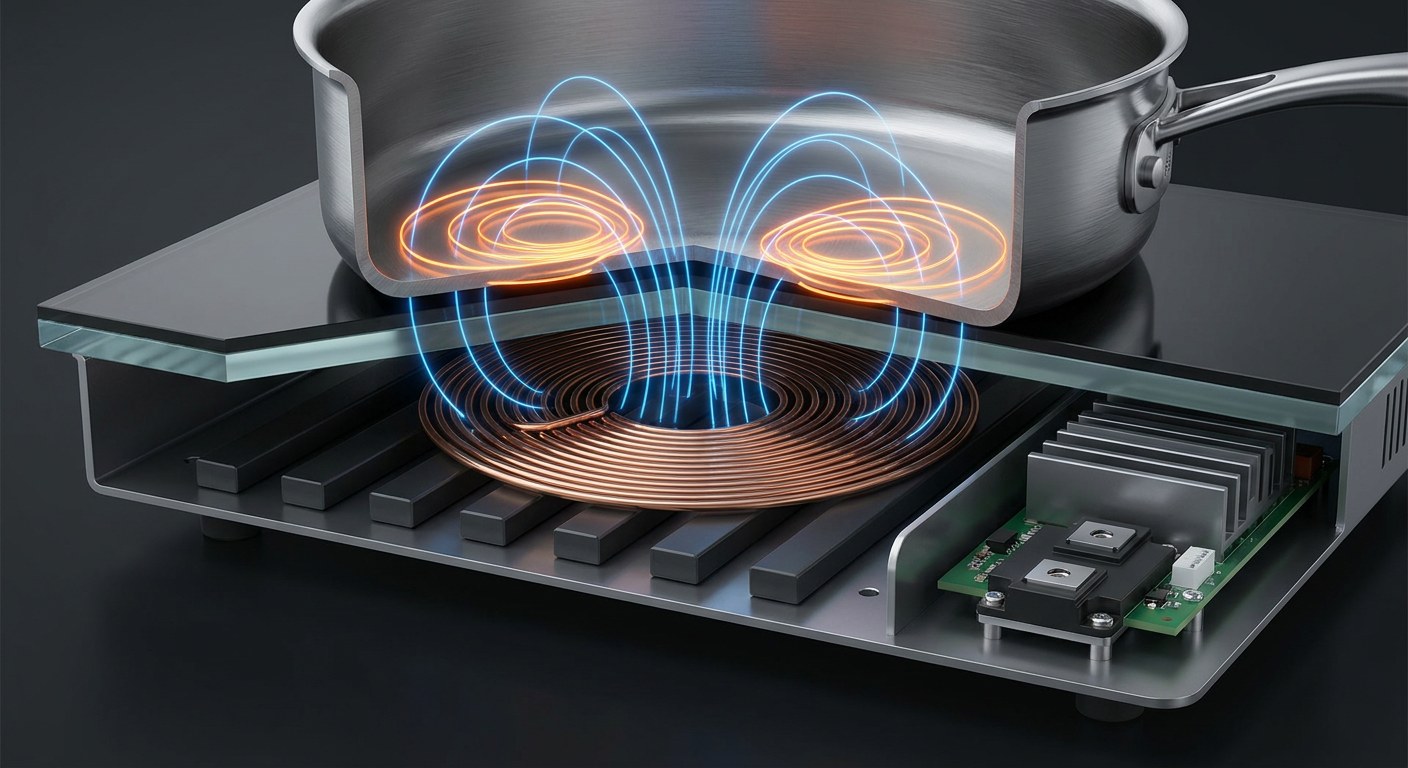
You put a cold pan on the glass, turn the knob, and ten seconds later the butter sizzles. The glass itself, if you touch it at the edge, is barely warm. There is no flame and no element glowing red: underneath there is only a spiral of copper. What heats up is the pan — because the pan is not the container of the heat, it is the resistor that makes it.
A transformer whose secondary winding is your cookware
Every zone of an induction hob hides a flat coil of Litz wire (many thin, individually insulated strands braided together so the current does not crowd onto the surface of the conductor). Below it sit ferrite bars that heat nothing: their job is to close the magnetic circuit and push the field upward, through the glass, instead of scattering it into the electronics.
Alternating current runs through that coil at a frequency far above the mains: typically between 20 and 40 kHz, with 25 kHz as the usual value. The magnetic field crosses the glass, which is a dielectric and practically transparent to it, and meets the base of the pan. That is where the trick happens: a ferromagnetic base behaves as a single short-circuited turn on the secondary of a transformer. The voltage induced per turn is only a couple of volts, but the resistance of that turn is tiny, so the current jumps to hundreds of amperes.
The power dissipated does not come from an added resistor but from the resistivity of the steel itself: P = I²R. At those currents, any fraction of a milliohm turns into kilowatts. And it is not spread across the whole base: because of the skin effect, the current concentrates in a very thin layer. Penetration depth δ = √(ρ / π f μ) drops to a few tens of micrometres in ferritic steel at 25 kHz, because the magnetic permeability of iron amplifies the effect. The heat is born, literally, in the first tenth of a millimetre of metal; the rest of the base spreads it by conduction.
Why iron works and aluminium does not
This is the practical frontier of the technology. Aluminium conducts too well: its resistivity is about five times lower than that of carbon steel, and its relative permeability is 1, so it does not concentrate the field. The result: currents are induced, yes, but the dissipation is so low that the pan would barely notice, and the coil would run out of tune. Copper is even worse, for the same reason. A pure aluminium pan on an induction hob is not a malfunction: it is physics.
That is why “induction-ready” cookware carries a steel disc pressed into its base (the classic steel-aluminium-steel sandwich, with the aluminium in the middle to spread heat sideways). It is also why manufacturers do not settle for sensing alone: if the receiver does not qualify, they cut the power. A thin piece of metal such as a spoon or aluminium foil is also heated by induction and can catch fire, so the sensors must tell it apart from a real pan.
The resonant half-bridge: two switches and a capacitor
Generating kilowatts at 25 kHz is not done with an oscillator and a linear amplifier. The heart is a half-bridge inverter: two IGBTs (insulated-gate bipolar transistors, built to switch hundreds of volts and tens of amperes) or, in the newest designs, silicon-carbide MOSFETs. They alternate the DC bus voltage — rectified straight from the 230 V mains — across the coil and a resonant capacitor, which together form a series LC tank.
The key is that switching happens near the resonant frequency, not at some arbitrary rate. In that region the tank current lags the voltage and the inverter can switch with almost zero voltage across the device (ZVS, zero-voltage switching): switching losses fall and overall efficiency stays between 85% and 90%, well above the 60-65% of a resistive plate or a gas flame. The trade-off is that the coil sees tens of amperes RMS and the capacitor sees more than a thousand volts, so thermal design rules: heatsink, fan, NTC sensors bonded to the power module and automatic power reduction as the IGBT junction approaches its limit.
How do you set the power when the switch only knows on and off?
An IGBT is not a variable resistor: it either conducts or it does not. Power is controlled in two combined ways. The fine control shifts the switching frequency away from resonance: detuning changes the impedance of the tank and with it the current and the power delivered. The coarse control works in bursts synchronised to the grid: for a whole number of 50 Hz half-cycles it applies full power, and for the rest it switches off, with duty cycles of two to six seconds.
That second technique explains two things users notice. The first is the intermittent hum: the base of the pan magnetostricts (changes shape microscopically) at the frequency of the field, and when power arrives in bursts the noise arrives in bursts. The second is that a zone “at half power” does not heat at half rate: it alternates between a hard boil and a pause, which you can see when melting chocolate. Better designs combine both strategies and share the total demand: the hob cannot exceed the contracted supply, so when you enable PowerBoost on one zone it automatically turns down or switches off the one next to it.
Measuring without touching: pan detection
The same circuit that heats also tells the hob what is on top. With the tank in resonance, a ferromagnetic base shows up as a measurable change in impedance: coil current rises, the phase shifts and the DC bus draw responds. The controller reads that signature in milliseconds, compares it with the fingerprint of an empty coil and decides. No receiver, it switches off; a receiver too small, it switches off; and if it detects that temperature is rising with no water left to evaporate (the pan has boiled dry), it cuts out on over-temperature using a sensor under the glass or, in some models, a thermocouple or infrared pyrometer aimed at the base of the pan.
The glass plays no chemical part in any of this: it is borosilicate glass-ceramic with an almost zero expansion coefficient, chosen so it will not crack under the thermal gradient. The “residual heat” light that stays on after you switch off does not come from the coil, which is already cold, but from the pan still giving up heat to the glass. The IEC 60335-2-6 family of standards requires that indicator, and also limits the inverter’s electromagnetic emissions and the magnetic exposure at the edge of the worktop.
In the end, intuition fails because the heat does not travel: it is manufactured inside the metal. The glass is only a window for the field, the electronics only supply the frequency, and the hum you hear is the iron of the pan trying to follow, 25,000 times a second, a field that never stops reversing.