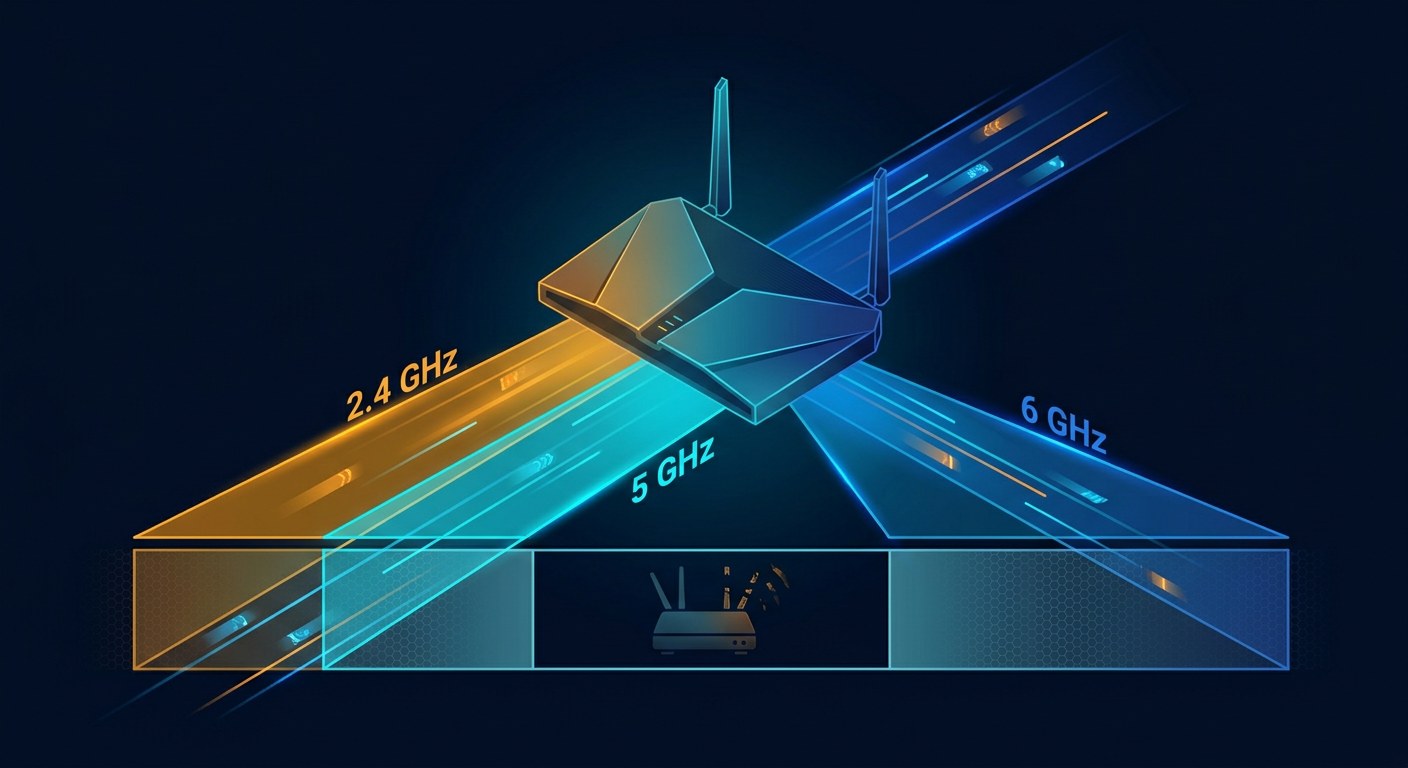
For twenty years a Wi-Fi access point has done roughly the same thing: pick a band, pick a channel, transmit there. If something went wrong on that channel, client and router agreed to drop to a narrower channel or hop to another band. The 802.11be standard, which the Wi-Fi Alliance sells as Wi-Fi 7, changes that logic on two fronts that work together: a single device can hold simultaneous links on 2.4, 5 and 6 GHz, and it can occupy a 320 MHz channel while leaving a hole exactly where someone else is transmitting.
The first idea is called MLO, multi-link operation. The second is preamble puncturing. Neither lifts the big number on the box — the theoretical speed — as much as marketing suggests, but both attack the real problem in a home or small office network: not the lack of peak bandwidth, but the unevenness of it.
Three radios, one device as far as the network knows
In Wi-Fi 6 a client has one MAC address and one link. In Wi-Fi 7 the standard defines the MLD (multi-link device), an entity with a common upper MAC and several per-link MACs, one for each radio and band. To the network, the phone or laptop is a single device with several doors; underneath, each link has its own physical layer, its own encryption and its own retry counters.
That enables three things that did not exist before. The first is aggregation: a data flow can be split across a 5 GHz link and a 6 GHz link, adding capacity even when each radio is modest. The second is instant failover: if the 6 GHz link degrades as you walk past a wall, traffic continues on the 5 GHz one without reassociation, without the one or two second stall you notice on a video call. The third is latency: the standard includes mechanisms to send the same packet over two links and keep whichever copy arrives first, aimed at virtual reality and at the uplink traffic from headsets.
There is a technical nuance that separates good hardware from cheap hardware. Full MLO, with simultaneous transmit and receive on two bands (STR), requires two independent radio chains and filters that do not interfere with each other. Many routers advertised as Wi-Fi 7 only implement alternating MLO: they use one link at a time and switch very fast. It works, but it does not add capacity.
Four thousand and ninety-six symbols instead of one thousand and twenty-four
Modulation changes too. Wi-Fi 6 uses 1024-QAM, that is, 1024 distinct amplitudes and phases per symbol, equivalent to 10 bits per symbol. Wi-Fi 7 adds 4096-QAM (4K-QAM): 12 bits per symbol, 20 % more data in the same bandwidth. It sounds like a gift, but the price is a much tighter constellation: the receiver has to resolve levels separated by very little voltage, with an error margin (EVM) better than about −38 dB and a signal-to-noise ratio of roughly 40 dB.
In practice that means 4K-QAM only engages when the client is close to the access point with a reasonable line of sight. At ten metres with a wall in between, the rate algorithm itself falls back to 1024-QAM or lower, and the user notices nothing: the link keeps working, just at the previous speed. It is the usual Wi-Fi pattern — headline figures describe the best case, one metre away with nothing in the way.
The hole-punched channel trick
Here is the least visible and probably most useful innovation. Wi-Fi channels are contiguous blocks: 20, 40, 80, 160 and now 320 MHz. The problem is that the spectrum is not clean. A neighbour occupying 20 MHz in the middle of your 160 MHz channel is enough for the older standard to force you down to 80 or to look elsewhere.
Wi-Fi 6 already allowed puncturing one 20 MHz subchannel in the lower part of an 80 or 160 MHz channel. Wi-Fi 7 generalises the idea: inside a 320 MHz channel you can declare several 20 MHz blocks idle, at arbitrary positions, and keep using the rest. The router scans the spectrum, works out where a foreign network or a radar sits, and transmits with energy spread around the hole. To the receiver this is not a broken channel: it is a valid subcarrier allocation, declared in the preamble.
The practical effect is that a flat with six neighbouring networks keeps a wide, usable channel instead of degrading to half of it. In 6 GHz, where there is more room and fewer people, the mechanism is used mostly to coexist with radars and fixed links that have legal priority.
320 MHz and the spectrum that does not exist everywhere
A 320 MHz channel needs 320 MHz free. In the United States the 6 GHz band offers 1200 MHz, so three wide channels fit. In Europe the harmonised range for Wi-Fi runs from 5945 to 6425 MHz: 480 MHz, that is, one 320 MHz channel plus the leftovers. And not everyone can use it the same way: the low-power category (LPI) caps radiated power and restricts use to indoors, while very low power (VLP) barely covers a room. Standard power, the one that would give outdoor reach, requires in the US querying a coordination database (AFC) so as not to step on fixed links.
That is why European Wi-Fi 7 is in practice a short-range 6 GHz standard. Its value is not covering the house from the hallway, but providing a clean, extremely fast lane in the same room as the router: the living room with the TV, the study with the NAS. Coverage still comes from 2.4 and 5 GHz.
What the standard does not fix
No version of Wi-Fi improves the bottleneck that usually sits behind the router. A 5 Gbps link between laptop and access point is worthless if the router talks to the world through a 1 Gbps Ethernet port. Nor does it fix the backhaul: in a multi-node system, the wireless hop between satellite and main unit shares the same air as clients, and that is where throughput is lost. Wi-Fi 7 recommends 2.5 or 10 Gbps ports and, on expensive gear, a radio dedicated to the node-to-node link.
Then there is the small print on the client side. Most phones and laptops have two antenna chains (2×2), not the four, eight or sixteen that appear in spec sheets. With 2×2, 320 MHz and 4K-QAM, the theoretical maximum is around 5.8 Gbps; under normal conditions, between 1 and 2 Gbps in practice. Still enormous for almost everything, but far from the number printed on the box.
Wi-Fi 8 already has a name, and a different goal
The next standard, 802.11bn, will be sold as Wi-Fi 8 and its working group sums it up with one acronym: UHR, ultra high reliability. It does not chase higher peak speeds but a lower chance of a packet arriving late. The drafts talk about coordinated spatial reuse between access points — two nearby routers sharing information so they do not step on each other —, redundant transmission between nodes and latency management for interactive traffic. It is a logical change of target: with 320 MHz and 4K-QAM the air is fairly squeezed already, and what fails in a home with fifteen connected devices is consistency, not the peak.
Until then, practical advice has not changed: cable wherever you can, one access point per zone with a planned channel, and a router that supports real MLO if you are buying new. The rest is spec-sheet paperwork.