Leave an e-reader forgotten in a drawer for a month, open the cover, and the last page is still there. The screen is not on, there is no current, the battery may well be at zero, and yet the text is still visible. It is not an image held by inertia or a faulty panel: it is the result of a technology that moves physical matter, leaves it still and then walks away from it.
A capsule thinner than a hair
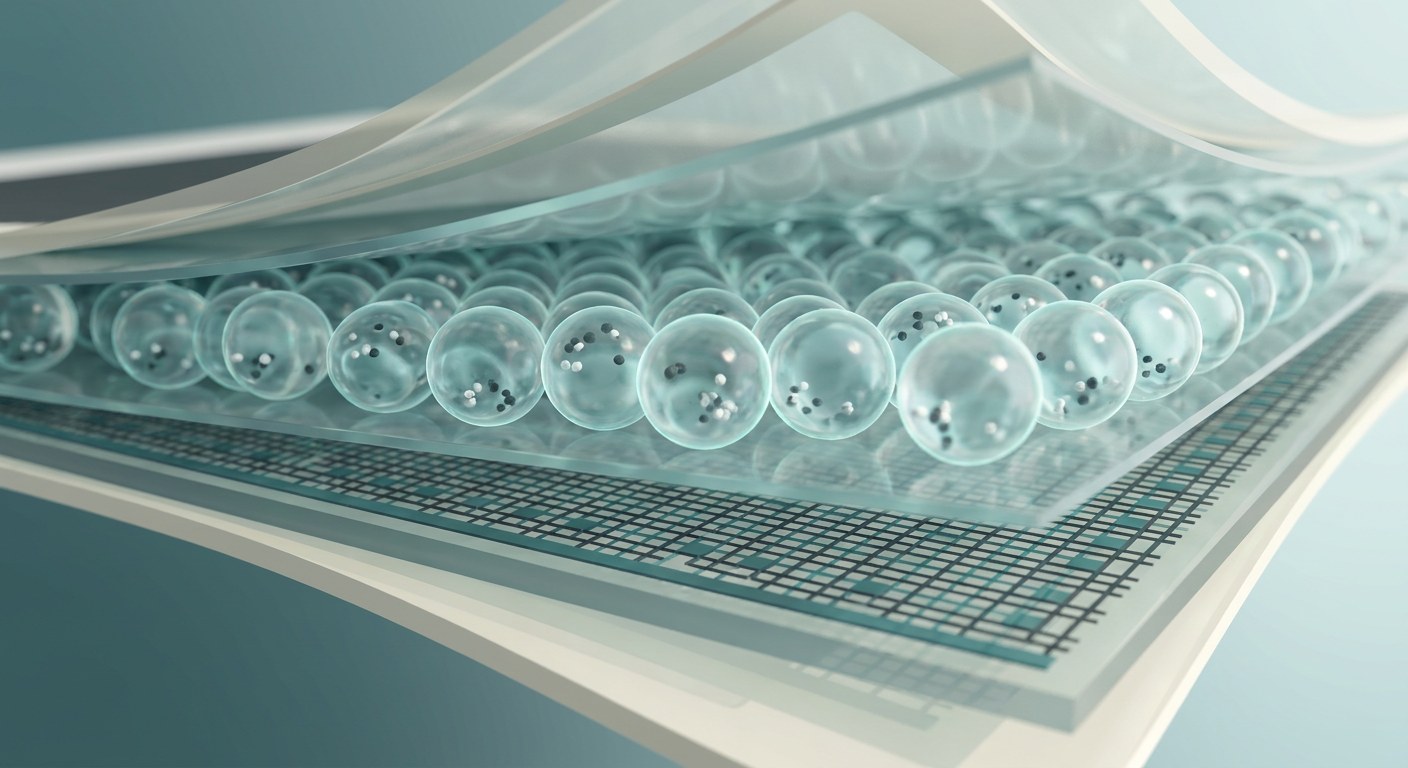
The electronic ink used by nearly every reader on the market looks nothing like an LED or a liquid crystal. Its basic unit is a transparent microcapsule about 30 to 40 micrometres across — less than half the thickness of a human hair — filled with a clear fluid. Inside, two pigments with opposite charges float: titanium dioxide particles, which are white and carry a positive charge, and black pigment particles, which are negatively charged.
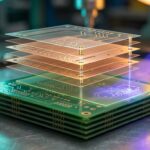
That assembly is laminated between two electrodes. The top one is a transparent conductive film, usually indium tin oxide (ITO), that lets light through. The bottom one is a thin-film transistor (TFT) array that acts as an independent electrode at every pixel. There are no polarisers, no liquid crystal to twist and no backlight: the screen emits nothing, it only reflects the light that reaches it.
Fifteen volts and a field of one volt per micrometre
To write a pixel, the controller applies a potential difference between the two electrodes. The typical voltage is around 15 volts, and because the active film is only tens of micrometres thick, the resulting electric field is on the order of one volt per micrometre, that is, a million volts per metre. That field exerts a force on each particle proportional to its charge and drags it along by electrophoresis: the white ones rise towards the transparent electrode and the black ones sink, or the other way round, depending on polarity.
Speed depends on the electrophoretic mobility of the pigment in the fluid, which in these systems is around 10-10 square metres per volt-second. With a field of 106 volts per metre, the arithmetic gives a velocity of a few tenths of a millimetre per second: crossing the 30 micrometres of the capsule takes a few hundred milliseconds. That is where the characteristic flash of a page turn comes from, and also why an electronic ink screen will never play video comfortably.
Why it draws nothing when nothing changes
When the field disappears, the particles do not go back. They stay stuck to the capsule wall through van der Waals forces and the viscosity of the fluid itself, which damps any movement. The state is bistable: white and black hold without any energy. Keeping a page on screen costs zero watts; consumption is concentrated in the instants when the capacitance of the electrodes is charged in order to change something. That is why battery life is measured in weeks rather than hours, and why the screen keeps the image even with the device switched off.
Sixteen greys with pulses, not steady voltages
Pure black and white are easy, but text looks better with antialiasing and photos need grey scale. Typical panels handle 16 levels, four bits per pixel, and they get there by mixing two tricks. The first is using pigments with different charge-to-mass ratios inside the same capsule: some particles respond sooner than others to the same stimulus. The second is modulating the length of the electrical pulse, so that a short pulse leaves the mix halfway between white and black.
The practical consequence is that the panel is not a passive display you send a brightness value to, but a system with memory that needs to know what was there before. The controller keeps a buffer of the previous image and applies a waveform table — the waveform — that differs for every transition: black to white is not reached with the same pulse as mid-grey to light grey. That table is proprietary, it is calibrated per manufacturing batch and it changes with temperature.
The black flash is not a defect
When the reader performs a full refresh, the screen goes black, then white, and only then draws the page. That flash serves two technical purposes. First, it erases history: particles that stopped halfway leave a residue that shows up as a ghost image on the next page. Second, it balances the net charge of the system, because a panel that is always polarised the same way accumulates ions and degrades. Partial refresh modes, faster and flicker-free, accept some ghosting in exchange for speed; single-bit modes, designed for writing and turning pages, are the fastest of all.
Temperature matters more than it seems. The fluid inside the capsules thickens in the cold, and at zero degrees the mobility of the particles drops enough for the controller to stretch the pulses and slow everything down. Readers carry a thermal sensor and several waveform tables to compensate: the same page takes visibly longer on a platform at seven in the morning in January than on the sofa.
No light of its own, less contrast
Because it does not emit, contrast depends on ambient light. A well-tuned electronic ink panel sits around 15:1 between white and black; a modern LCD exceeds 1,000:1 and some reach 1,500:1. The upside is that reading in full sun is perfect, with no glare or washed-out highlights, and that the front light on modern readers is a separate diffusing layer that lights the paper from the edge, not a backlight shining through the panel.
Underneath the capsules, the TFT array sets the resolution: 300 pixel-per-inch panels use amorphous silicon transistors deposited on plastic or glass, with gate and source drivers at the edges. Pixel density can be high because each pixel needs no three colour subpixels, just one.
Colour arrived with a concession
Colour electronic ink screens solve the problem in two ways. The first and most widespread puts a colour filter over the monochrome panel: each pixel is split into red, green, blue and white, which costs between half and two thirds of the brightness and leaves saturation muted. The second and more ambitious packs four different pigments into the same capsule and sorts them by charge, with no filters, at the price of far slower refreshes and finer voltage control.
That is where applications with nothing to do with reading come from: electronic price labels in supermarkets, shop signage and information panels updated by radio every few hours. A tag running on a coin cell lasts five years precisely because it only spends energy when the price changes, not while it shows it.
What ink will not solve
No materials improvement will turn this technology into a video display: the limit is not the controller but the physics of the pigment, which takes hundreds of milliseconds to cross the capsule and stays where it was left. That is why the e-reader remains a specialised object, comfortable for reading and clumsy for almost everything else. And why the last page is still there when you come back weeks later with a dead battery.