
The cloud was the promise… until it filled with smoke
For years we were told that everything was going to live in the cloud. Your photos, your documents, even the way your phone understood your voice. The idea was simple: you do not need a powerful computer, because the hard work is done in enormous data centers, thousands of kilometers away, and only the result reaches you.
And to a large extent it was like that. But technology has changed its mind, and in recent years a term has been born that puts the focus back where it all started: on your own device. It is called edge computing, and it promises to change how everything from your smartwatch to factories and autonomous cars works.
What “the edge” really means
The “edge” is not a physical place, but a concept. It is everything that is close to the user and to the data, instead of being concentrated in a single remote center. When your phone recognizes your face to unlock without sending the photo to any server, you are using the edge. When your assistant answers “turning on the light” before consulting the cloud, you are too.
The central idea is simple: process near where the data is generated, instead of sending it to a distant central office and waiting for the response to come back.
And why now?
For decades, the “everything in the cloud” model made sense because devices were weak and servers were immensely powerful. But that equation has been inverted. Today’s phones carry more power than the computers that sent a man to the Moon, and the new chips are designed expressly for tasks such as on-device artificial intelligence.
Meanwhile, the cloud began to show its limits. Sending and receiving data has a cost in time (the famous latency), in energy and in privacy. For a car that must brake in milliseconds or a surgeon operating a robot remotely, every tenth of a second counts. And for your photos, sending them to a server in another country is increasingly unnecessary and less desirable.
Three advantages you really notice
Speed. If the processing happens on your device, the response is immediate. It does not depend on the connection or on how far away the server is. It is the difference between your video call freezing and flowing without interruption.
Privacy. The fewer data leave your device, the less risk they end up where they should not. Recognizing your voice or your face on the phone itself, without uploading them to the cloud, is a clear win for your privacy.
Robustness. If your connection goes down, your device keeps working. Factories and hospitals that depend on the network no longer grind to a halt because of an internet outage.
No, the cloud is not going to disappear
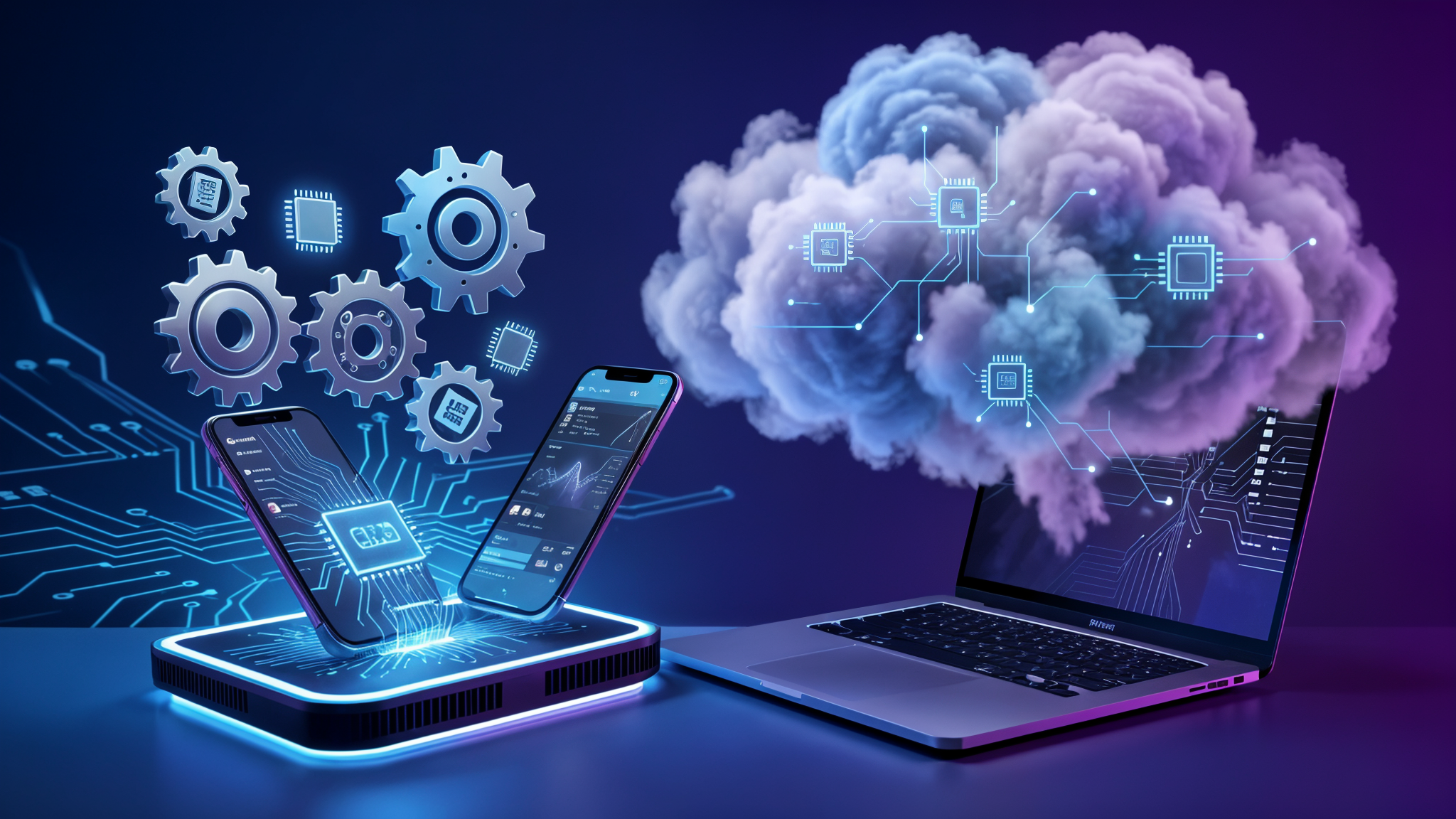
It is worth clarifying: this is not a battle in which the edge wins and the cloud disappears. The reality is a division of labor. What is small, urgent and private stays on your device. What is heavy, complex and needs a lot of power or collaboration is still done in the cloud.
Experts call it hybrid computing: one part at the edge and another in the cloud, coordinated so that each task is done where it is best solved. Your assistant will understand the command on your phone, but will search the internet for the answer. Your car will decide to brake on its own, but will download software updates at night.
A faster and more discreet future
Edge computing is, at heart, a return to common sense: doing things where it makes sense to do them. It does not need your information to travel halfway around the world for an app to work, and that translates into speed, privacy and a technology that feels closer and less dependent.
The next time your phone recognizes you instantly or answers your voice without batting an eye, think about it: it may not have gone to the cloud at all. The future is not only up there, among the clouds. It is also, increasingly, at the edge of your own hand.