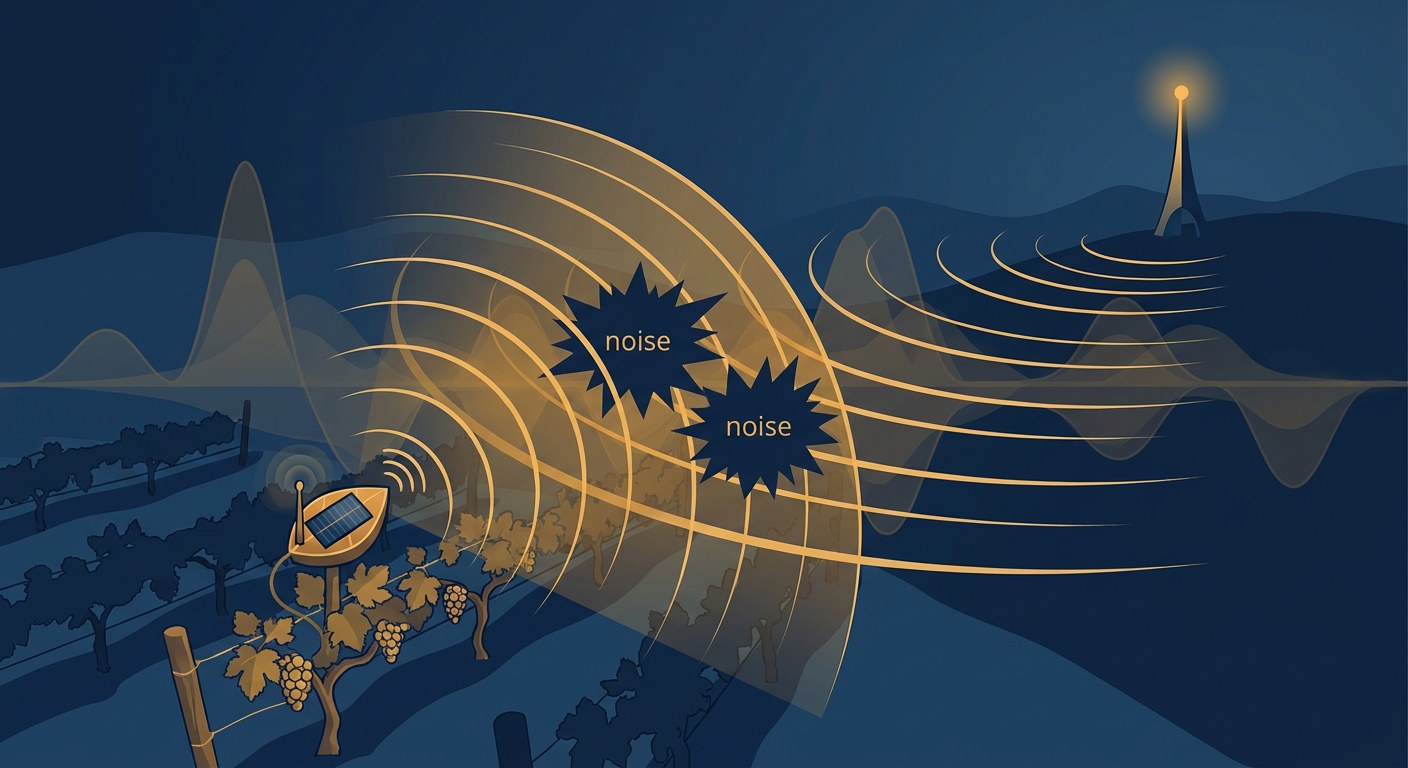
In a vineyard, a sensor the size of a matchbox measures soil moisture every fifteen minutes and reports it to a gateway seven kilometres away, behind a hill. It does so with fourteen dBm of radio power, the same as a toy walkie-talkie, and with a single AA battery that is supposed to outlast the vines. The technology is called LoRa, and its trick is not to shout louder but to speak slowly and spread every message across a band far wider than it strictly needs.
The noise floor: hearing something weaker than the noise
Every receiver generates its own noise. Thermal noise from a resistor at room temperature is about -174 dBm per hertz; if the receiver listens across a 125 kHz band, it integrates that noise over 125,000 hertz and the floor rises to -123 dBm. Add the chip noise figure (around 6 dB in a cheap transceiver) and a conventional receiver needs the signal to arrive above -117 dBm to tell it apart. An SX1276 in LoRa mode, on the same bandwidth, claims -137 dBm of sensitivity: twenty decibels below the noise. In power terms that is a hundred times less energy than it has to overcome. The obvious question is how.
A chirp: frequency rising in a straight line
LoRa uses CSS, chirp spread spectrum. Each symbol is a linear frequency sweep across the 125 kHz band, rising (or falling) at a constant rate. On a spectrum analyser the signal looks like a diagonal: it fills the whole channel, but only briefly at any given frequency, so its spectral density is tiny and it blends into the background noise.
The receiver does the opposite: it generates the inverse chirp internally, multiplies it by the incoming signal, and the two ramps cancel each other out. What remains is a fixed tone whose frequency depends on the offset with which the original symbol arrived. Feed that into an FFT and all the energy that was scattered across the band collapses into a single bin. That is the whole trick: nothing has been amplified, the signal has been integrated coherently for the entire symbol. The processing gain is the time-bandwidth product, and it grows with every doubling of the number of chips per symbol.
Seven spreading factors: speed against range
That chip count is the spreading factor (SF), and it runs from 7 to 12. At SF7 each symbol lasts 1.024 ms and carries 128 chips; at SF12 it lasts 32.768 ms and carries 4,096. The useful bit rate falls off a cliff: roughly 5,470 bps at SF7 against 293 bps at SF12. In exchange, each step adds about three decibels of sensitivity and doubles the time the receiver can spend integrating the signal.
The interesting part is that different SFs are almost orthogonal to one another: because each uses a different chirp base, several nodes can transmit at once on the same 125 kHz channel as long as they do not share an SF, and the receiver separates them. Almost is the key word. The orthogonality is not perfect, and a strong node sitting next to the gateway can drown out a distant one using the same SF: the classic near-far problem, and the reason power control and channel planning matter so much in a dense network.
How long a message takes, and the one per cent rule
The arithmetic is simple and explains the whole architecture of these networks. A 51-byte frame, the maximum in the European region for the slowest SFs, takes about 2.46 seconds to go out at SF12 and only 62 milliseconds at SF7. ETSI EN 300 220 limits the 868.0 to 868.6 MHz sub-band to 25 mW of radiated power and a 1 per cent duty cycle. One per cent of an hour is 36 seconds of airtime: fourteen slow messages, not one more. Hence the design: nodes talk little, send few bytes, and trust that soil temperature does not change much in fifteen minutes.
LoRa is not LoRaWAN: three ways of listening
It helps to separate the layers. LoRa is only the physical layer, the chirp modem; LoRaWAN is the network protocol that defines how a device joins, how frames are encrypted and when the radio opens to receive commands. Joining can be by activation by personalisation (ABP), with keys burned in at the factory, or by OTAA, an exchange in which the node identifies itself with its DevEUI and JoinEUI and both ends derive session keys from a shared root. Everything is encrypted with AES-128: one key protects the payload and another authenticates the frame with an integrity code, so a gateway can forward the packet without being able to read it.
The classes define the trade-off between battery life and responsiveness. A Class A node wakes the radio, transmits and opens two receive windows, one after a second and another after two, then sleeps until the next message: the most efficient mode, and the one used by the vast majority of sensors. Class B adds periodic gateway beacons, every 128 seconds, which allow scheduled receive windows and bounded latency. Class C keeps the receiver on almost permanently, which gives the lowest latency and wrecks the energy budget.
ADR: the network tells the node how to speak
With six possible speeds it makes no sense to leave the choice to the user. The network server collects the signal-to-noise ratio and received power history of each device and sends it a LinkADRReq downlink with the power, data rate, channel mask and repetition count it should use. A sensor a hundred metres from the antenna will end up transmitting at SF7 and saving battery; one at the bottom of the valley will climb to SF12 and spend two and a half seconds per frame. The scheme breaks with mobile nodes: if the device moves, yesterday’s margin no longer holds and ADR can silence it. That is why a mobile variant of ADR switches itself off as soon as the device changes position.
The limits that are not in the brochure
- Medium access is pure ALOHA: a node transmits when it wants and collisions are resolved with random retries. A well-placed gateway moves a few thousand messages a day, not hundreds of thousands.
- The downlink is scarce and shares the same one per cent duty cycle. Acknowledging every message is expensive; many applications simply do not.
- The useful payload ranges from 51 to 242 bytes depending on data rate, and frame size drives airtime and, with it, the capacity of the whole cell.
- Latency is measured in seconds or minutes, and security depends on root keys not leaking at the factory: encryption protects the journey, not a tampered device.
Against NB-IoT, the licensed cellular alternative, LoRa loses on quality of service and on support for high traffic, but wins on cost per node, on battery life and on independence from any operator: anyone can set up a gateway. Against Sigfox, which bet on a single centralised network, it wins on flexibility. Its real niche is where the data is tiny, the battery must last years and there is no mobile coverage: water meters, farm sensors, leak detectors, cattle on the hillside.
In the end, the feat belongs to physics, not to power. A two-second frequency sweep and a well-aligned FFT let a twenty-byte message climb out of the noise it was buried in. The radio does not shout: it whispers for a long time and lets the receiver listen patiently.