
For years we have talked about artificial intelligence as if it were just another tool: something that is activated when you need it, like an advanced calculator or a digital assistant. But in 2026 that metaphor has become obsolete. AI is no longer something we use from time to time; it has become the infrastructure on which critical processes of the economy, science, and everyday life are sustained. This change is not incremental: it is structural.
From tool to digital operating system
What distinguishes 2026 from previous years is that AI has ceased to be an optional complement to become the substrate on which entire companies operate. Language models are no longer limited to answering questions: they manage supply chains, detect anomalies in power grids before they occur, and coordinate complex workflows that previously required dedicated human teams.
This leap has been made possible thanks to three converging advances: the maturity of open source models, which have democratized access to capabilities that two years ago were the privilege of a few tech giants; the drastic improvement in context windows and persistent memory of AI agents, which allows them to operate over long time horizons without losing the thread; and the emergence of self-verification mechanisms that reduce the accumulation of errors in multi-step flows.
The year of the agents (for real)
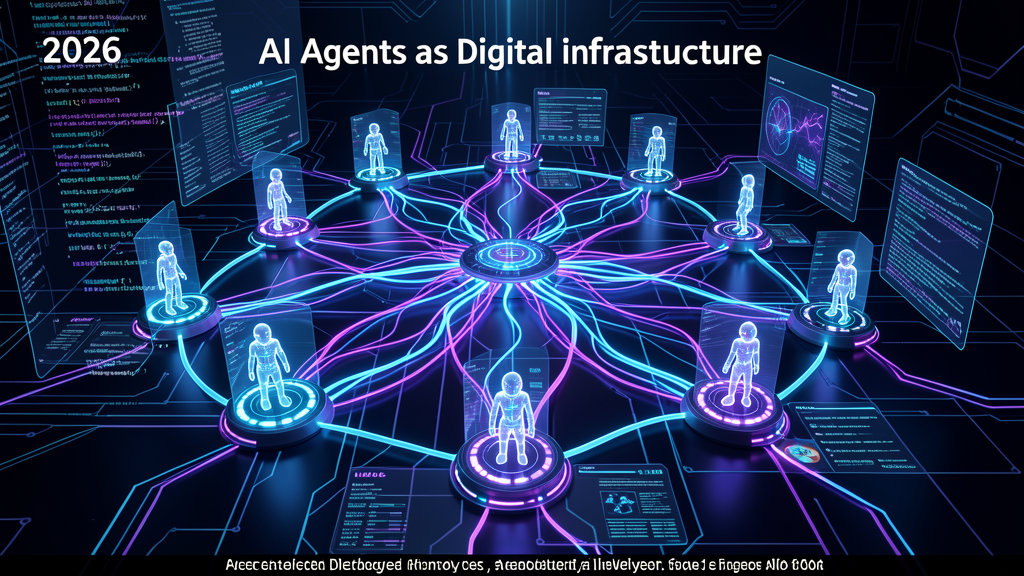
So much has been said about the “year of the agents” that the expression runs the risk of becoming a cliché. However, 2026 is making real what was previously a promise. AI agents have overcome the technical demo phase and are operating in production, integrated into real business systems.
The key has been interoperability: agents no longer live in walled gardens. They are beginning to communicate with each other through open protocols, discovering services, negotiating tasks, and executing flows that cross platforms. It is the birth of an agent economy, a concept reminiscent of the APIs revolution, but with an additional layer of autonomy.
At the same time, local AI is gaining ground over the cloud. Running models directly on devices — laptops, mobiles, even smart appliances — reduces latency, improves privacy, and eliminates dependence on constant connectivity. This is driving a new generation of hardware optimized for local inference, with dedicated processors that consume a fraction of the energy of their cloud equivalents.
English as the dominant programming language
One of the most silent and profound transformations of 2026 is the rise of natural language programming. It is no longer necessary to master the syntax of Python or Go to build software: it is enough to know how to clearly articulate what you want to achieve. Code assistants have reached a level of maturity in which the bottleneck is no longer writing code, but knowing what product to build.
This is democratizing software creation at a scale we had not seen since the appearance of the first visual development environments. According to industry analysts, the number of people capable of creating functional applications could multiply by ten in the next two years. The impact on productivity and on the structure of technology employment will be profound.
The energy cost: the elephant in the room
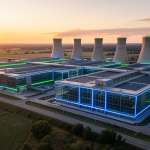
Not everything is bright lights. The massive expansion of data centers specialized in AI is pushing energy consumption to levels that are beginning to worry governments and grid operators. It is estimated that the electricity demand of AI data centers could grow 40% year over year in 2026. This is accelerating investment in energy efficiency, liquid cooling, and above all in dedicated renewable energy sources.
Paradoxically, the very technology that consumes huge amounts of energy is being crucial for optimizing power grids, improving the efficiency of solar panels, and accelerating research into new battery materials. AI is at once the problem and the solution.
Beyond the hype: what really matters
In 2026, the noise around AI remains deafening. But beneath the hype, there is an undercurrent that is changing the way organizations work. The companies obtaining real results are not those that buy the biggest model or the most expensive assistant: they are those that integrate AI into their processes with a clear vision of the problems they want to solve.
AI has become infrastructure. Like electricity or the internet, it stops being visible when it works well. And that — precisely that — is the greatest indicator that it is here to stay.
The question is no longer “should we use AI?” but “how do we reconfigure our organization to operate on this new infrastructure?” The answers we give this year will define the next decade.