

You may have heard about quantum computing in the news: that Google has achieved a breakthrough, that IBM promises a more powerful machine or that Microsoft is betting big on this technology. But what exactly is a quantum computer? And why are so many companies fighting to build one?
You do not need to be a physicist to understand it. We are going to explain it in a simple way, with everyday examples.
First, how does a normal computer work?
The computer in your home or your phone works with bits. Think of a bit as a light switch: it can only be in two positions, on (1) or off (0). Everything you do —sending a message, watching a film or writing a document— is nothing more than millions of these switches turning on and off at high speed.
This system works very well for almost everything. But there are problems that, although today’s computers are getting faster and faster, they struggle enormously to solve.
The big difference: the qubit
The quantum computer does not use bits, but qubits. And here is the key: while a bit can only be 0 or 1, a qubit can be 0 and 1 at the same time.
Let us go with a simple comparison. Imagine you have to go through a maze to find the exit. A normal computer tries one path at a time: first one, then the next, and so on until it finds the exit. In a small maze it is fast; in a huge one, it takes a very long time.
The quantum computer, thanks to that ability to be in several states at once, can explore many paths at the same time. What would take a normal one thousands of years could take a quantum one minutes.
What is it really for?
It is worth clarifying: a quantum computer is not faster for everything. It is not going to make your phone charge faster or make Excel run more smoothly. In fact, for normal tasks it is slower and more delicate than a classical one.
Its talent lies in very specific problems. Three examples that hit close to home:
- Medicine. Simulating how molecules behave would allow designing new and more effective drugs, or materials with surprising properties, without so many years of testing.
- Security. It could break the encryption systems that today protect our passwords and data. This worries people a lot, and that is why new “quantum” protection systems are already being worked on.
- Optimization. Finding the best solution among millions of possibilities: delivery routes, city traffic, a factory’s energy consumption.
Why is it so hard to build?
If it sounds so good, why do we not have them at home yet? Because qubits are extremely fragile. Any vibration, heat or noise “breaks” them, and the data is lost in a fraction of a second.
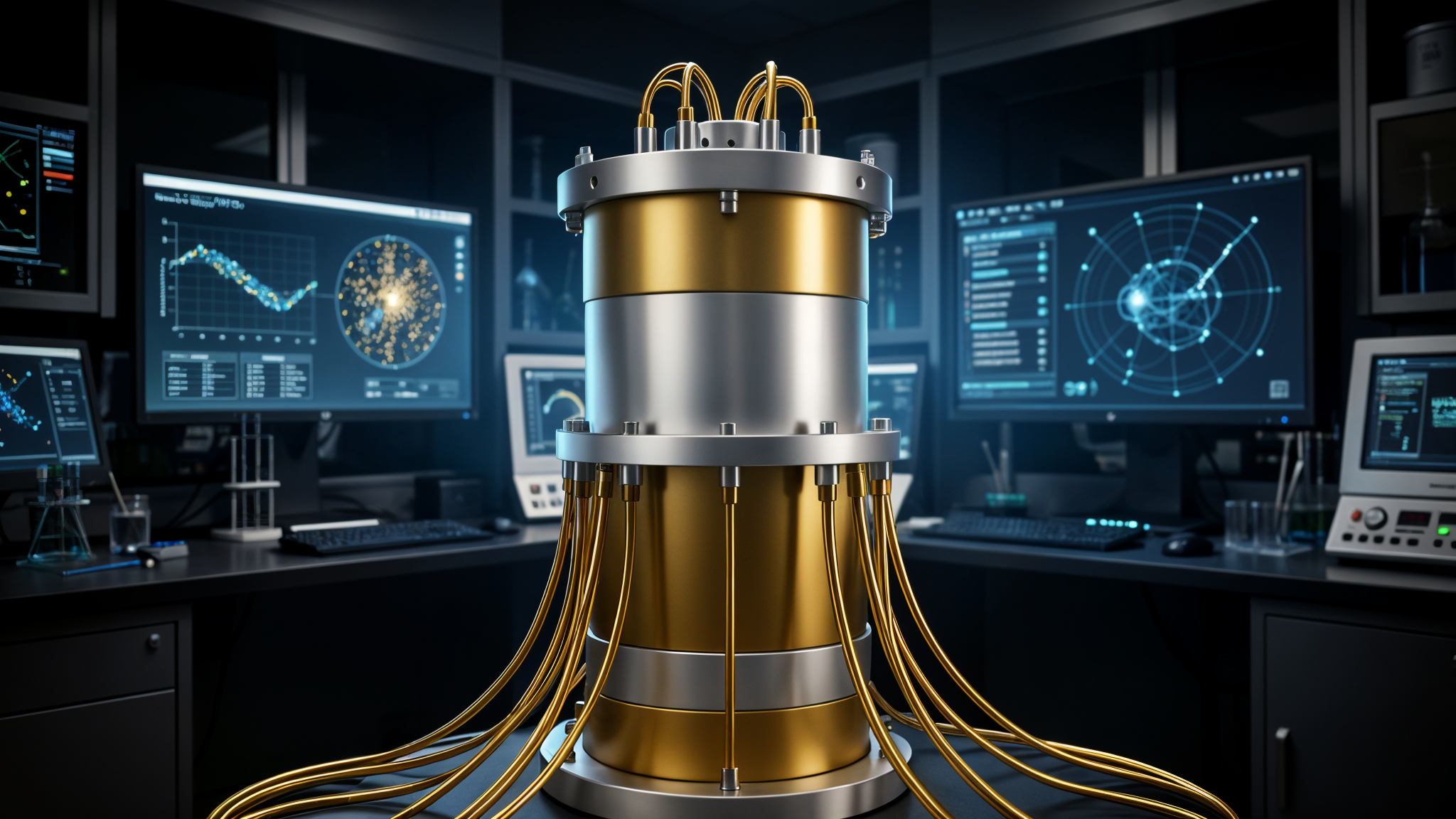
That is why these computers operate at temperatures colder than outer space and are kept in huge golden machines that look like they come out of a science fiction film.
There are still years to go before this technology is used on an everyday basis. But the advances of recent months are real and increasingly fast. Google, IBM, Microsoft and even whole countries such as China are investing billions in the race.
Should I be worried?
No, at least for now. Quantum computing is one of those technologies that will change the world, but behind the scenes: in medicine, science or security. You will not see it in a shop, but its results will end up reaching your life.
The next time you hear that a company “achieves a quantum milestone”, you will know they are talking about a computer that, instead of turning switches on and off, learns to be in several places at once. And that, although it sounds like magic, is just physics. Fascinating, at that.