It is half past eight in the morning and the alarm in the hallway is warning about the same thing again: the toast. Last week, by contrast, the cable of a desk lamp smouldered for half an hour behind a sofa and the device said nothing until the plastic finally caught flame. It is not a manufacturing defect or bad luck: there are two different physics inside the same white plastic disc, and one of them is almost blind to the kind of smoke each fire produces.
Two sensors, two ways of “smelling”
Almost every household detector sold in Europe belongs to one of these two families, or to a mix of both.
The ionisation chamber: measuring a current of picoamps
Inside there is a tiny amount of americium-241, on the order of 37 kBq (one microcurie). The isotope emits alpha particles of about 5.4 MeV that ionise the air in a closed chamber, splitting molecules into positive ions and electrons. A DC voltage is applied between two electrodes and the resulting current is measured: a few picoamps, a minuscule signal that a transimpedance amplifier turns into a workable voltage.
When smoke enters, the particles capture those ions and encourage them to recombine before reaching the electrode. The current drops. The circuit does not measure “smoke”: it measures a reduction in the conductivity of the air, and that reduction depends on the number and size of the particles, not on their chemical composition.
The optical chamber: light bouncing where it should not
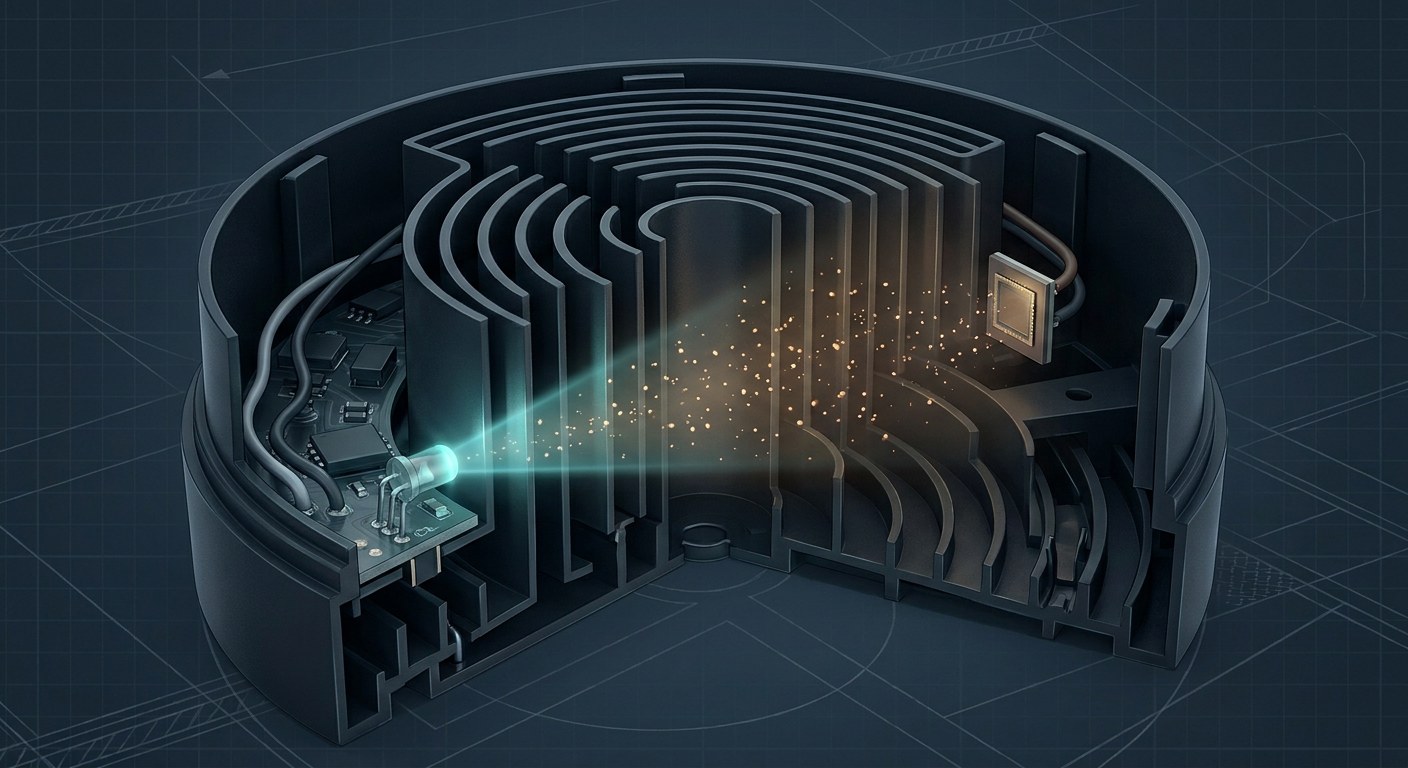
The photoelectric sensor is a geometry exercise. An infrared LED, almost always at 880 or 940 nanometres, fires pulses into a light trap: a labyrinth of black walls designed so the beam never reaches the photodiode. In clean air the photodiode receives practically nothing. When smoke enters the chamber, the particles scatter part of that light and a fraction lands on the receiver, placed some 30-60 degrees off the beam. That angle is chosen on purpose: forward scattering (Mie) is far more intense than sideways scattering, so you gain signal with the same electronics.
None of this would work without synchronisation. The LED fires in bursts of a few microseconds and the receiver only integrates inside that window, so ambient light and sunlight coming through a window stay out of the measurement. Decent models also add drift compensation: they keep a reference for the clean chamber and compare it with the current reading, because dust accumulated over years shifts the baseline and would eventually produce false alarms.
The particle size decides the winner
Smoke is not a gas: it is an aerosol of solid particles and microscopic droplets. A flaming fire produces very fine soot, typically 0.01 to 0.3 micrometres across; slow, flameless combustion, such as a cable heating up or a sofa charring, produces noticeably larger particles, from 0.3 micrometres to several microns.
There is the key. Rayleigh scattering, which dominates when the particle is much smaller than the wavelength, grows with the sixth power of the diameter: very small particles scatter very little light, but they move easily and stick to ions, so the ionisation chamber detects them earlier. Conversely, a large particle scatters much more (we enter the Mie regime) and the optical chamber sees it clearly, while its effect on the ion current is proportionally smaller.
Translated into real life: the ionisation sensor is fast with flaming fire and with fine kitchen aerosols; the photoelectric one is better with embers, melting plastic and a fire that starts slowly. That is why the same device that stays quiet for a smouldering cable can shout at a slice of toast.
Why toast wins almost every time
Frying, grilling or toasting generates an aerosol of fat droplets and pyrolysis products around 0.05-1 micrometre in size, right in the band where both sensors are sensitive. Add the steam from the kitchen, which also scatters light and, with the door open, can mimic light smoke. Old detectors, with a fixed threshold and no discrimination, have no way of knowing whether those particles come from a steak or from a short circuit.
Recent designs attack this in two ways. The first is sensor fusion: a single device combines an optical chamber, an ionisation chamber, a carbon monoxide sensor and a thermistor, and decides with logic that weighs signals and how they evolve over time. A slow, steady rise over twenty minutes does not look like a sudden jump, and that temporal profile is worth as much as the amplitude. The second is dual wavelength: some models emit in blue (around 470 nm) as well as in infrared, and the ratio between both signals helps tell smoke particles from steam or dust, because the size relative to the wavelength changes the scattering pattern.
From millivolt to siren
The alarm threshold is not a universal number but a curve: the European EN 14604 and EN 54-7 standards set the obscuration per metre the device must detect and the maximum response times against a battery of test fires, the well-known TF1 to TF6, ranging from flaming wood to smouldering cotton or polyurethane foam. The detector must trigger before a certain obscuration level and not before a lower one, so that it is neither deaf nor trigger-happy. The required sound output is around 85 dB at three metres, using the T3 temporal pattern: three short pulses, a pause, and again — a code designed to be recognised by someone waking up in the dark.
Hysteresis matters as much as the threshold. If the alarm switched on at one level and off at exactly the same one, any fluctuation would make it blink; that is why it clears well below the trigger point, and many units wait for several consecutive measurement cycles before deciding.
The clock you do not see
In a real fire the margin is measured in minutes. A living room can go from a small flame to generalised ignition (flashover) in three to five minutes, and from that point on the heat and toxic gases make escape impossible. A detector that responds two minutes late is not a slow detector: it is a useless one. That is why interconnection matters so much: hard-wired units, or those linked over 868 MHz radio with a proprietary protocol, alert each other, and all of them sound even if the fire is at the other end of the house.
It also explains the annoying nocturnal low-battery beep. Most use a sealed lithium cell rated for ten years, and its voltage falls with the cold: the alarm estimates the state using the room temperature, and on a January night the same voltage that looked fine at 22 °C no longer does.
What to do with the unit on your ceiling
- Press the test button once a month. If it does not sound within two seconds, it is protecting nothing.
- Vacuum the slots once a year: dust is the first cause of false alarms and of progressive blindness.
- Replace it ten years after the manufacturing date, even if the battery still lasts. The chamber gets contaminated and the electronics drift.
- Do not paint it or wrap it: the optical labyrinth stops being a labyrinth.
- Mount it on the hallway ceiling, away from the kitchen and the bathroom, one per floor; interconnected if you can.
- A smoke detector does not detect carbon monoxide. The boiler needs a different device, and that is a different sensor.
In the end, the disc on the ceiling is not an electronic nose that “smells” fire: it is a very modest particle spectrometer with a threshold chosen by engineers who had to pick between warning too early and warning too late. The toast is the price of the device being awake on most nights.