

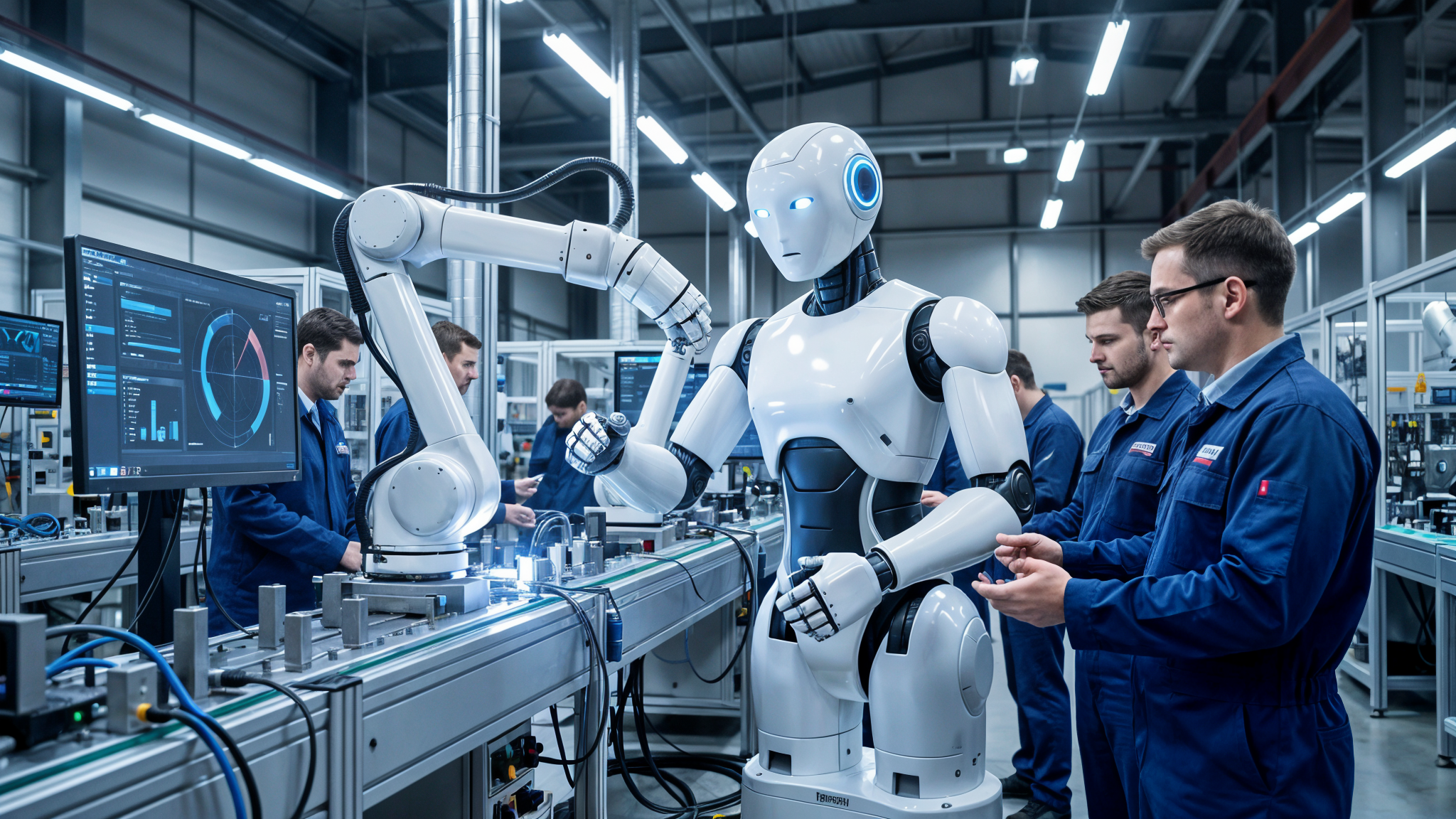
For years, humanoid robots have been more of a promise than a reality. We saw them in films and at technology fairs, moving clumsily, unable to hold up through a day’s work. That is changing fast: 2026 is the year in which human-shaped robots have left the showrooms to really settle into factories, warehouses and logistics centres.
Why now and not before
Industrial robots have been working for decades, but they were almost always fixed arms anchored to the floor, specialized in always doing the same task. They are very good at what they do, but they are not good for anything else. Humanoids aim to solve that problem: a machine with two arms, two legs and a human shape can move through a space designed for human beings and do what a person does.
Three things have made the leap possible. The first is artificial intelligence: robots no longer need a programmer to tell them every movement, but learn by observing and repeating. The second is sensors, increasingly cheap and precise, which allow them not to crash into what is around them. And the third is cost: a decade ago a robot of this type was extremely expensive; today manufacturers compete to bring it down to a price that companies can afford.
What jobs they are really taking on
The field where they are advancing most is logistics. Picking up a box, placing it on a pallet, moving it from one point to another, breaking down a shipment… these are repetitive and physical tasks in which a humanoid performs well and does not get tired. Large commerce and parcel companies are already testing them in real warehouses, not in demonstrations.
They are also entering car factories, where they help load parts, and sectors with positions that are hard to fill, such as industrial cleaning or basic maintenance. In all cases the logic of the companies is the same: these are tasks that do not attract enough labour and that a robot can do 24 hours a day.
The big debate: do they take away jobs?
It is the question everyone asks, and the answer is not simple. It is true that these robots can take on tasks that people do today, especially the most physical and repetitive ones. But experts remind us that automation does not usually wipe out jobs at once, but transforms them: the positions that remain require more supervision, maintenance and programming of those machines.
The key point is in how that transition is managed. That is why more and more voices are calling for companies that bring in robots to do so with training and retraining plans for their workers, instead of just replacing them.
What comes next
The road is still long. Today’s humanoids are still slow, consume a lot of energy and fail more often than companies would like. The industry is cautious: nobody wants a robot causing problems in the middle of an assembly line.
Even so, the direction is clear. The tech giants are investing huge sums, factories are starting to buy, and prices are falling year after year. Within a decade, seeing a human-shaped robot working alongside us in an industrial warehouse will probably stop being surprising.
It is not science fiction, nor a passing fad. It is a technology that has taken decades to mature and that, finally, is starting to take its first steps in the real world.