
If you are reading this page, it has very likely already travelled over HTTP/3. The newest version of the protocol that runs the web has been quietly rolling out for years, and it rides on a surprising foundation: UDP, the same protocol used by video games and voice calls. Understanding why means understanding how the Internet has changed on the inside.
The underlying problem: TCP and its bottleneck
For three decades, almost all web traffic travelled over TCP (Transmission Control Protocol), the layer that guarantees packets arrive in order and without loss. TCP is reliable because it implements what is called congestion control: it detects when the network is saturated and automatically slows its sending rate.
The cost is a mechanism called a handshake, a sequence of packet exchanges performed before any data is transferred. Classic TCP needed three round trips between your browser and the server just to establish the channel, and adding TLS (encryption) brought two more. Each round trip costs at least the time a packet takes to go and come back: the latency. On a typical connection, that is tens of milliseconds wasted simply to get started.
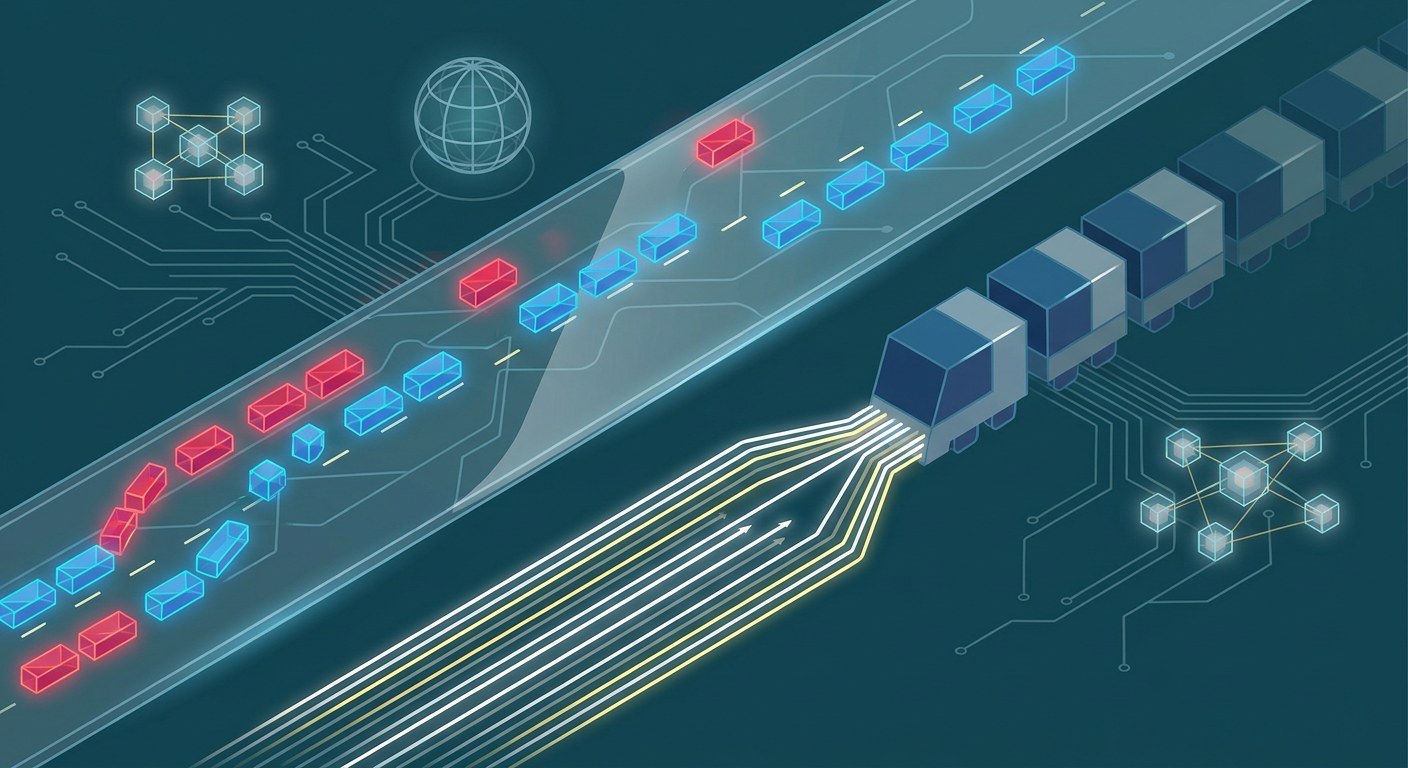
Worse is head-of-line blocking: if a page loads many resources at once and one packet is lost, TCP halts the whole stream until it recovers that packet. A single delayed packet would stall the rest of the page.
QUIC: TCP rewritten over UDP
HTTP/3 solves both limitations by replacing TCP with a new protocol called QUIC, designed by Google and standardized by the IETF in 2021. The key move is that QUIC does not invent a new transport protocol inside the operating system: it runs as its own layer on top of UDP.
That gives it two immediate advantages. First, it does not depend on updating the kernel or intermediate routers: UDP already passes through every firewall and network device. Second, all of QUIC’s control lives in user space, inside the application itself, which lets it evolve far faster than TCP, which takes years to change because it lives inside the operating system.
Encryption by default and a reusable connection
QUIC integrates TLS 1.3 directly into the protocol, so encryption is not a layer added afterwards but part of the handshake itself. As a result, establishing the connection costs at most one round trip, and often zero: with session resumption (0-RTT), a previous connection lets the browser send already-encrypted data in the very first packet, without waiting for confirmation.
QUIC also includes multiplexing by default: several independent data streams travel over the same channel, each with its own loss control. If a video drops a packet, the image loading next to it does not stop. That is the practical disappearance of head-of-line blocking.
The connection identifier: surviving an IP change
TCP identifies a connection by the pair of IP addresses and ports. If you change networks — say, from Wi-Fi to mobile data — your IP changes and the connection breaks, forcing a new handshake. QUIC instead uses a Connection ID, a unique identifier that does not depend on the IP.
Thanks to that, when your phone hops from one network to another, the QUIC connection survives: servers track it with the same identifier even though the IP changed. For a video call or a page still loading, it is the difference between an annoying pause and an imperceptible transition.
Is it really faster?
On fresh connections in low-loss networks, HTTP/2 and HTTP/3 are similar in raw speed, because the bottleneck is usually the same network. QUIC’s advantage shows most when there is packet loss (wireless, mobile, congested networks) or when connections are resumed often, where the latency savings are measurable.
That is why adoption has been broad: Chrome, Firefox, Safari and Edge support it, and major platforms such as Google, Meta, Cloudflare and Netflix serve it in production. According to ecosystem telemetry, a very large share of web traffic already travels over HTTP/3, and the number keeps growing because servers and CDNs enable it by default.
The other side: UDP and middleboxes
The decision to lean on UDP is not free. Historically, UDP was used for traffic that did not require reliability, and some network devices and firewalls treated it worse, giving it lower priority than TCP or dropping its packets. Also, QUIC’s encryption is total: even the initial configuration is encrypted, which complicates the work of traffic inspection systems.
These are real challenges that the industry has been solving, and the handicap is offset by the design: by encrypting end to end and moving over UDP, QUIC has avoided many of the bottlenecks and leaks that affected TCP. Today’s web is faster in real-world conditions, more resilient to network changes and more private — and it achieved all of that with a protocol that technically “flies under the radar” over UDP.