
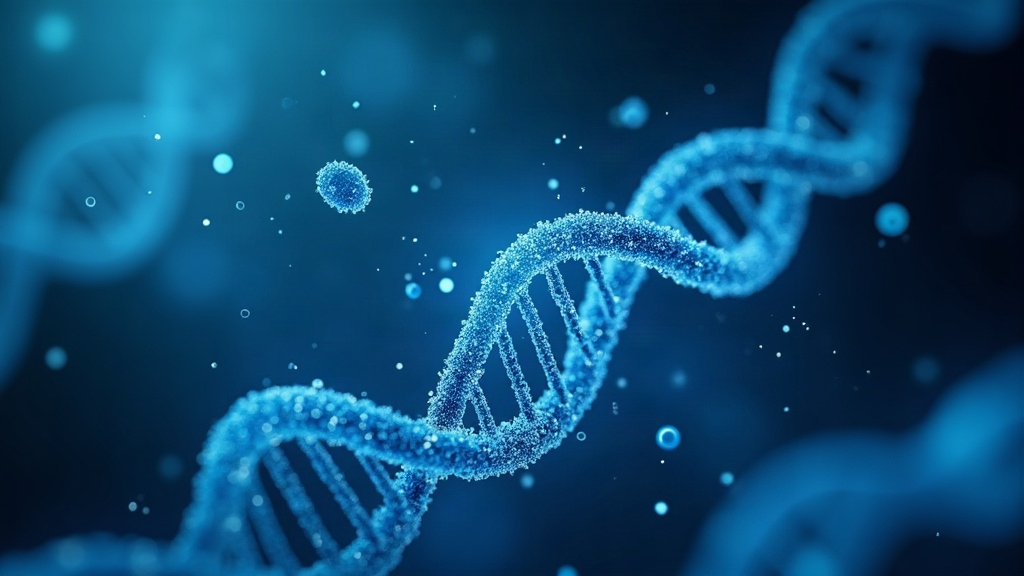
Cold archiving is the industry’s awkward problem: data that must be kept for decades —medical records, satellite imagery, backups with legal value— is not consulted daily, yet cannot be deleted. LTO magnetic tape lasts around 30 years if temperature and humidity behave; a spinning hard drive degrades much sooner, and both force you to migrate the information every few years. A single gram of synthetic DNA can theoretically hold some 215 petabytes: the same as thousands of LTO cartridges, inside a test tube that fits in the palm of your hand. The idea was demonstrated back in 2012, and in 2026 the debate is no longer whether it works, but who pays the bill for writing it.
Two bits per letter
DNA is a polymer made of four units, the nucleotides adenine (A), cytosine (C), guanine (G) and thymine (T), chained together by phosphodiester bonds. Four symbols mean exactly two bits per position, so any binary file can be translated with a simple lookup table: A=00, C=01, G=10, T=11. On paper it is trivial; in practice you have to negotiate with chemistry. Synthesis and sequencing fail on monotonous stretches, so the encoder forbids long homopolymers (more than three identical letters in a row) and keeps the G and C content between 40% and 60% so the double helix does not destabilise. Each oligo —a short fragment of 200 to 300 nucleotides— also carries an index with its position and the file it belongs to.
Because no copy comes out perfect, the same tricks used on a disk or a radio link apply: redundancy. Goldman’s rotating code (2013) and, above all, DNA Fountain (Erlich and Zieliński, 2017) package the data with fountain codes plus a Reed-Solomon correction layer, so losing a third of the oligos still leaves the original recoverable. The useful image is a storm of fragments: the more you collect, the more likely you hold the whole message.
Writing: chemistry at laboratory prices
Writing DNA is chemical synthesis: the chain is built nucleotide by nucleotide using phosphoramidite chemistry, on wafers where millions of oligos are produced in parallel (array synthesis, the same technique behind sequencing chips). That is the bottleneck. An 18-terabyte LTO cartridge costs around USD 0.005 per gigabyte amortised; storing in DNA today runs between USD 1 and USD 1,000 per gigabyte, depending on vendor and volume. Add the typical error rate —roughly one deletion every 300 to 500 bases— which forces extra redundancy and makes every useful byte even more expensive. Milestones help calibrate: in 2019 Microsoft and the University of Washington demonstrated a fully automated system that wrote the word “hello” and read it back with no human intervention; in 2021 the same team stored 200 megabytes in DNA. The alliance between Twist Bioscience, Illumina, Western Digital and Microsoft points the same way: cheaper synthesis and a standardised writing pipeline.
Reading and random access
Reading requires sequencing: the material is amplified with PCR (polymerase chain reaction) and fed to a sequencer. Short-read platforms (Illumina) produce millions of 150- to 300-base reads with very high accuracy; long-read platforms (Oxford Nanopore) read thousands of bases in one go and suit long oligos better, at the cost of more noise per base. Since every file is stored in millions of copies, it is enough to rebuild a majority-consensus sequence and decode it using the indices and the redundancy codes.
The advantage over tape is addressing. Each file is flanked by two unique primer sequences; to recover just that document you run a PCR with those primers and the polymerase amplifies only the oligos that start and end that way. That is random access without reading the whole tube: the equivalent of opening a file by name instead of rewinding the entire tape.
What it endures, what it costs
At room temperature and kept dry, DNA encapsulated in silica or precipitated with salts can last centuries, perhaps millennia. It needs no electricity, no heads, no migrations every few years, which is why some propose it as a time capsule for archives that must outlive the very infrastructure that wrote them. The price of that permanence is latency: writing and reading are laboratory processes measured in hours or days today, not milliseconds. Nobody is going to run a query against a test tube.
So the sensible niche in 2026 is genuine cold storage: data written once and read a handful of times, with tape still winning on cost per gigabyte and DNA reserved for what must last far longer or fit in far less space. The theoretical 215 petabytes per gram is the headline; the interesting figure is another one: DNA is the only storage technology we already know can work for millennia, because it has been doing so since before we existed. What is missing is not physics, it is cheap chemistry.